--

| Index |
BENJ. F. TAYLOR,
AUTHOR OF "SONGS OF YESTERDAY," "OLD-TIME PICTURES," "WORLD ON
WHEELS," "CAMP AND FIELD" ETC.
WITH ILLUSTRATIONS.
CHICAGO:
S. C. G-RIGGS AND COMPANY.
1878.
MRS. MARY SCRANTON BRADFORD,
OF CLEVELAND, OHIO,
WHOSE DAILY DEEDS OF NOBLE KINDNESS HAVE
BRIGHTENED MANY A LIFE AND BEAUTIFIED
HER OWN, THIS BOOK OF DAYS OF
SUNSHINE IS AFFECTIONATELY
INSCRIBED BY HER
RELATIVE AND FRIEND.




CONFIDENTIAL.
THE only care-free, cloudless summer of my life, since childhood, was spent in California. The going there was a delight, and the leaving there a regret.
This gypsy of a book has few facts and not a word of fiction; not so much as a dry fagot of statistics or a wing-feather of a fancy.
" How do you like California?" was the daily question, and to the uniform reply came the quick rejoinder: "Ah, but you should see it in the winter, for the summer is in the winter."
The writer sympathizes with any reader who misses what he seeks in this small volume, and can only soften " the winter of our discontent" by saying: Ah, but you should know "what pain it was to drown" what had to be omitted!
Perhaps we two may meet again in the groves of Los Angeles, when the oranges are in the gold and the almond blossoms shine.
CONTENTS.
OVERLAND TRAIN
" SET SAIL"
PREFACE. CHAPTER I. CHAPTER II.
FROM VALLEY TO MOUNTAIN -
CHAPTER III.
WONDERLAND TO BUGLE CANON -
CHAPTER IV.
THE DESERT, THE DEVIL AND CAPE HORN
CHAPTER V.
FROM WINTER TO SUMMER
CHAPTER VI.
SAN FRANCISCO STREET SCENES
CHAPTER VII.
THE ANIMAL, MAN - -
"John," the Heathen
" Hoodlum," the Christian Picnics - -























|
6 CONTENTS. |
|
|
CHAPTER VIII. |
|
|
COAST, FORTY-NINERS AND CLIMATE - - |
- 94 |
|
The Pacific Breezes - |
- 101 |
|
Weather on Man - - |
- 103 |
|
_ CHAPTER 1X. |
|
|
GOING TO CHINA - - •• - |
- 106 |
|
A Chinese Restaurant - - |
108 |
|
" We'll All Take Tea" |
- 109 |
|
The Joss-House and the Gods |
110 |
|
"Twelve Packs in his Sleeve" |
114 |
|
An Opium Den - |
115 |
|
The Opium-Smoker's Dream - |
- 116 |
|
"The Royal China Theatre" - |
- 118 |
|
"The Play's the Thing" - - |
- 119 |
|
The Orchestra - - |
- 121 |
|
CHAPTER X. |
|
|
MISSION DOLORES AND THE SAINTS - - |
- 124 |
|
The Old Graveyard |
126 |
|
The Saints - |
- 128 |
|
CHAPTER XI. |
|
|
VALLEY RAMBLES AND A CLIMB - - |
- 131 |
|
A Dead Lift at a Live Weight |
133 |
|
On the High Seas |
140 |
|
The Hog's Back - - - |
143 |
|
CHAPTER XII. |
|
|
THE GEYSERS |
- 146 |
|
CHAPTER XIII. |
|
|
THE PETRIFIED FOREST - - - - |
156 |
CONTENTS. 7
CHAPTER XIV.
HIGHER AND FIRE
CHAPTER XV.
A MINT OF MONEY
Aladdin's Cave
Is it Worth it - Washing-Day
Midas's Kitchen - Bricks and Hoop-Poles Weighing Live Stock "The Golden Dustman"
CHAPTER XVI.
BOUND FOR THE YO SEMITE -
Taking a Mountain A Mountain Choir
"The Ayes Have It" Down the Mountains The Big Trees -
A Forest Ride -
First Glimpse of the Yo Semite Through the Valley - The Grand Register -
El Capitan - The Bridal Veil
Mirror Lake
Up a Trail
Yo Semite Fall and Sun Time Breaking up Camp -
166
174 177 180 182 183 184 189 190
192 200 201 ' 202 203 205 209 210 214 217 221 222 224 227 232 236
CONTENTS.
CHAPTER XVII. WHALES, LIONS AND WAR DOGS
Seals - - The Golden Gate
CHAPTER XVIII. A TRIP TO THE TROPIC
A Difficult Sunrise
The Tehachapi Love-Knot
The Mojave Desert A Vegetable Acrobat
The Mirage - -
The City of the Angels The Orange Groves The Vineyards
"A Bee Ranch" -
The Mission of San Gabriel
The Garden -
CHAPTER XIX. KINGS OF SOCIETY
Latitudes -
The Spirit of California The Men and Women Home Again -
BETWEEN THE GATES.
OVERLAND TRAIN.
1.
FROM Hell Gate to Gold Gate FROM
the Sabbath unbroken, A sweep continental
And the Saxon yet spoken!
By seas with no tears in them,
Fresh and sweet as Spring rains,
By seas with no fears in them,
God's garmented plains,
Where deserts lie down in the prairies' broad calms, Where lake links to lake like the music of psalms.
II.
Meeting rivers bound East
Like the shadows at night,
Chasing rivers bound West
Like the break-of-day light,
Crossing rivers bound South
From dead winter to June,
From the marble-old snows
To perennial noon — Cosmopolitan rivers, Mississippi, Missouri,
That travel the planet like Jordan through Jewry.
9
OVERLAND TRAIN. 11
And this world glancing back with a colorless face. Who marvels Mount Sinai was the State House of God? Who wonders the Sermon down old Galilee flowed? That the Father and Son each hallowed a height Where the lightnings were red and the roses were white! Oh, Mountains that lift us to the realm of the Throne, A Sabbath-day's journey without leaving our own, All day ye have cumbered and beclouded the West, Low glooming, high looming, like a storm at its best, By distance struck speechless and the thunder at rest.
v.
All day and all night
It is rattle and clank, All night and all day
Smiting space in the flank,
And no token those clouds Will ever break rank. Still the engines' bright arms
Are bared to the shoulder
In the long level pull
Till the mountains grow bolder.
Ah! we strike the up grade!
We are climbing the world!
And it rallies the soul
Like volcanoes unfurled,
Where it looks like the cloud that led Moses of old, And the pillar of fire born and wove in one fold From the womb and the loom of abysses untold.
12 BETWEEN THE GATES.
VI.
We strike the Great Desert
With its wilderness howl, With its cactus and sage,
With its serpent and owl, And its pools of dead water,
Its torpid old streams, The corpse of an earth
And the nightmare of dreams;
And the dim rusty trail
Of the old Forty-nine,
That they wore as they went
To the mountain and mine,
With graves for their milestones;
How slowly they crept,
Like the shade on a dial
Where the sun never slept,
But unwinking, unblinking, from his quiver of ire Like a desolate besom the wilderness swept
With his arrows of fire.
VII.
Now we pull up the globe! It is grander than flying, 'Mid glimpses of wonder that are grander than dying, Through the gloomy arcades shedding winter and drift, By the bastions and towers of omnipotent lift, Through tunnels of thunder with a long sullen roar, Night ever at home and grim Death at the door.
We swing round a headland,
Ah! the track is not there!
OVERLAND TRAIN. 13
It has melted away
Like a rainbow in air!
Man the brakes! Hold her hard! We are leaving the world!
Red flag and red lantern unlighted and furled.
Lo, the earth has gone down like the set of the sun—Broad rivers unraveled turn to rills as they run—Great monarchs of forest dwindle feeble and old — Wide fields flock together like the lambs in a fold — Yon head-stone a snow-flake lost out of the sky That lingered behind when some winter went by!
Ah, we creep round a ledge
On the world's very edge,
On a shelf of the rock
Where an eagle might nest,
And the heart's double knock
Dies away in the breast
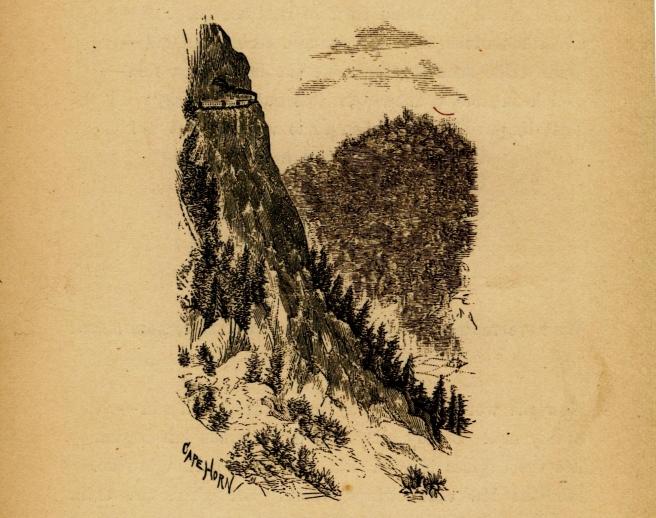
We have rounded Cape Horn! Grand Pacific, good morn!
VIII.
Now the world slopes away to the afternoon sun — Steady one! Steady all! The down grade has begun. Let the engines take breath, they have nothing to do, For the law that swings worlds will whirl the train
through.
Streams of fire from the wheels,
Like flashes from fountains;
And the dizzy train reels
As it swoops down the mountains : And fiercer and faster
14 BETWEEN THE GATES.
As if demons drove tandem
Engines "Death" and "Disaster!"
From dumb Winter to Spring in one wonderful hour; From. Nevada's white wing to Creation in flower! December at morning tossing wild in its might—A June without warning and blown roses at night!
DOUBLING CAPE HOBN.
Above us are snow-drifts a hundred years old, Behind us are placers with their pockets of gold, And mountains of bullion that would whiten a noon, That would silver the face of the Harvesters' moon. Around us are vineyards with their jewels and gems,





OVERLAND TRAIN. 15
Living trinkets of wine blushing warm on the stems, And the leaves all afire
With the purple of Tyre.
Beyond us are oceans of ripple and gold,
Where the bread cast abroad rolls a myriad fold—Seas of grain and of answer to the prayer of mankind, And the orange in blossom makes a bride of the wind, And the almond tree shines like a Scripture in bloom, And the bees are abroad with their blunder and boom — Never blunder amiss, for there's something to kiss Where the flowers out-of-doors can smile in all weather, And bud, blossom and fruit grace the gardens together. Thereaway to the South, without fences and bars, Flocks freckle the plains like the thick of the stars; Hereaway to the North, a magnificent wild,
With dimples of canons, as if Universe smiled. Ah! valleys of Vision,
Delectable Mountains
As grand as old Bunyan's,
And opals of fountains,
And garnets of landscapes,
And sapphires of skies,
Where through agates of clouds
Shine the diamond eyes.
Ix.
We die out of Winter in the flash of an eye,
Into Eden of earth, into Heaven of sky;
Sacramento's fair vale with its parlors of God,
Where the souls of the flowers rise and drift all abroad,
16 BETWEEN THE GATES.
As if resurrection were all the year round
And the writing of Christ sprang alive from the ground, When He said to the woman those words that will last When the globe shall grow human with the dead it has
clasped.
Live-oaks in their orchards, rare exotics run wild, No orphan among them, each Nature's own child. Oh, wonderful land where the turbulent sand
Will burst into bloom at the touch of a hand,
And a destrt baptized
Prove an Eden disguised.
x.
There's a breath from Japan
Of an ocean-born air, Like the blue-water smell
In an Argonaut's hair! 'Tis a carol of joy
With a sweep wild and free;
And the mountains deploy
Round the Queen of the West,
Where she sits by the sea—By the Occident sea
In her Orient vest, Babel Earth at her knee, And the heart of all nations
Alive in her breast—Where she sits by the Gate
With its lintels of rock,
And the key in the lock—
17
OVERLAND TRAIN.
By the Lord's Golden Gate,
With its crystal-floored chamber,
And its threshold of amber,
Where encamped like a king,
The broad world on the wing, Her grand will can await. Where now are the dunes, The tawny half-moons
Of the sands ever drifting, Of the sands ever sifting, By the shore and the sweep Of the sea in its sleep? Where now are the tents,
With their stains and their rents. All landward and seaward
Like white butterflies blown? All drifted to leeward,
All scattered and gone. And this uttermost post
Of earth's end is the throne Of the Queen- of the Coast, Who has loosened her robe And girdled the globe
With her radiant zone—The throb of her pulses
Has fevered the Age—She has silvered and gilded
All history's page!
She has spoken mankind, 1*
18 BETWEEN THE GATES.
And has uttered her ships Like the eloquent words
From most eloquent lips — They have flown all abroad Like the angels of God! Sails fleck the world's waters
All bound for the Gate, All their bows to the Bay,
Like the finger of Fate. Child of the wilderness
By deserts confined,
Wide waters before her,
Wild mountains behind, She unlocks her treasures
To the gaze of mankind.
Her name is translated into each human tongue,
Her fame round the curve of the planet is sung,
And she thinks through its swerve By the telegraph nerve.
%I.
When the leaf of the mulberry is spun into thread, Then the spinner is shrouded and the weaver is dead; And that shroud is unwound by the fingers of girls, And the films of pale gold clasp the spool as it whirls,
As it ripens and rounds
Like some exquisite fruit
In the tropical bounds,
In air sweet as a lute,
Till the shroud and the tomb,
OVERLAND TRAIN. 19
Dyed in rainbow and bloom, Glisten forth from the loom Into garments of pride, Into robes for a bride,
Into lace-woven air
That an angel might wear. Ah! marvelous space
'Twixt the leaf and the lace, From the mulberry worm To the magical grace
Of the fabric and form! Oh, Imperial State,
Splendid empire in leaf,
That grows grand on the way
To the sky and the day, Like the coralline reef
To be royally great.
Dead gold is barbaric, but its threads can be woven
Into harmonies fine, like the tones of Beethoven, Can be raveled and wrought
Into love-knots of faith
For the daughters of Ruth—Into garments of thought,
Into pinions for truth —
And be turned from the wraith
Of a misty ideal
That may vanish in night, To things royal and real That shall live out the light.
20 BETWEEN THE GATES.
So the true golden days
Shall be kindled at last, And this realm shall rule on When the twilights are gone, In the grandeur of truth And the beauty of youth's
Till long ages have passed!
ON a bright Spring morning we set sail from Chicago for the Golden Gate. Nothing on solid land is the twin of an ocean voyage but a trans-continental trip by rail. There is a sort of through" look about Pacific-bound passengers. The shaggy blanket; the bruin of an overcoat; the valise not black and glossy, but the color of a sea-lion; the William Penn of a hat, broad as to its brim as the phylacteries of the Pharisees; the ticket that shuts over and over like a Chinese book; the capacious lunch basket where, amid sardines, cheese; dried beef, bread, pickles and pots of butter, protrude bottles with slender necks like Mary's, Queen of Scots, and young teapots with impudent noses; the settling into place like geese for a three-weeks' anchorage—all these betoken, not a flitting, but a flight.
The splendid train of the Chicago and Northwestern road, that controls a line of more than three thousand miles, and traverses six states and territories, steams out of the "Garden City's" ragged edges that refine and soften away into rural scenes, and meets many a lovely village hurrying toward the town. It rings its brazen clangor of salute. Shrubbery and stations clear the way. The horizons curve broadly out. We are fairly at sea amid the rolling glory of Illinois. The eastward world
21
22 BETWEEN THE GATES.
slips away beneath the wheels, like the white wake at a schooner's heels.
And then I think of another day in the year '49, and the stormy month of' March, when the tatters of white winter half-hid earth's chilly nakedness, and Euroclydon blew out of the keen East like the King's trumpeter, and a little procession of wagons was drawn up facing West on Lake street, Chicago, and daring fellows were snapping revolvers and casing rifles, and making ready for the long, dim trail through wilderness, desert and canon, through delay, danger and darkness—a trail drawn across the continent like the tremulous writing of a death-warrant when Mercy holds the pen. The horses' heads were toward the sunset, and the stalwart boys were ready, the gold-seekers of the early day. There were women on the sidewalks, there were children lifted in men's stout arms that might never clasp them more.
The captain gave the word, and the cavalcade drew slowly out, the last canvas-covered wain dwindled to an ant's white egg, and the pioneers were gone; gone into a silence as profound as the grave's. Spring should come and go, June should shed its roses, autumn roll its golden sea and break into the barn's broad bays in the high-tides of abundance; the winter fires should glow again, and yet no word from the Argonauts, no lock from the Golden Fleece of the new-found El Dorado of the farthest West. Ah, the weary waitings, the hopes deferred, the letters soiled and wrinkled and old, that crept by returning trains, or doubled the Cape or crossed the Isthmus, that the readers thanked God for and took courage, be-cause the writers were not dead last year.
And now it is a six days' sweep as on wings of eagles
"SET SAIL." 23
from the Prairies of Garden Gate to Pacific's Golden Gate! Verily Galileo's whisper has swelled to a joyful shout: "THE WORLD MOVES!" Fox river, Rock river, Mississippi, the old Father of them all, are crossed in one sunshine. The Cedar is reached by tea-time ; we are riding the breezy swells of Iowa; the second morning finds us giving Council Bluffs a cold shoulder, and making for " The Big Muddy," which is the prose for that ancient maiden, Missouri. Council Bluffs is the old Ranesville, where the Mormons advanced the first parallel in their long siege to take the parched desert of Utah, with its strange mimicry of the salted ocean that slakes no thirst, and to make a blooming garden with streams of living water.
Omaha goes between wind and water, a bad region for a solid shot to strike a ship, but a good thing for a town. It was the base of supplies for the bearded mountain-men who bundled their furs down to the river. It was the point of departure for the Pike's Peakers and the caravans " Frisco "-bound. It has hot water on both sides of it, from ocean to ocean. It has cold water, such as it is, "slab and good," like witches' broth, in the Missouri that, allied with the Mississippi, flows from the regions of the rude North, up the round world to the Gulf of Mexico and the sea. And it has wind. Caves (f 1Eolus! How it blows! If the wild asses of Scripture times could live on the East wind, they would fairly fat-ten on the Zephyrs of Omaha.
The bridge over the Missouri, swung in the air like a rainbow with no colors in it, and almost three thousand feet long, is a great gateway to the West. It has triumphed over the uneasiest sands that ever slipped 'out from under a foundation, and the worst river to drown
24 BETWEEN THE GATES.
geographies that ever went anywhere. I have crossed that river in _a stage-coach, in a boat, and on foot. It gets up and lies down in a new place oftener than any other running water in America. It changes beds like a fidgety man in a sultry night. It is as worthless for a boundary-line as a clothes-line. It has been known to slice out an Iowa county-seat, and leave it within the limits of Nebraska, as a sort of lawyer's lunch, to be wrangled over.
Fort Calhoun, some two hours' drive up the river from Omaha, is the point whence Lewis and Clark set forth, seventy-three years ago, into a wilderness that howled, and discovered that great watery trident of the Columbia, and named it Lewis, Clark and Multnomah. A while ago I visited the Fort, and the stump of the flag-staff yet remained whence the old colors drifted out in the morning light, when the Discoverers set forth. In their day the Fort stood on the river's bank, and in case of in-vestment from the landward side, water could be drawn up in buckets from the Missouri, and so they wet their throats and kept their powder dry. In my day, I looked from the old site upon a forest of cottonwoods about a Sabbath-day's journey in breadth! That river had gotten up and lain down again at a quiet and comfortable distance from the click of locks and clank of scabbards. What it will do next nobody can tell.
The Union Pacific train is just ready to move out. The bright-hued cars of the Northwestern are succeeded by the soberly-painted coaches of the Union Pacific. They have taken the tint of ocean-going steamers. Men and women are bundling aboard with bags and baskets. The spacious Depot is thronged with crowds in motley wear.
"SET SAIL." 25
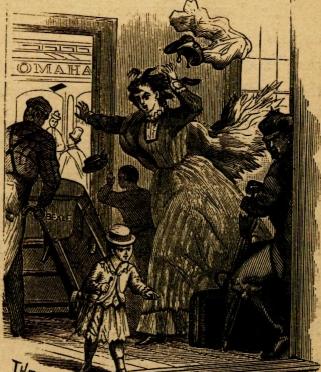
A breeze draws through the great building like the blast of a furnace. .At one hawk-like swoop it catches up a woman's bonnet and dishevels her head, and blows her
ticket out at one door
while her urchin of a boy trundles out at another. Her desperation is logical. She grasps for the hat, plunges for the ticket, and proceeds to look up the baby. Let no indignant matron deny the soft impeachment. The fact remains: bon-net, ticket, baby.
Here, a Norwe-
gian sits upon a I °4Poq,c
knapsack colored like rr
an alligator, his leather breeches polished as a razor-strap, and his hair gone to seed. There, an Indian with his capillary midnight flowing down each side of his oleaginous face, as if he had ambushed in a horse's tail and forgot his body was in sight.
Yonder, a pair of Saxons just escaped from a band-box, fit for the shady side of Broadway, but not for the long trail.
Now, an Englishman in tweed, and sensible shoes with soles as thick as a shortcake, an inevitable white bat, and a vest that nobody would think of asking him to " pull 'down," for a little more waistcoat, and pantaloons could
2


26 BETWEEN THE GATES.
go out of fashion. Then, a girl with .a portfolio in a strap, who means to be " a chiel amang us takin' notes," when she ought to be using her bright eyes and giving " Faber No. 2 " a blessed rest.
The Depot bubbles and boils like a caldron. The engine backs, clanging down with a cloud and a rush. People climb on and climb off the laden cars crazier than ever. They are giving old ladies a lift from behind. They are tugging up carpet-bags like cats with their last kittens. They are all colors with excitement and hurry. It strikes you queerly that everybody is going, and no-body is staying. The demon of unrest is the reigning king. "Long live the king!" for life is motion. Still life is death's first cousin. A Babel of trunks is surging toward the baggage-cars. Trucks are piled like dromedaries. There's the Saratoga that might be lived in if it only had a chimney, and the iron-bound chest of the mistletoe-bough tragedy, and the dapper satchel as sleek and black as a wet mink, and the little brindled hair-trunk with its brazen lettering of nail-heads, and the canvas sack as rusty as an elephant. And so they tumble aboard with an infinite jingle of checks; an acrobatic, jolly troop, the heart's delight of the trunk-makers. You see your own property, bought new for the occasion, rolling over and over corner-wise like a possessed porpoise. Alas, for any pigments or unguents or dilutions or perfumes that may break loose in that somerset, and make colored maps of the five continents upon your wedding vest or your snowy wrapper. Last, the leathern purses of the United States Mail fly from the red wagons like chaff from a fanning-mill. The engine's steam and impatience are blown off in a whistle together. It spits
"SET SAIL." 27
spitefully on one side and the other, like a schoolboy out of the corners of his mouth.
And amid the whirl of the Maelstrom—for if Nor-way has none, at least Omaha has one—there are only two living things that are quiet and serene. The one is a youthful descendant of Ham, with a heel like the head of a clawhammer—five claws instead of a pair—lying on a truck upon a stomach that, like an angleworm's, pervades the whole physical man, and the descendant turned up at both ends, like a rampant mud-turtle, his mouth full of ivory and his eyes round with content.
The other is the " last man "—not Montgomery's, but an earlier product — that man in gray, in a silk cap, and taking lazy whiffs at a cigar that has about crumbled to ashes. He is as calm as the Sphinx, but neither so grand nor so grim. He is going to San Francisco when—the train goes, and he patiently bides his time. He is an old traveler, and watches with an amused eye the human vortex. He has seen it before at Gibraltar, at Canton, and now at Omaha.
At last the conductor gives the word "All aboard!" signals the engineer who has been leaning with his head over his shoulder, the bell lurches from side to side with a clang, your last man gives his cigar a careless toss and swings himself upon the rear platform, and the train with its black banners and white flung aloft pulls out, and we are off for the plains and the deserts, and the gorges and the mountains, and the Western sea.
CHAPTER H. FROM VALLEY TO MOUNTAIN.
IF a man cannot stay at home, traveling in a Pullman palace car is the most like staying there of any-thing in the world. It takes about an hour to get settled in a train bound for a five days' voyage, and some people never do. See the man across the way. He has turned that carpet-bag over and over like a flapjack, and set it before him as a Christian does the law of the Lord, and had it under his feet, and tried to hang it up somewhere. It is as restless as a San Francisco flea. And then his overcoat has been folded with each side out, and his blanket vexes him, and his hat is an affliction, and he is a nephew-in-law of Martha, who was " troubled about many things." There is a sort of solar-system genius about some men in the adjustment of their rail-way belongings that is pleasant to see: everything with a sort of gravitation to it; all at hand and nothing in the way.
When people leave Omaha for the West they usually have eyes for nothing but the scenery. There was one man in our car who kept his nose in a book, like a pig's in a trough, and he had never traveled the route, and he was a tourist! An asylum for idiots ought to seem like home to him!
The sun was borrowed from an Easter-day. The air
is transparent. The willows show the green. The mean-der of emerald on the hillsides paints the route of the water-courses. We are overtaking the Spring. Behind us, Winter was begging at the door. The trees were as dumb as an obelisk. Around us are tokens of May and whispers of June. You are turning into a cuckoo —Logan's cuckoo; not General Logan, of the Boys in Blue, nor Logan, the last of his race, who used dolefully to say in the declamation of our boyhood, " not a drop of my blood flows in the veins of any living creature," but Logan the poet, who apostrophized the bird, " Companion of the Spring," and said:
"Sweet bird, thy bower is ever green, Thy sky is ever clear.
There is no sadness in thy song, No winter in thy year!"
We strike the bottom lands of Nebraska, as rich as Egypt. We are following the trail of Lewis and Clark, for here is a stream they christened Papilion, from the clouds of butterflies, those " winged flowers" that blossomed in the air as they went. The men are gone, but the breath of a name remains. Sixty miles from Omaha,
and no sign of wilderness. Towns, farms, rural honas
I confess to a covert feeling of disappointment. I expected to be knocked in the head with the hammer of admiration upon the anvil of sublimity right away. We have entered the great Valley of the Platte, the old highway of the emigrants, who paid fearful toll as they went. The world widens out into one of the grandest plains you ever be-held, and in the midst of it, lying flat as a whipped spaniel, is the Platte, a river that burrows sometimes like a prairie dog, and runs under ground like a mole,




30 BETWEEN THE GATES.
and sometimes broadens into a sea that can neither be forded or navigated — a river as lawless as the Bedouins. It would not be so much of a misnomer to rechristen it the Flat. And the thread of a train moves through this magnificent hall for hundreds of miles, with its sweeps of green and its touches of russet grass here and there, as if flashes of sunshine had rusted thereon in wet weather. Herds of cattle freckle the distance. An Indian village of smoky tents is pitched beside the track, and the occupants are all out, from the caliper-legged old grizzly to the bead-eyed papoose sprouting behind a squaw from " the fearful hollow " of his mother's dingy blanket. They are here to get the wreck of the lunch-baskets flung from the windows of the eastward trains. The chemistry of civilization has bleached some of them. It is a village of beggars.
Clouds fly low in the Valley of the Platte, and thunder-storms have the right of way. It was wearing toward sundown when great leaden clouds with white edges showed in the route of the train. They looked like -a solid wall with irregular seams of mortar, built up from earth to heaven. Then the wind came out of the wall, and the careening cars hugged the left-hand rail, and the hail played tattoo upon the dim windows, and the engine " slowed," for we were running in the teeth of the storm, and darkness fell down on the Valley like a mantle. The lightning hung all about in tangled skeins, like Spanish moss from the live-oaks, and played like shuttles of fire between heaven and earth, carrying threads of white and red, as if it were weaving a garment of destruction There were evidently but two travelers in the Valley, the storm and the train. And the thunder did not go
FROM VALLEY TO MOUNTAIN. 31
lowing and bellowing about like the bulls of Bashan, as it does among the Catskills and the Cumberlands, but it crashed short and sharp, like shotted guns, that have a meaning to them, and not like blank cartridges, " full of sound and fury, signifying nothing." The scene was sub-lime. The pant of the engine and the grind of the car-wheels were inaudible. We were traversing a battle-field. It was crash, rattle and flash. The " thunder-drum of heaven" must have had a drum-major to beat the long-roll that day.
There was a young lady in our car, California-born, who was returning home from an Eastern visit. She had never heard the thunder nor seen the lightning in all her life. She had lived in a cloudless land of everlasting serenity. The pedal-bass of the skies and the opening and shutting of the doors up aloft filled her with alarm, and when the storm died down to great fitful sighs, the lightest heart in all the train was her own.
We had hoped to see a prairie-fire somewhere on the way, if only it would not harm any body or thing—one of those flying artilleries of flame that sweep the plains in close order from rim to rim of the round world, but we were only indulged with a rehearsal. Just before the storm a fringe of fire showed in the Northwest, like an arc of the horizon in flames. It was as if Day, getting ready for bed, had trimmed it with a valance of fire; but it was "out," like Shakspeare's "brief candle," under the weight of the tempest.
We go to supper at Grand Island in sheets, like so many unbound books, albeit they were sheets of rain, and it was pleasant to get back to the lighted car, with its homelike groups and its summer hum of talk. Prepara-
tions for going to bed are in order. Sofas turn couches, and couches alcoves. The lean man shelves himself as •a saber is slipped into its scabbard. The fat man, condemned to the upper berth, is pulling himself up the side as an awkward bear boards a boat. There is a flitting of female shapes behind the restless curtains; one bulge in the crimson and the woman is unbuttoning her shoes; another bulge and she says, " Good-by, proud world, I'm going home," and she turns her back upon us and bounces into bed —"to sleep, perchance to dream."
The steady clank-it-e-clank of the wheels grows plain in the silence, like the roar below the dam of a village mill at night. There is something wonderfully sedative about the regular motion of the Overland Train. Its regular twenty and twenty-two miles an hour are as restful as a lullaby. There is no fatigue about it. The nervous dashes of a devil's-darning-needle of a train are as catching as the whooping-cough. They make you nervous also. As twenty-two miles is to forty-five miles, so is one worry to the other, is the Rule-of-Three of the road.
It is not usual for anybody to get up in the morning higher than he went to bed at night, but if you sleep from Grand Island and supper to Sidney and breakfast, you will have slept yourself more than two thousand feet higher than the sea level when you gave that pillow its last double and fell asleep.
The morning is splendid, and everybody is on the alert. "Prairie dogs!" cries some watchful lookout, and every window frames as many eager faces as it will hold. And there, to be sure, they are; the fat, rollicking, sandy dogs, as big as exaggerated. rats, but with tails of their own. They sit up straight as tenpins and watch the
FROM VALLEY TO MOUNTAIN. 33'
train. Their fore paws hang down from the wrists in a deprecating, mock-solemn way, as if they had just washed their hands of you, and said, " There they are; more of them; jogging along to California." They fling up a pair of heels and dive into their holes. They appear as much at home on one end as the other. Travelers say they bark at the. trains, but they didn't bark at ours, unless they "roared us gently." Soon there is another cry of "Antelope!" and again the car is in commotion. There the graceful fellows are, showing the white feather behind, as they dash off a little way, then turn and look at us with lifted head, then bound down the little hollows and out of sight. Prairie dogs and antelopes, in their native land, were better than two consolidated menageries at the East. To the tame passengers of the party, whereof this writer was one, there was a wilderness flavor about it quite strange and delightful. But there was a couple on board, a British lion and his mate, that never ventured an eye on
the picture. They were
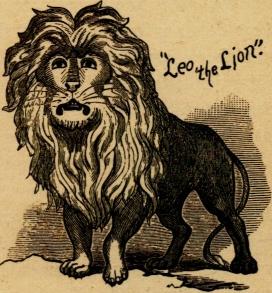
Bible people, for " their strength was in sitting still," and in keeping still withal. The lion parted his hair in the middle, and his eyebrows were arched into the very Gothic of superciliousness. Escaped from the sound of Bow Bells, he was a cockney at large, and of all poultry
an exclusive cockney is the cheapest. The figure is a little mixed, but then there was a gallinaceous strain in
34 BETWEEN THE GATES.
his leonine veins. Together they made about as lively a brace of beings for the general company as a couple of mummies direct from the pyramid of Cephren would have been I respect the noble, hearty Briton of Motherland; I pray always that peace may dwell in her palaces—but the lion, in his best estate, is apt -to fall off a little in the hinder quarters. His front view is the grander view, but when those quarters are finished out before with the brow and bearing of a snob, it becomes an unendurable animal whose ancestors never would have been admitted into the Ark.
There is a mightier lift to the land. The bluffs and peaks begin to rise in the distance. The horizon is scolloped around as if some cabinet-maker had tried to dove-tail earth and sky together. To eyes that have looked restfully upon the rank green pastures of the East, these billowy sweeps of tawny landscape seem just the grazing that Pharaoh's lean kine starved upon, but they are really in about the finest grass country in America. Watch those dots on the hillsides at the right. They are sheep, and there are thousands if there is so much as one "Mary's little lamb." Those spots on the distant left, like swarms of bees, will develop, under the field-glass, into herds of "the cattle upon a thousand hills."
We are pulling up the world, and away to the North, like thunder-heads at anchor, rise the sullen ranges of the Black Hills, a glimpse or two of surly Alps. The first snow-shed is in sight. It looks like an old rope-walk slipped down the mountain on a land-slide, and we rumble through it while the unglazed windows wink day-light at us in a sinister way that is new, but not nice.
The first glimpse of Winter watching the world from
FROM VALLEY TO MOUNTAIN. 35
the crest of Colorado is a poem. There he stands in the clear Southwest, calm and motionless as Orion. Long's Peak is in sight! It seems near enough for a neighbor. It is eighty miles away. Its crown of snow is as serenely white in the sunshine as if there had been a coronation this very morning, and it had freshly fallen from the fingers of the Lord, and the height made King of the Silver State, the Centennial child of the Republic.
They say I shall see grander mountains, but that day and that scene will be bright in.my memory as the hour and the picture of perfect purity and peace.
I think of other eyes than mine—weary eyes—that brightened as they caught sight of that December in the sky. I think of the caravans of the long ago; of the heroes of the trail; of the oxen that swung slowly from side to side in their yokes, as if, like pendulums, they would never advance; of the days they traveled toward the Peak that never seemed to grow nearer, like a star in far heaven. And I see at the right of the train the old trail they wore, and the years vanish away, and the camp-fires of the cactus and grass are twinkling again, and I lie down beside them under the sky that is naked and strange, and I hear the cayote's wild cry and the alarms of the night.
An untraveled man's idea of a mountain is of a tremendous, heaven-kissing surge of rock, earth and snow, rolling up at once from the dull plain like a tenth wave of a breaker, and fairly taking your breath away. But a mountain range grows upon you gradually. It some-how gets under your feet before you know it, until the tingling sweep of the light air startles you with the truth that you are above the world.
36 BETWEEN THE GATES.
Here is an apparent plain, but in twenty miles you begin to encounter the globe's rough weather again. The tandem engines, panting and pulling together like a perfect match, labor up the Black Hills. The dimples of valleys are green as emeralds. The rugged heights are tumbled thick with gray granite, and sprinkled with dwarfs of pines that stand timidly about as if at a loss what to do next. A round eight thousand feet above the sea, where water boils with slight provocation, and you begin to feel a little as if you had swallowed a balloon just as they made ready to inflate it, and the process went on, and you are at Sherman. It is the highest altitude the engine reaches between the two oceans. Strange that the skill of a civil engineer can teach a locomotive how to fly without wings; can wile it up by zigzags and spirals along the craggy heights and through the air, fairly defrauding the attraction of gravitation out of its just due.
The train halted, and everybody disembarked, much as Noah's live cargo might have done on Ararat. We wanted to set foot on the solid ground at high tide like the sea, but we all discovered that it took a great deal of air to do a little breathing with. Nothing was disdained for a souvenir. Pebbles that little David would have despised were picked up and pocketed, and one of the party, more fortunate than the rest—it was the writer's alter ego—found a dainty little horseshoe on that tip-top of railroad things in North America, and bore it cheer-fully away— for doesn't it make us witch and wizard proof ? We accepted it as a good omen, but who wore it? Perhaps the winged horse, Pegasus, made a landing there and cast a shoe—if he was ever shod. Sherman
was named after the brilliant General who marched to the Sea.
Beyond the hemlock shadows of the spruce pine and the scraggy ridges, where giants played " jack-stones " when giants were, seventy miles away to the South, glitters Pike's Peak, whose name. was inked across many a canvas-covered wain in the old time, and whose cold and deathless light has kindled ardor in many a toiler's tired heart. Long's Peak, to the west of it, and three days'
journey off as the mules go, is near us still.


CHAPTER M.
WONDERLAND TO BUGLE CANON.
TO get away from great mountains in white cloaks is about as difficult as to escape from the fixed stars. We travel all day with ridges of snow on our left, billowing away into magnificent ocean scenery, as if the Arctic had been lashed into foaming fury, and then frozen to death with all its icebergs, drifts and caflons imperishable as adamant. They were thirty miles away, yet so distinct and clear-cut against the blue, so palpably present as seen through air that might blow on the plains of Heaven unforbidden, that almost anybody on the train fancied he could walk near enough to make a snowball before breakfast! This mountain atmosphere is a perpetual illusion. Among these gorges are those graceful cats with the long stride, to whom men are mice, the mountain lions—you will see a pair of them caged at the next station—and here are those huge but rather amiable and aromatic brutes, the cinnamon bears, the blondes among the bruins.
The train works its way between the Black Hills and the Rockies, and you half fancy, as you watch the silent plunge-down of their shaggy sides, and the gloomy gorges, and the inaccessible crags, that the grizzlies must have been born of mountains, not of bears. You can hardly realize that those monstrous dromedaries of hills, those
38
WONDERLAND TO BUGLE CANON. 39
stone mastodons lying about, with streaks of Winter here and there, really belong to the backbone of the continent.
Among those sombre hills the thunders have their nests, and when the broods come off, as they do sometimes, five at once, the flapping of their wings is something to be remembered. Think of five thunder-storms let loose in the air together, all distinctly outlined like men-of-war!
Nature has its compensations, and so you are not surprised to know that rainbows are about two fingers broader here than they are in the East, and the colors deeper and brighter. There is no lack of material for making those gorgeous old seals of the covenant. But I did not see enough ribbon of a bow to make a girl's necktie, nor hear thunder enough to stock a Fourth-of-July oration.
Before setting out for the Golden Coast, I thought a young earthquake would be pleasant to write about, and there is the Bohemian instinct. I have changed my mind. People who are acquainted with them tell me that no-novice needs an introduction when he experiences one of those planetary ague-thrills. He knows it as well as if he had been rocked in the same cradle and brought up with an earthquake all his life. It jars his ideas of earthly stability all to pieces. Who is it says that the globe is swung by a golden chain out from the throne of God, and that sometimes a careless angel on some errand bound, just touches that chain with the tip of his long wings, and it vibrates through all its links, and so we have the little shiver men call earthquake? I fancy that writer regarded the phenomenon through the long-range telescope of sentimental poetry. "Let us have peace."
BETWEEN THE GATES.
The tribes and nations of bright-hued flowers every-where are wonderful to behold. No chasm so dark, no mountain so rude, that these fearless children of Eden are not there. They smile back at you with their quaint faces from rugged spots where a Canada thistle would have a tug for its life. They ring blue-bells at you. They salute you with whole belfries of pink and purple chimes. They swing in delicate necklaces from grim rocks. They flare like little flames in unexpected places. You see old favorites of the household magnified and glorified almost beyond recognition. It is as if a poor little aster should full like the moon and be a dahlia. The inmates of the Eastern conservatories are running about wild, like children freed from school. And it does not look effeminate to see a broad-breasted, wrinkled rock with a live posy in its button-hole. I think every human bosom, however rude and rough, has some sweet little flower of thought or memory or affection that it wears and cherishes, though no man knows it. Let us have charity.
Hark! There is nothing to hear! The engines run as still as your grandmother's little wheel with her foot on the treadle. The tandem team is holding its breath a little. It is not exactly facilis est deseensus Averni, but in plain talk we are going down hill. We are making for the Laramie Plains. They open out before us into four thousand square miles of wild pasture. They sweep from the Black Hills to the range of the Medicine Bow. Where are your Kohinoors, your " mountains of light," now? Yonder are the gorgeous Sultans, the Diamond Peaks cut by the great Lapidary of the Universe. And yet they may be tents, those radiant cones, pitched by





WONDERLAND TO BUGLE CARON. 41
celestial shepherds on that lofty height. Did ever earthly pastures have such regal watch and ward? See there, away beyond the jeweled encampment, where the Snowy Range lifts into the bright air, as if it were a ghostly echo of the Diamond Peaks at hand.
All the country is rich in mineral wealth as a thou-sand government mints. The Bank of England, " the Old Lady of Threadneedle street," could lay the very foundations of her building upon a specie basis should she move it hither. Those suspicious holes far up the mountain sides and away down in the valleys, with their chronic yawn of darkness, are not the burrows of bears nor the dens of beclawed and bewhiskered creatures that make night hideous with complaint. They are the entrances to mines of gold, silver, copper, lead and cinnabar. Cinnabar is the red-faced mother of white quicksilver, but she has a ruddy daughter that inherits the family complexion. You have seen her on sweeter kissing places than these rude mountain heights. She shows at times upon a woman's cheek, and her name is Vermilion.
You see all along, ruined castles, solitary towers, triumphal columns, dismantled battlements, broken arches, some red as with perpetual sunset, and some gray with the grime of uncounted years. At the mouth of that caflon, far up the crags, stands a Gibraltar of desolation, a speechless city where no smokes pillar to the skies, no wheels jar the rocky streets, no banners float from minaret or dome. It is the city of No-man's-land. Its builders are the volcanic blacksmiths. How the forges roared and glowed to make it! Its sculpture is the work of frost and rain and time. It has been founded a thou-sand years.
2*
42 BETWEEN THE GATES.
The coarse bunches of buffalo grass dot the plains here and there. A mule would carry his ears at "trail arms" if it were offered him for breakfast, but it is sweet to the raspy tongues of the beef-cattle of the wilderness. It is the buffalo's correlative: first the grass, then the beast. Where are the stately herds, fronted like the curly-headed god of wine or the Numidian lion, that in columns myriad strong trampled out ground-thunder as they marched? Gone to gratify the greed of lawless butchers who turned a ton of beef into a vulture's dinner for the sake of a dozen pounds of tongue. Cowper's man who shot the trembling hare was a prince to such fellows.
Sage-brush has the freedom of the desert, highland and lowland. You see its clumps of green everywhere. It is the rank seasoning, the summer-unsavory for the sage-hen. Though without beauty, you regard it with affection. It was the fuel of the old pioneers. It has cooked the buffalo-steak, and boiled the coffee, and baked the wheaten cake. Women with babes in their arms have gathered around the sage-brush fire in the chill nights and thanked God. Strange, indeed, that the more we receive the more ungrateful we grow! And there are the cactuses, the green pincushions of the desert, the points all ready to the heedless hand.
By Point of Rocks, where stand the columns of the American Parthenon, four hundred feet high, a thousand feet in the air, and grander than any Grecian ruin that ever crumbled; over Green river, lighted up by its fine green shale McAdam as an old pasture brightens in May; through clefts where rock and ridge run riot; sunless gorges where crags frown down upon the train from the top of the sky; swinging from cliff to cliff, as spiders float
WONDERLAND TO BUGLE CANON. 43
on their flying bridges; booming through snow-sheds, with their flitter of sunshine; on tracks looped around upon themselves like love-knots for Vulcan; railroad above you and railroad below; by giants' clubs, and bishops' mitres, and Cleopatra's Needles, and Pompey's Pillars, and monoliths of Pyramids older than Cheops, founded with a breath and builded with a touch; up on the swell and down in the trough of the boisterous old mountains, as a ship rides the sea; past the mouths of grim canons that swallow the day; through tunnels of midnight that never knew dawn; cutting flourish and capital, swings the long, supple train.
Through a gate in the Wahsatch Mountains we plunge into Echo Canon and Utah together; Utah, the tenth sovereignty on our route from New York; Utah, Turkey the second, and the land of harems—much as if you should bind up a leaf or two of the Koran with the books of Moses — a region where the Scripture is reversed, and one man lays hold of seven women. You look to see the red fez and the Turkish veil, and you do see dwellings with a row of front doors that seem to have been added, one after another, as the new brides came into the family; a door a bride, which is pretty much all the adoration any of the poor creatures get.
Yonder, in a row before a house with three doors, sit a man and three women, and around them a group of children of assorted lengths, like the strings of David's harp. Here, for the first time, I see a Mormon store with its sanctimonious sign. It almost seems to talk through_ its nose at you with the twang that often issues from an empty head and seldom from a full heart, and it whines these words: "Holiness to the Lord"—here the picture
44 BETWEEN THE GATES.
of an eye—"Zion's Co-operative Mercantile Institution," and the profits of it are the prophet's, and his name was Brigham Young.
The train is just swinging around a bold battlement of rock, beside which Sir Christopher Wren's St. Paul's would be nothing more than the sexton's cottage. You see at its base a well-worn wagon-road, that looks enough like a bit of an old New York thoroughfare to be an emigrant. It is the stage road and trail of the elder time. You catch a glimpse of irregular heaps of stone piled upon the edge of the precipice five hundred feet aloft. They are the solid shot of the Mormon artillery. Twenty years ago, when the United States troops were marching to Salt Lake, with inquisitive bayonets, curious to know whether the Federal Government included the heathendom as well as the Christendom of the United States, they must pass by that rugged throat of a road, and under the frown of the mountain, and here the Nauvoo Legion proposed to crush them with a tempest of rock, but the army halted by the way and the ammunition remains.
The train seems hopelessly bewildered. It makes for a mountain wall eight hundred feet high, just doubles it by a hand's-breadth, sweeps around a curve, plunges into a gorge that is so narrow you think it must strangle itself if it swallows the train; red rocks everywhere huge as great thunder-clouds touched by the sun, and big enough for the kernel of such a baby planet as Mars; monuments, graven by the winds; terraces, along whose mighty steps the sun goes up to bed; the glow of his crimson sandal on the topmost stair, and it is twilight in the valley and midnight in the gorge. It is a fearful
WONDERLAND TO BUGLE CANON. 45
nightmare of stone giants. Weird witches in gray groups, whispering together in the hollow winds of the mountains; witches' bottles for high revel; Egyptian tombs; fortresses that can never be stormed. Yonder, a thousand years ago, they were launching a ship six hundred feet high in the air, but it holds fast to " the ways" still ! Its stately red bow carries a cedar at the fore for a flag. It is a craft without an admiral. Some day an earth-quake out of business will turn shipwright, put a shoulder to the hull, and leviathan will be seen no more.
If you want to reduce yourself to a sort of human duodecimo, handy to carry in the pocket, you can effect the abridgment as you make the plunge with bated breath into the canon. It is a splendid day, old Herbert's sky above and a Titanic carnival below. Echo Canon, where voices answer voice from cliff and wall and chasm, and talk all around the jagged and gnarled and crushed horizon. Just the place for Tennyson's bugle;
"The splendor falls on castle walls, And snowy summits old in story—"
and here is Castle Rock, with its red lintels and its gray arches, and the mighty Cathedral that no man has builded, with its sculptures and its towers; and yonder is the Pulpit, ten thousand tons of stone heaved up a hundred feet into the air, where Gog and Magog might stand and be pigmies; and there are the white lifts of the Wahsatch Range:
"The long light shakes across the lakes,
And the wild cataract leaps in glory. Blow, bugle, blow, set the wild echoes flying, Blow, bugle; answer, echoes, dying, dying, dying.
"0, hark, 0 hear! how thin and clear, And thinner, clearer, farther going!













46 BETWEEN THE GATES.
0, sweet and far from cliff and scar The horns of Elfland faintly blowing!
Blow, let us hear the purple glens replying:
Blow, bugle; answer, echoes, dying, dying, dying—"
and here are glen and cliff, and here is Elfland. The engine gives a single scream, and airy trains are answering from crag and crown, from gulf and rock, as if engines had turned eagles and taken wing from a hundred mountain eyries.
"0 love, they die in you rich sky,"
and here is that same sky above us, affluent with the flowing gold of the afternoon sun; an unenvious sky that lets you look through into heaven itself; an ethereal azure like the glance of a blue-eyed angel;
"They faint on hill, on field, on river;"
and here beside us the Weber River rolls rejoicing, and the hills are not casting their everlasting shadows upon us like the veil of the temple that could not be rent. And then come the last lines, that, thanks unto God, are true the world over:
"Our echoes roll from soul to soul,
And grow forever and forever.
Blow, bugle, blow, set the wild echoes flying,
And answer, echoes, answer, dying, dying, dying."
Let the lyric be known as the Song of Echo Canon. In my memory the twain will be always one.
This being afraid of a motionless rock when -there is no more danger of its falling than there is of the moon crushing your hat in, is a new feeling, and yet it is an emotion akin to fear. So vast, so rude, so planetary in magnitude, such ghostly and ghastly and unreal shapes, you fancy some enchantment holds strange beings locked
WONDERLAND TO BUGLE CARON. 47
in stone; that, some day, there will be a general jail-delivery, and the spell will be broken. To me, as I re-member that valley of illusions, they seem the monstrous petrifications of a wild and riotous imagination. I am glad I saw that huge stoneyard of the gods, but I have no desire, to dwell in it. To have heard a bugle blown in it would have been something to remember, but I should have wanted it to sound " boots and saddles," and then be the first man to mount. To carry those boulders about mentally requires an atlas of a fancy, so I will just leave them where I found them, monuments to the memory of patient centuries and imperishable power. Weber River and the Pacific train are both doing their best to get out of these enchanted mountains, but they stand before us, and close up behind us, and draw in around us, and offer us gorges to hide in, and water to drown in, and gulfs to tumble in, and anvils to dash our brains out, and—there! the escape is accomplished! The rugged canon vanishes like a dream of the night, and a valley of surpassing loveliness, sweet as the vale of Rasselas or Avoca, a little parlor of the Lord, guarded by gentle mountains and carpeted with the fine tapestry of cultivation, and dwelt in by peace, has taken. us in. Have you ever, when walking along a woodland path in s, summer night, discovered a dewdrop at your feet by the light of a star that shone in it? So is that valley, fallen amid those scenes of ruggedness and wonder.




CHAPTER IV.
THE DESERT, THE DEVIL AND CAPE HORN.
" THE Thousand-mile Tree!" So cried everybody.
There it stands beside the track, with its arms in their evergreen sleeves spread wide in perennial greeting. A thousand miles from Omaha and twenty-five hundred from New York. No stately tree with a Mariposa ambition, yet, after the Oak of the Charter and the Elm of the Treaty, few on the continent are worthier of historic fame. Forty years ago, defended round about by two thousand miles of wilderness, a wilderness as broad as the face of the moon at the full ! To-day it is almost like the tree of knowledge, " in the midst of the garden." The articulate lightnings run to and fro upon their single rail, almost within reach of its arms, from Ocean to Ocean. Hamlets and cities make the transit of the wilderness like Venus crossing the sun. Millions of eyes shall look upon it with a sentiment of affection. It stands in its vigorous life for the Thousandth Milepost on the route of Empire.
Why so many grand things in the Far West go to the Devil by default nobody knows. I think it high time he proved his title. Thus, " Devil's Gate " names a Gothic pass in the cleft mountains, through which, between rocky portals lifting up and up to the snow-line, the mad and crested waters of the Weber River plunge in tumultuous crowds. They seem a forlorn hope storm-
48
THE DESERT, THE DEVIL AND CAPE HORN. 49
ing some tremendous Ticonderoga. " The Devil's Slide " is a Druidical raceway seven hundred feet up on the mountain side, twelve feet wide, pitched at an angle of
fifty degrees, and dry as a powder-house. It is bounded
by parallel blocks of granite lifted upon their edges, and projecting from the mountain from twenty to forty feet. A ponderous piece of work, but who was the stone-mason? Instead of being a slide, it seems to me about such a
THOUSAND-MILE TREE.
pig-trough as Cedric the Saxon would have hewn, in the days before "hog" turned "pork" and "calf" was " veal." If it belongs to the Devil at all, it must have been the identical table-ware he pitched after the herd of possessed swine that ran down into the sea, and here it lies high and dry even until this day.
At Ogden we take the Silver Palace-cars of the Central Pacific. Let nobody forget what toil, danger, privation, death and clear grit it cost to bring the twenty miles an hour within human possibilities; that everything from a pound of powder and a pickax to a railroad bar
3







50 BETWEEN THE GATES.
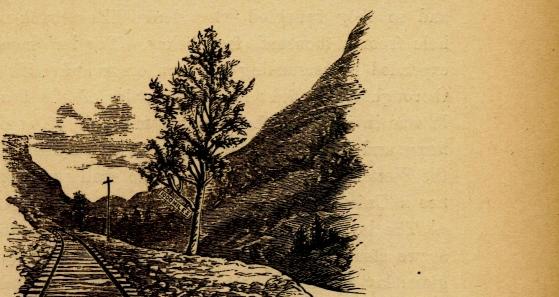
followed the track of the whalers of old Nantucket and doubled Cape Horn; a hundred miles and a lift of seven thousand feet heavenward; a hundred miles and not a drop to drink for engine or engineer; a thousand miles and hardly an Anglo-Saxon dweller. Two thousand feet of solid granite barred the way upon the mountain top where eagles were at home. The Chinese Wall was a toy beside it. It could neither be surmounted nor doubled, and so they tunneled what looks like a bank-swallow's hole from a thousand feet below. Powder enough was expended in persuading the iron crags and cliffs to be a thoroughfare to fight half the battles of the Revolution. It was in its time the topmost triumph of engineering nerve and skill in all the world. It stitched the East and the West lovingly together, and who shall say that we are not a United States?
The level rays of the setting sun glorified the scene as we steamed out a- few miles, until at our left, a sea of glass, lay the Great Salt Lake, a fishless sea, and as full of things in " urn" as an old time Water Cure used to be of isms, with its calcium, magnesium and sodium. A man cannot drown in it comfortably. No decent bird will swim in it. If Jonah, the runaway minister, had been pitched into it, that lake would have tumbled him ashore before he had time to take lodgings at the sign of " The Whale." It absolutely rejects everything but some-thing in " um." It ought to be the " duke dons um " for Lot's wife. Everybody passes Promontory Point in the night, the memorable spot where, on that May day, 1869, the East and the West were wedded, and the blows that sent home the spikes of silver and gold securing the last rail in the laurel were repeated by lightning at Wash-
THE DESERT, THE DEVIL AND CAPE HORN. 51
ington and San Francisco, in the length of a heart-beat; blow for blow, from the Potomac to the Pacific. Think of echo answering echo through a sweep of more than three thousand miles! All in all, after the signing of the Declarationtof Independence, it was the most impressive and thoughtful ceremony that ever graced the continent. It was electric with the spirit of the New Era.
Tally Eleven! We are in Nevada, eleventh sovereignty from the Atlantic seaboard. We have struck the Great American Desert. I wish I could give, with a few brief touches, the scenery of the spreads of utter desolation, strangely relieved by glimpses of valleys of clover that smell of home, and conjure up the little buglers of the dear East, that in their black and buff trimmed uniforms and their rapiers in their coat-tail pockets, used to campaign it over the fields of white clover where we all went Maying; sights of little islands of bright greenery, as at Humboldt, as much the gift of irrigation as Egypt is of the Nile; great everlasting clouds of mountains, tipped as to their upper edges with snow as with an eternal dawn; patches ghastly white with alkali as if earth were a leper, and yellow with sulphur as if the brimstone fire of the Cities of the Plain had been raining here, and salt had been sown and the ground accursed forever.
Tumble in upon these alkali plains a few myriads of the buffalo that have been wantonly slaughtered, and with the steady fire of the unwinking, unrelenting, lid-less sun that glares down upon the dismal scene as if he would like to stare it out of existence, you would have the most stupendous soap factory in the universe, to which the establishments of the Colgates and the Babbitts would be as insignificant as the little inverted conical
52 BETWEEN THE GATES.
leach of our grandmothers, wherewith they did all the lyeing the dear simple souls were guilty of.
Fancy an immense batch of wheaten dough hundreds of miles across, wet up, perhaps, before Columbus discovered America, permeating and discoloring and tumefying in the sun through five centuries; strown with careless handfuls of salt and sprinkles of mustard, and garnished, like the mouth of a roasted pig, with parsley-looking sage-brush, and tufts of withered grass, and rusty cactuses, and veins of dead water sluggish as postprandial serpents; and whiffs of hot steam from fissures in the unseemly and ill-omened mass; a corpse of a planet weltering and sweltering, with whom gentle Time has not yet begun; no May to quicken it, no June to glorify it, no Autumn to gild it.
Then fancy all this in a huge basin whose red and rusty rim, broken and melted out of shape, you see here and there in the northern horizon—fancy all this, and yet there is nothing but " the sight of the eyes" that will " affect the heart." Miners and mountain men have been lavishly liberal in giving things to the Devil. If he must have something in the way of estate, give him this bleached batch of desert dough for his own consumption!
You will take notice that in this description of waste places I have not mentioned Tadmor nor alluded to Thebes. A man cannot very well be reminded of things he never saw; neither have I quoted anything from Ossian about lonely foxes and disconsolate thistles waving in the wind. All these things have been mentioned once or twice, and the American Desert needs no foreign importations of Fingals to make it poetically horrible.
THE DESERT, THE DEVIL AND CAPE HORN. 53
You nave gone over it in a palace. You have eaten from tables that would be banquets in the great centres of civilization. You have slept upon a pleasant couch " with none to molest or make you afraid." You have drank water tinkling with ice like the chime of sleigh-bells in a winter night—water brought from mountains fifteen, twenty, thirty miles away. You have retired without weariness and risen without anxiety. Now, I want you to remember the men and women without whom there would be nothing worth seeing that could be seen, on the Pacific Slope; the men and women who crossed these plains in wagons whose very wheels clamored for water as they creaked; those men and women who toiled on through this realm of disaster, parched, famished, dying yet not despairing, to whom every day was only another child of the Summer Solstice, and who said every morning, " Would to God it were night!" Some made their graves by the way, and some lived to look upon the Pacific sea, and I want you to believe that in our time there has never been a sturdier manhood, a ruggeder resolution, a more Miles Standish sort of courage, than marked the career of the pioneers to the West.
Tally Twelve! Twelfth empire from the Atlantic. Less than three hundred miles from the Pacific. We are in California—the old Spanish land of the fiery furnace. The turbaned mountains rise to the right, and the dark cedars and pines in long lines single file, like Knight Templars in circular cloaks, seem marching up the heights.
You feel, somehow, that though not a pine-needle vibrates, the wind must be " blowing great guns," so to
54 BETWEEN THE GATES.
ruffle up and chafe the solid world. Across ravines that sink away to China like a man falling in a nightmare, and then the swooning chasms suddenly swell to cliffs and heights gloomy with evergreens and bright with Decembers that never come to Christmas, the train pursues its assured way like a comet. It circles and swoops ,and soars and vibrates like a sea-eagle when the storm is abroad. Mingled feelings of awe, admiration and sublimity possess you. Sensations of flying, falling, climbing, dying, master you. The sun is just rising over your left shoulder. It touches up the peaks and towers of ten thousand feet, till they seem altars glowing to the glory of the great God. You hold your breath as you dart out over the gulfs, with their dizzy samphire heights and depths. You exult as you ride over a swell. Going up, you expand. Coming down, you shrink like the kernel of a last year's filbert. We are in the Sierras Nevada! The teeth of the glittering saws with their silver steel of ever-lasting frost cut their way up through the blue air—up to the snow-line—up to the angel-line between two worlds.
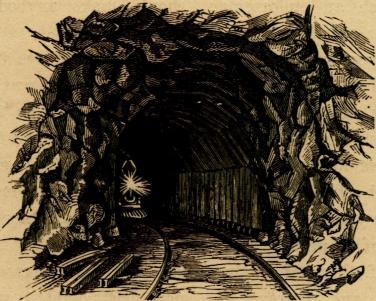
It was day an instant ago, and now it is dark night. The train has burrowed in a tunnel to escape the speech-less magnificence. It is roaring through the snow-sheds. It is rumbling over the bridges. Who shall say to these breakers of sod and billows of rock, " Peace, be still!" and the tempest shall be stayed and the globe shall be at rest?
And all at once a snow-storm drives over your head. The air is gray with the slanting lines of the crazy, sleety drift. Some mountain gale that never touches the lower world, but, like a stormy petrel, is forever on the
THE DESERT, THE DEVIL AND CAPE HORN. 55
wing and never making land, has caught off the white caps and turbans from some 'ambitious peaks, and whipped them whirling through the air. You clap your hands like a boy, whose sled has been banging by the ears in the woodshed all summer, at his sight of the first snow. But the howling, drifting storm goes by, and out flares the sun, and the cliffs are crimson and silver.
You think you have climbed to the crown of the world, but lo, there, as if broke loose from the chains of gravitation, "Alps on Alps arise." Look away on and on, at the white undulations to the uttermost verge of vision, as if a flock of white-plumed mountains had taken wing and flown away.
A chaos of summers and winters and days and nights and calms and storms is tumbled into these gulches and gorges and rugged seams of scars. , Rocks are poised midway gulfward that awaken a pair of perpetual wonders: how they ever came to stop, and how they ever got under way. With such momentum they never should have halted: with such inertia they never should have
56 BETWEEN THE GATES.
started. Great trees lie head-downward in the gulfs. Shouting torrents leap up at rocky walls as if they meant to climb them. See these herds of broad-backed recumbent hills around us, lying down like elephants to be laden. See the bales of rocks and the howdahs of crags heaped upon them. They are John Milton's own beasts of burden, when he said, " elephants endorsed with towers," and such an endorsement should make anybody's note good for a million.
Do you remember the old covered bridges that used to stand with their feet in the streams like cows in mid-summer, and had little windows all along for the fitful checkers of light? Imagine those bridges grown to giants, from five hundred to two thousand feet long, and strong a a fort. Imagine some of them bent into immense curves that, as you enter, dwindle away in the distance like the inside of a mighty powder-horn, and then lay forty-five miles of them zigzag up and down the Sierras and the Rockies, and wherever the snow drifts wildest and deepest, and you have the snow-sheds of the mountains, with-out which the cloudy pantings of the engines would be as powerless as the breath of a singing sparrow. They are just bridges the other side up. They are made to lift the white winter and shoulder the avalanche. But you can hardly tell how provoking they are sometimes, when they clip off the prospect as a pair of shears snips a thread, just as a love of a valley or a dread of a canon, or something deeper or grander or higher or ruder catches your eye, " Out, brief candle ! " and your sight is extinguished in a snow-shed. But why complain amid these wonders because you have to wink!
Summit Station is reached, with its sky parlors, and
THE DESERT, THE DEVIL AND CAPE HORN. 57
grand Mount Lincoln, from whose summit it is two miles "plumb down" to the city by the sea, and we have a mile and a half of it to swoop. The two engines begin to talk a little. One says, " Brakes!" and the other, "All right!" " Take a rest!" says the leader. " Done ! " says the wheeler, and they just let go their nervous breaths, and respire as gently as a pair of twin infants. The brakes grasp the wheels like a gigantic thumb and finger, the engines hold back in the breeching, but down we go, into the hollows of the mountains; along craggy spines, as angry as a porcupine's and narrow as the way to glory; out upon breezy hills red as fields of battle; off upon Dariens of isthmuses that inspire a feeling that wings will be next in order. Sparks fly from the trucks like fiery fountains from the knife-grinder's wheel, there is a sullen Bride of expostulation beneath the cars, but down we go. Should the water freeze in the engines' stomachs, " the law that swings worlds would whirl the train through ! "
The country looks as if a herd of mastodons with swinish curiosity had been turned loose to root it inside out. It is the search for gold. Mountains have been rummaged like so many potato-hills. When pickax and powder and cradles fail, and the " wash-bowl on my knee" becomes what Celestial John talks—broken China —then as yonder! Do you see those streams of water playing from iron pipes upon the red hill's broad side? They are bombarding it with water, and washing it all away. The six-inch batteries throw water about as solid under the pressure as cannon-shot. A blow from it would kill you as quick as the club of Hercules. Boulders dance about in it like kernels in a corn-popper. I give
58 BETWEEN THE GATES.
the earnest artillerymen a toast: "Success to the douche! The heavier the nugget the lighter the heart."
The train is swaying from side to side along the ridges, like a swift skater upon a lake. It is four thousand feet above the sea. It shoulders the mountains to the right and left. It swings around this one, and doubles back upon that one like a hunted fox, and drives bows-on at another like a mad ship. Verily, it is the world's high-tide! You have been watching a surly old giant ahead. There is no climbing him, nor routing him, nor piercing him; but the engines run right on as if they didn't see him. Everybody wears an air of anxious expectancy. We know we are nearing the spot where they let men down the precipice by ropes from the mountain-top, like so many gatherers of samphire, and they nicked and niched a foothold in the dizzy wall. and carved a shelf like the ledge of a curved mantel-piece, and scared away the eagles to let the train swing round.
The mountains at our left begin to stand off, as if to get a good view of the catastrophe. The broad canons dwindle to galleries and alcoves, with the depth and the distance You look down upon the top of a forest, upon a strange spectacle. It resembles a green and crinkled sea full of little scalloped billows, as if it had been overlaid with shells shading out from richest emerald to lightest green. Nature is making ready for something. The road grows narrower and wilder. It ends in empty air There is nothing beyond but the blue! And yet the engines pull stolidly on.
Down brakes! We have reached the edge of the world, and beyond is the empyrean! You stand upon
THE DESERT, THE DEVIL AND CAPE HORN. 59
the platform. The engines are out of sight. They are gone. The train doubles the headland, halts upon the frontlet of Cape Horn!— clings to the face of the precipice like a swallow's-nest.
The Grand Canon is beneath you. It opens out as with visible motion. The sun sweeps aslant the valley like a driving rain of gold, and strikes the side of the mountain a thousand feet from the base. There, twenty-five hundred feet sheer down, and that means almost a half mile of precipice, flows in placid beauty the American River. You venture to the nervous verge. You see two parallel hair-lines in the bottom of the valley. They are the rails of a narrow-gauge railroad. You see bushes that are trees, martin-boxes that are houses, broidered handkerchiefs that are gardens, checked counterpanes that are fields, cattle that are cats, sheep that are prairie-dogs, sparrows that are poultry. You look away into the unfloored chambers of mid-air with a pained thought that the world has escaped you, has gone down like a setting star, has died and left you alive ! Then you can say with John Keats upon a far different scene, when he opened Chapman's magnificent edition of Homer:
"Then felt I like some watcher of the skies When a new planet swims into his ken;
Or like stout Cortez when with eagle eyes He stared at the Pacific, and all his men
Looked at each other with a wild surmise—Silent upon a peak in Darien."
Queer people travel. Returning to the car I saw a broad-gauge Teuton, with the complacent bovine expression of a .ruminating cow, eating a musical Bologna lunch of " linked sweetness long drawn out," and I said to him, " Did you see Cape Horn?" " Cabe Hornd? Vat
60 BETWEEN THE GATES.
is she?" One of those difficult old-bachelor questions that will never find anybody to answer. Everything in this world but sausage and lager
"A yellow primrose was to him, And it was nothing more."
ACALIFORNIA train is a human museum. Here now, upon ours, are the stray Governor of Virginia, an army captain going to his company in Arizona, a trader
from the Sandwich Islands, a woman from New Zealand, a clergyman in search of a pastorate, an invalid looking for health, a pair of snobs, Mongolians with tails depending from between their ears, the proprietor of an Oregon salmon-fishery, a gold-digger, a man whose children were born in Canton while his wife lived in San Francisco, some Shoshones and dogs in the baggage car, and a family who ate by the day, breakfasted, dined, supped, lunched, picked and nibbled without benefit of clergy. It would take a chaplain in full work just to "say grace" for that party_ Victuals and death were alike to them. Both had " all seasons for their own." They ate straight across
the continent. If they continue to make grist-mills of
themselves, crape for that family will be in order at an early day.
At some station in the Desert where we halted for water, there sat, huddled upon the platform, some Shoshone Indians, about as gaudy and filthy as dirt and red blankets could make them, and papooses near enough like little images of Hindoo gods to be cousins to the whole mythology. One of the squaws, with an ashen
61




62 BETWEEN THE GATES.
gray face and white hair, a forehead like a hawk's, an eye like a lizard's, an arm like a ganglion of fiddle-strings, and a claw of a hand, looked to be a hundred years old, and her voice was as hollow as if she had an inverted kettle for the roof of her mouth, and talked under it. Near by, on the same platform, an English-man was pacing to and fro, putting down his well-shod feet as if he had taken the country in the name of the queen of 'ome and the Empress of India. A Frenchman, in a round cap with a tassel to it, stands with the wind astern and his brow bent like a meditative Bonaparte, trying to light a twisted roll of paper in the hollow of his hand. Two Chinamen in blue, broad-sleeved blouses, their shiny black cues swinging behind like bell-ropes in mourning, stood near, shying their ebony almonds at the whole scene. On the track, waiting for a shake of the bridle, waited the engine, breathing a little louder 'low and then, like a man turning over in his sleep.
Regarded with thoughtful eyes, the grouping was impressive. Here in the Desert, as far away from blue water as they could possibly get, standing upon the same hundred square feet of platform, were Mongolians from the pagoda-land of " the drowsy Easf," aborigines from the heart of the continent, men from Fatherland and Motherland, and the lands of the lilies, the storks, the long nights, the broad days and the —interrogation-points, all met and mingled here for a little minute, and the cause of it is the wonder of it. There it stands upon the track. It is number 110. It is the locomotive, at once a beast of burden, a royal charger, a civilizer and a circuit-rider.
At stations throughout the way, in places unutterably
FROM WINTER TO SUMMER. 63
dismal and desolate, wagon roads, stage routes and horse trails make for the mountains. No man not gifted with geological eyes, which means a pair of organs that can see through millstones before they are picked, would ever suspect what floods of disguised mercury, what billions of blue-pills and boluses, what caverns of honest silver, what spangled nuggets of clean gold, what Pactolian sands, what wealth of agates of price, what life-giving springs, what Cracows of salt, what fountains of soda, lurk in all impossible places, as if the planet had gone into bankruptcy and hidden its assets in these regions. You pass through a place without knowing it whence seventy-five millions of pure gold have been taken, with a two-million income to-day, and the world is there still — not so much as an eyelet-hole through it.
Unless you have been made cosmopolitan by travel, the Overland Voyage gives you a lonely far-away feeling it will puzzle you to describe. The air is so clear, the horizon so broad, the world so strange, the tune of life keyed two or three notes higher than you ever played it before, that you catch yourself wishing for a lounge on some old native sod where, if your name is not "McGregor," at least it is Richard when he was "himself again," beneath a rock maple that gives you sugar in April, shade in June and beauty in October.
We have rounded Cape Horn! Grand Pacific, good morn! Rattling down the ridges, bringing up with a sweep in niches of valleys, like a four-in-hand before stage-houses with room for the cut of a figure 8. A half-mile down and one hundred and ninety-three out, and there is The Golden Gate. We are plunging into a carnival of flowers. They hold up their dear little faces
64 BETWEEN THE GATES.
everywhere to be admired, and why not? Snow-storm in the morning and midsummer at noon! Read over the old stories of the Arabian Nights, and believe every word of them. The chaparral of little evergreen oaks shows bright along the hills, and the air is sweet with the white blossoms. You pass settlements of a tree that has original ways of its own. Like the Manzanita tree, it does not grow in Webster's Dictionary. It is the Madrona. It has no fall of the leaf, but it strips off its clothes like a boy bound for a swim, for it slips out of its old bark and is fitted to a new suit. It borrowed the fashion from the Garden of Eden. Its wood is crooked enough for a politician, and it has as much the look of a foreign land as a date-palm. Many trees and shrubs in California are evergreen, though there is nothing about them to make you suspect it, and the reason they are, is that the weather is so wonderful from January to December they never know the proper time to shed their leaves, and so "wear green on their coats" and never change their clothes all the year round!
The valley of the Sacramento is a garden, and Sacramento is the " orbs in horto" of it. It is our first glimpse of the Celestial Flowery Kingdom of the Christian world. Roses never die. Rare exotics that we at the East cherish as if they were infants, and bend over like new-made fathers and mothers, are distrained for conservatory rent and turned out-of-doors. The white dome of the State Capitol rises like a pale planet above the green surges and waving banners of semi-tropic luxuriance — a planet with one mansion, the Temple of Liberty, and one inhabitant, an unprotected female, Power's Genius of California,
FROM WINTER TO SUMMER. 65
and the blue dome of Mount Diablo lifts in the far horizon.
These are the spacious parlors with their seventeen thousand square miles, and all carpeted with beauty from the silver Sierras " at the eastward of Eden " to the thin apparition of the Coast Range in the West. The orange blossoms are abroad, and the fruit is as golden as the three pawnbroker planets, and as green as a walnut in its first round-about, all at once. They that dwell here sit under their own vine and fig-tree, and the palm waves over their heads. The stately orchards of live-oaks, in their chapeaux of green, stand at ease in the picture, to counterfeit the royal parks of Old England. The Sacramento River wanders down on the way to the sea, while cloudlets of steam and flicker of flag and of wing mark the route. Taste and wealth have conspired with Nature. There is no fairer landscape between the Tropics.
And what a blessed country for Don Quixote! How " the knight of the sorrowful countenance" would brighten at sight of California! The Castilian Alexander sighing for more 'windmills to conquer, would have them here. Every well-ordered family may keep a dog, a cat, or some children, but the windmill is sure to be the pet of the household. It .is an odd sight, fifty windmills in a broad landscape, all going at once; some painted green as dragon-flies, some red, white and blue; these with hoods, those with their arms bare to the shoulder; facing different ways, looking square at you, or askance, or not seeing you at alL Insects out of some gigantic entomology, whirling their antennae at you, to beckon you or frighten you, or halt you or start you. Then with a little whisk of wind, one will whip about like a cat and front the
3*
66 BETWEEN THE GATES.
other way. Some of them have tails like a fish. Others, in the rolling country, have long slender bodies of wooden aqueducts that suggest devil's-darning-needles, only they have long, thin legs, sometimes four, and then a dozen, just to keep their dropsical bodies at the right altitude for irrigation. These fellows turn their heads like hooded owls on a perch, and it would not astonish you much to see any of them develop wings and fly away, if only it was not your way. They are as thick in California as the little white and yellow butterflies around a wet place in the road. It would have puzzled Agassiz to classify them, but they are the home-made rain-storms of the California summer. Look at those coppery hills yonder, dried to tinder point. See the dust, fine as Scotch mist, rolling around the wagons and enveloping them in clouds as was old Eneas. But how brilliant the green fields, how new the flowers, how glittering the trees, how rank the
corn fresh from
the baptism of the precious bugs of windmills. How sweet the air as with the smell of rain! This is a
rainless land from -D NQa, OTC'"RADISH
spring to fall, but like other Ships of State it runs by wind and water all the same.
You plunge into a tunnel a thousand feet long, are gone a minute in a kind of short night with noon at one end of it and sunshine at the other. You emerge into valley after valley with picturesque halls between, the mountains keeping company as you go. Diablo draws
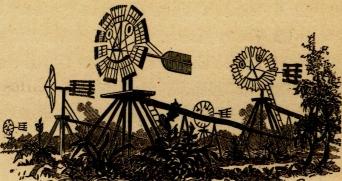
FROM WINTER TO SUMMER. 67
near, gashed with gorges, his robe of mountain blue folded away, and the cowl of a ghostly Franciscan flung over his head. The salt sea breezes, such as Dibdin could have sung a rousing song about, come rushing up to welcome the stranger from the alkali air and the shimmering heat and the giddy heights and the everlasting snow. There are pansies by the way, broad-faced like little moons — pansies, and that's for thought of thankfulness. There are poppies scattered abroad — poppies, and that's for forget-fulness of all things that weary. There are wild lupins, true blue, and buttercups that take you back to child-hood and home pastures, where the reflected tint of the floral gold upon your chin told the secret of your love, not of beauty but of butter. At last! the bay of San Francisco, with its gems of islands, its waters doubling the flags of all nations; the Queen, with her face to the Golden Gate, and her hair wet with the breath of the Pacific. It is seven miles to San Francisco. Say it is ope of the finest voyages you ever made. Thank God you are yet in the United States. There floats the twin of the flag you left three thousand miles ago. The denser, richer, more gracious air comes to you like a familiar friend.
But let us not ride high-horses to bed. The sun is sliding down into what you never saw it drown in before —the Pacific Ocean. The last time you saw it meet with a like calamity, it fell into Lake Michigan. It has strength enough left to show what manner of person you are: as dusty as an elephant, a smutch on your face, a kink in your hat, and your ungloved hand shaded like some smoky work of the old masters. Let us leave scenery for soap, and beauty for broom brushes.
68 BETWEEN THE GATES.
The car is an aggravated case of the First of May. Everybody is making ready to move. Leather valises, cot-ton trunks, carpet-bags of the style that it takes two to show the pattern, are repacked, the wrecks and bones of departed luncheons tossed from the window, cloaks and wraps shaken out of wrinkle, traveling-caps wadded and pocketed. Dusky porters are alert, whisking half dollars from coats with a wisp-broom, leaving the dust undisturbed, as if they thought California tourists carried the sacred ashes of their forefathers about with them. A woman is polishing her front hair with a licked finger. One mother is washing a family of three with Desdemona's handkerchief.
Everybody is going everywhere, one to Puget Sound, that looked very dim and other-worldish on the old maps; another to the Halls of the Montezumas, where the grand old hero of Lundy's Lane went; a third to Japan. You open upon a new page of the geography, and hear more names of far-away regions in an hour than you ever heard in your life. They talk in a neighborly way of up the coast to Oregon, and down the coast to Callao, and over to Honolulu, as if it were just across a four-rod street.
The train runs through Oakland, a lovely live-oak suburb of San Francisco, thirty thousand strong, where a thousand houses a year has been the recent rate of growth. You catch a glimpse of the tropical glories. You see hedges of fuchsias and walls of scarlet geraniums twelve feet high, blazing like the Burning Bush. You-see walls of evergreen carved into arches and alcoves and gateways, as if they were green marble. You see the California quail in his neat uniform and his quaint
FROM WINTER TO SUMMER. 69
crest running about the door-yards of the city, as domes-tic as witty-legged bantams. You see bits of velvet lawn as emerald as emeralds, and intense as green fire. You see calla-lilies as large and pure as holy chalices. You see a cloud of foliage on a distant hill as blue as if a bit of clear sky had fallen down upon green trees and dyed them the color of heaven. It is the blue gum-tree. You see Australian shrubbery that never knows it is an exile.
At last you go to sea on the cars. You run three miles out in salt water upon a pier. You are in the midst of ocean-going ships, and saucy tugs, and fishing-smacks and rollicking jolly-boats. Men-of-war lie quiet with cables in their noses and anchors at the end of them, nasal charms of gigantic dimensions. You see the double-headed fowl of the imperial standard of the Czar, and the tricolor of France, and the tawny moon of Japan in a brick-red sky, and the calico-pattern of the Hawaiian Islands, and the splendid flag you were born under, more beautiful than all. You hear fitful blasts of music from the distant decks. You see lines of ports like the finger-holes of flutes along the ships' sides. They are the bur-rows of thunder and lightning.
The little company here separate. Good-byes and good wishes interchange, and we part with a figurative " cup of kindness " at our lips, and few, I dare say, left the train who could not have joined in the sad old song of the " Three Friends:"
"And in fancy's wide domain There we all shall meet again."
I do not know Pythias, and I did not see Damon on the train, but I do know that just in proportion as men be-come truly human, they grow frank and friendly.
70 BETWEEN THE GATES.
You board one of the grandest ferry-boats in American waters, El Capitan, vast parlors on a bridge that crosses while you sit still, whereon four thousand people can be borne without a battle of the bones. Everything is sweet and tidy as a nice little bride's first house-keeping. I recall the old steamer "Nile," Commodore Blake, that used to sail the fresh-water seas, with a pair of golden lizards at the bow for a figure-head. It was thought grand with its owlish saloons and its stuffy cabins, and its hissings and sputterings and rumblings of hot water everywhere, and its perpetual palsy like an irritable volcano with an uneasy digestion. You could have put the habitable part of that Nile, crocodiles and all, into El Capitan's back parlor.
You left the runners and hackmen of the East in fourand-twenty-blackbird rows, all their mouths wide open like young robins, all hailing you together in gusts of Northeasters, to ride somewhere and stay somewhere, and they are always " going right up." Here, they meet you on the boat. They accost you confidentially, they touch you in a velvety way on the elbow with " kerridge, sir?" They are " the mildest-mannered men- that ever "—asked a fare. I am not sure I quite like it. I take a kind of malicious satisfaction in watching the howling dervishes, as they stand just the other side "the dead line" of the curbstone or the rope railings, and howl. It is delicious to think they cannot get at me and pull me apart, and rend my baggage, and send me around to various hotels a morsel apiece, even as they feed lions and variegated cats in a menagerie.
SAN FRANCISCO STREET SCENES.
SAN FRANCISCO! Crowned with palaces and dense with business houses as a redwood forest, six cur-rents of life surging along her congested streets that jar with the endless thunder of commerce, four on the side-walks and .two on the cars; the ships of the world courtesying through the Golden Gate and sailing into the Bay like stately old dowagers entering the reception-room of a monarch. And then remember it was a desert of sand-dunes, strown with seaweed and white bones, and desolate as an old African Gold Coast thirty years ago, a time hardly long enough for a century plant to get a good ready for blossoming, and now more than three hundred thousand strong, it faces both ways and con-fronts the world!
The stranger's home is the hotel. There are lions and lions, and no lack of them in San Francisco. The Grand, The Lick, The Occidental, The Russ, The Baldwin, The Cosmopolitan, The Commercial and The Palace. With the affectionate republican weakness for simplicity you go direct to The Palace. It is a house full of houses, a kind of architectural Surinam toad that swallows uncounted broods of little toads to keep them out of danger. The comparison is not appetizing, but it will serve. Five such hotels would have bought all Florida at the time of

72 BETWEEN THE GATES.
the Government purchase. It has seven stories, seven hundred and fifty rooms, eighteen acres of floor, and has broken out with bay windows till it is knobby as an old-fashioned bank-vault door, and full of eyes as a field of potatoes, or a peacock's tail, or an overwhelming affirmative. If you wish to hide from an enemy who dwells at The Palace, the safest thing to do is to board there yourself. There is slight chance of your ever meeting him. The table, attendance, rooms and prices are all first class, but why a man is any happier on a vulgar fraction of eighteen acres, than on some cozy corner of an acre and a half, and why he is willing to pay more for it, is, perhaps, a vulgar question concerning a vulgar fraction. It is annexing a State to get a bedroom.
A certain degree of elegance comports with the comfort of the average man, but the elegance may attain an uneasy magnificence, as when the luxurious pile of the carpet you tread yields to your foot, resembling a leisurely stroll on an immense feather bed, or as when a man unused to dwelling in a huge looking-glass, is constantly hastening to meet himself and be introduced to himself and be polite to himself. This incessant meeting with the identical stranger gets monotonous after awhile, particularly if you wish to room alone.
The bay-window order of architecture prevails to a degree that suggests the proverb about glass houses and geological restlessness. It is the first feature the stranger observes, and it gives the city a Venetian-balconied look, hinting moons, flutes and troubadours. You think of Juliet when that love-lorn fanatic of a Romeo declared, in defiance of rhetoric and gender, " and Juliet is the sun!"
SAN FRANCISCO STREET SCENES. 73
You have only to look at the stately fronts mile after mile, with all the windows gracefully leaping out of themselves, to read the weather record. They are an almanac far more accurate than Poor Richard's. The sun of California is a power. There is nothing to dim a fire-fly between the. king and the Californian. But the windows tell you the people crave the sun. " Pleasant, shady rooms to let," says the New York Herald. " Bright, cheerful apartments, with the sun all day," says the San Francisco Chronicle, though how that can be' is not quite so plain, unless you live in a lighthouse. The reason for this love of basking is a misty reason for one so clear. The fogs from the Pacific seldom rise a thousand feet, and the Coast Range of mountains, lifting its magnificent sea-wall, defends the land from these ghosts of the ocean. But they will drive down the Coast' and charge through the Golden Gate like clouds of shadowy horse, and roll over the city and sweep up the valleys. Again you learn from the street fronts that demoralized glaciers never bombard the city with hail-storms, else there would be "a wreck of matter" and a crash of glass. You look in vain for one of the old tallow chandler's fixed bayonets. No thunder-clouds open ports upon San Francisco, and you rejoice that you have escaped the lightning-rod man, who with the book-canvasser and the insurance agent, constitutes the three deadly sins against a quiet life.
Street life in San Francisco is a kaleidoscope that is never at rest. There is nothing like it on the continent. The flower-stands with their gorgeous array, the open-fronted alcoves fairly heaped with floral beauty, as if Eve had just moved in and had no time to arrange her "things"; the glimpses of bright color from leaf and
4
74 BETWEEN THE GATES.
blossom, that catch the eye everywhere, in mansion, shop and shed; the bits of bouquets you see on draymen's coat-collars, and blooming from broken cups in tinkers'. dens and smithies; smiling in churches in prayer-time; adorning brides with genuine orange blossoms; strewing coffins with everlasting June.
Then the fruit-stands that are never out of sight, with the mosaics of beauty spread upon them, as if Pomona's own self presided at the board. Rubies of tomatoes, plums and cherries; varnished apples from Oregon, as cheeky and ruddy as "a fine ould Irish gentleman "; pears, peaches, apricots, nectarines, oranges, and those cunning Lilliputs of lemons, the limes; strawberries, blackberries and raspberries, that melt at a touch of your tongue; fresh figs, looking like little dark leather purses, and full of seeds and sugar— all these grouped upon the same broad table; everything from all the year round but snowballs, as if the gifts of the seasons were converged, like sunbeams through a lens, upon one luscious spot of summer luxury and brilliance. You halt if you are not hungry, for you have learned that the richest beauty is not always in the flower. You find that fruit goes by avoirdupois; peaches are in pounds and not in pecks; that it is not much cheaper than it is three thousand miles away; that your dimes have turned into "short bits," your quarters into "two bits "; that three "bits" are thirty-seven and a half cents, and it takes forty cents to make it; that pennies are curiosities, and poor little nickels nowhere; if an article is not five cents it is nothing; if . it is twelve cents it is fifteen. So you buy something at a "bit" a bite and move on.
This is the paradise of bootblacks, the rainless-sky
weather from spring to fall rendering " a shine " a good investment. These artists on leather have little wardrobes of affairs set against the buildings along the sidewalks, furnished with easy-chairs and foot-rests, and often carpeted and adorned with mirrors and pictures. At the first glance, they remind you of the wayside niches in foreign countries wherein some saintly image is enshrined, but a second look, and the saint is resolved into a very earthly piece of human ware, armed with brushes and French polish, to make looking-glasses of your upper leathers. And these Mother Hubbard's cupboards of places are as good as a weather-gauge to a stranger, telling him that the year is one long genial season, neither summer nor winter, but the tonic of the one and the glow of the other.
And there come some strolling players that are not Hamlet's, to confirm the story, with their harps and fiddles stripped of the green-baize jackets of more inclement skies, and naked to the very bones and tendons.
You notice in the ever-moving tides of street life an absence of the rainbow tints and the flickering white of woman's Eastern apparel. The hues are soberer. Seldom a day in a whole year that fur sacques, shawls and over-coats are not in order at some hour between sunrise and bed-time. It is July, but see the fur-trimmed garments and the dark cloaks and the heavy veils go flitting along, and the sun just emptying his quiver of golden arrows all the while.
There, drawn by a span of horses, is a mill. By the wheel, five feet in diameter, you would say it is a grist-mill and runs by water, but the glimpse of a couple of big dogs chained behind discloses the power that moves

76 BETWEEN THE GATES.
that wheel, for they travel in it without going an inch. Some animals with less feet than Tray and Blanche make incessant efforts to advance with a like result. Tied to a post, they can travel all day without slipping the halter. That mill is a huge machine for sharpening shears, scissors, swords and chopping-knives. It has power enough to put an edge on the battle-ax of young Lochinvar.
A couple of breezy voices with a touch of the fore-castle in them raise a song above the din and roar and sharp castanet accompaniment of iron shoe and, flinty street. You turn and see something that might have been copied out of an old English seaport picture; a pair of 'tall, broad, rolling sailors in neat blue, with the flat tasseled caps and the neckerchief in the conventional salt-water knot. Each has but a single leg to go upon, and you catch yourself looking to see if the missing member is not shut up like a jack-knife, which might be the thing for a jack-tar; but no, it is clean gone, carried away, perhaps, by a cannon-shot, or else shut together like the tube of a telescope. Well, the two messmates with the one pair of legs, standing in the middle of the street, are singing jolly old sea-songs as salt as a mackerel, and swinging about on crutch and cane as the flakes of silver bits rattle down upon the pavement. Passing children bring out their dots of half dimes, and hurrying passers-by remember the old boys of the blue roundabout. It was a pleasant little touch of kindly feeling worth the time it took to see it.
You miss the trim-looking fellows in belted blue, silver buttoned, becapped, armed with clubs, and blazing with stars as big as Venus on the breasts of their coats. They are not here, but in their stead men in gray, neither
SAN FRANCISCO STREET SCENES. 77
showy nor obtrusive. The streets are safe to walk in by night and by day, and the city seems to a stranger to govern itself.
Here comes a covered wagon emblazoned " Flying Bakery "— a sort of flying battery of batter. It contains a table, chairs, stove, cook and driver. You step aboard, and in the turn of a hand, muffins are served up to you, as light as a wisp of fog and fresh from the fire. Brisk little two-wheelers go darting about jolly as a jaunting-car, and they are flying butteries, laden with butter in rolls shaped like a fruit-can, wrapped in tissue-paper and sweet as a field of red clover. Elephantine four-in-bands drawing huge wagons to match, are forever going and coming. Basket phaetons resembling runaway cradles are working in and out amid the great crashing wains and the saucy coaches and the cars of all colors, as busy as red ants in a flurry, that meet and cross and run side by side and swing about each other in a free-and-easy fashion. The streets are gridironed with tracks. You see thoroughfares lying up against the tall horizon, steep as a house roof, but the wagons go rattling down them at a reckless rate. You see a car at the foot of a hill, laden with passengers, and waiting behind a platform car with a lever in the middle of it, and an engineer without any engine. While you wait for the horses, that platform starts of its own accord, and tugs the car up that hill. It looks like a piece of witchcraft. The wooden horse of the Arab that went by a peg in his ear was not more magical. You see another car coming down without horse or hold-back. You are tempted to cry out, " The cars are running away with themselves!" The traction is an end-less chain beneath the track, the power a stationary engine
78 BETWEEN THE GATES.
on the top of the hill, and it draws up the cars like so many buckets of passengers. Looking at the cars black with people to the platforms, you say: everybody rides. Working your way through the counter-currents that flow and eddy and whirl around the corners, you say: everybody walks. Regarding both cars and pavements you say: everybody rides and the rest walk. The Italian fruit wagons are banging about; equestrians dashing to and fro upon horses that were born free and caught with a lariat — wiry fellows that will gallop all day without turning a hair.
Sometimes painters used to go to Gibraltar to copy the costumes of far countries that set the streets in a blaze; but to see nations, come to San Francisco! You meet a Spaniard in a wide hat, an Italian with ink in his hair, a correlative of frogs and soupe-maigre, all in a minute. A California Indian in still shoes, a moon-faced Mexican in partial eclipse and a sort of African by brevet, a Russian with a square chin and a furry look, all in three squares. You elbow South Americans, Australians, New Zealanders. You accost a man who was born in Brazil, who hails from Good Hope, who trades in Honolulu. One of the great Chinese merchants with an easy gait, an erect head and a boyish face, is coming around the corner. A man from Calcutta is behind you. " An Israelite in whom is no guile " is before you. The Scotch-man is here with the high cheek bones, the blue eyes, and the cutty-pipe and a word from Robby Burns in his mouth. The Dutch have taken us, and the Irish, do they not " thravel the round wurrld "? Of course, New-England is here, and New York and the South. They are every-where, but show us your Colombians and Peruvians and
SAN FRANCISCO STREET SCENES. 79
Sea-Islanders, and all sorts of people from the outer edges of geographies and the far borders of atlases, as here. Japanese and Chinese signs grow familiar to you in a week. Sclavonians and Mongolians are as thick as red pepper in East India curry. It is a tremendous Polyglot.
I write in the " Metropolitan Temple." It is built of pine from " the wild where rolls the Oregon," of fir, of sequoia, the giant redwood of California. Nothing composing the structure is familiar to Eastern eyes. We walk upon Portland stone, we drink melted ice from the Sierras, we write upon a portfolio from China, on paper kept in a cabinet from Japan, with a pen of California gold. We step upon a mat from Central America, recline upon a pillow woven of grass from the ocean, eat the eggs of sea-birds with shells clouded like Egyptian marble, sit in the shade of an Australian tree, and swing in a hammock from the Sandwich Islands.
"Stock three papers for ten cents!" is what the darting newsboys say to you when you land in San Francisco from the Overland Ferry. The swift Mercuries of the press are cleaner faced and better clothed than in the East. They are not gamins in any Parisian sense. They are vitalized atoms of California "stock!" and that is the key-note to everything on The Coast. It is a household word from the top of the Sierras to tide-water. The touchy and uncertain thermometers of California Street are read off in lonely ranches and in country cities. Almost everybody is interested—has made money, lost money, hoped money, in mining stocks. He has a bulletin-board on his gate-post. It is as if Wall Street were lengthened and widened to take in the whole of the Em-
80 BETWEEN THE GATES.
pire State. In San Francisco they deal in the raw material; bricks, bars, ingots, right from the mine; wealth in the original package; in what the mines promise; in what they perform. East, it is " cash down," it is " stamps." West, it is " out with the coin," " down with the dust." You get forty dollars in silver. There are eighty pieces; forty in the right pocket, forty in the left pocket, and there you are, an ass between two panniers, albeit it is a silver lading. How deftly your Californian pairs out the half dollars! They slip from one hand into the other as the creatures went into the ark, and as if they were born twins. On the Atlantic, money is as sonorous, to use old President Backus's simile, as if you should make a bell of a buff cap with a lamb's tail in it. On the Pacific, it is jingle and ring week in and week out. You pay as you go. A half dollar sheds its scales in no time, and nothing is left of it but " a short bit." It looks larger to you than a withered leaf of postal currency. It is more dignified, because its gravity is greater.

SAN FRANCISCO is a city where people are never any more abroad than when they are at home. They
support three hundred and fifty Restaurants, where all the delicacies and luxuries of this season or any other can be obtained at prices low enough to throw a Chicago caterer into bankruptcy. Not less than fifty thousand people eat at Restaurants, and live in lodgings; perhaps thirty thousand more at the ninety hotels and the eight hundred lodging-houses and the six hundred boarding-places of the city, besides a herd of five thousand that drift from lunch table to lunch table, like so many cattle grazing in a range. It is a Teutonic paradise, there being forty-two breweries; and as for liquors, there are enough to make a pretty heady punch of the Bay of San Francisco, if only they should play Boston Tea-Party with the stock in trade all at once, and rouse a fearful revel in the sign of Pisces, the Fishes, giving an extra tumble to the porpoises, and putting the sharks hors de combat. They tell of " dry statistics," but here is a bit of the wet variety: there are drinking-places so many, that a copper-lined man can take an observation through the bottom of his drained glass once a day for ten years, and not visit the same place twice!
And there are two hundred and sixty bakeries, enough .
Sl

82 BETWEEN THE GATES.
to make dough of a small harvest in a week. "Our daily bread " is tumbled out of the ovens by the ton. Seeing the fruit and vegetables everywhere, in a profusion and variety before unknown, you infer that this is a graminivorous people; but being nearly run down and made meat of yourself, by uncounted butchers' four-in-hands and dashing carts, a dozen times in a couple of days, and learning that there are four hundred and fifty knights of the white apron, butcher-knife and cleaver, you are morally certain this community is as carnivorous as a Royal Bengal tiger.
And then you go to one after another of the thirteen Public Markets, and there you read the whole story at a glance. San Francisco is undoubtedly omnivorous. A stroll through the " California," the " Washington," or the " Grand Central," will give a dyspeptic man a desire to go out and hang himself. Everything edible that creeps, swims, crawls, runs or flies is here. Forty-pound salmon, the grand fish of the Coast, are heaped in great red slabs like planks of the red sequoia; sturgeon hauled out of the Bay from fifty pounds weight to four hundred; rock-trout with their dappled sides; smelts of slender silver; soles that look as if they grew in slices; those piscatorial infants, the white-bait; calves' heads, their smooth cheeks and chins clean shaven as friars. There is one now with a curious Chinese smile, calf-like " and bland "; mouthfuls of sparrows rolled up in their little jackets and passing for reed-birds; rabbits that simulate rats; lobsters all claws like a legislative bill. Here is a table that runs to tongues, toes and brains. Regardless of the " R's " in the names of the months, oysters are in order the year
THE ANIMAL, MAN. 83
round; clams likewise, but if they fail it is not so much matter, as morsels of leather well-seasoned will do.
Shrimps—you know shrimps—are heaped about by the bushel. They are ten-legged, long-tailed crustaceans, with whiskers enough for one of Campbell's " whiskered pandours." A plate of those vermin is set before you at a restaurant—by way of recreation, while you are waiting for something to eat. It is all right, but how much more amusing it would be to have them alive! You could plague them with a stick, the precious bugs, and the restaurants could use them again. Here are box ter
rapins about the size
of the old Congressional snuff-box, with a head at one end and a taper tail at the other; sausages
" the savory meat" of the Old Testament
of every color and
size, from chimney-black to poppy-red, and from puppy to hippopotamus. Mottled and speckled and marbled and freckled, they are the very mosaic of meat. There is one that looks like an elephant's foot.
Everything from the gardens of the year round is here. I count twenty-two varieties of vegetables upon a single stand. Upon another are cocoanuts, oranges, lemons, limes, melons, pineapples, plums, figs, blackberries, rasp-berries, strawberries, apricots, pears, peaches, nectarines, tomatoes, grapes, apples, cherries. Now add anything you happen to think of, and it is there. Do you know gumbo? A green, fluted, West-Indies pod, coming to a point like
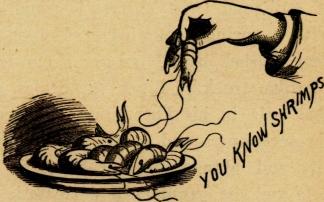
a spontoon. A little persuasion turns it into soup. By its name it ought to come from Guinea. Here are gorgeous flowers; and beneath them cages of dogs and doves. California chickens are mostly of the breed that Pharaoh had when his corn-crop failed, and their corn-crops also, but ducks, geese and turkeys are desirable.
"JOHN," THE HEATHEN.
You seem to be in the sign of Libra, the Scales. There is John, the taper-eyed, with his blue shirt and his wapsy trousers, and snubby shoes, and his black braid of stub and twist, thirty thousand of him, going about with a springy pole balanced upon his shoulder, and a deep bushel basket swung from each end, filled with " garden truck." Libra, the Scales, catches the spring of that pole in his knee-joints, and goes teetering about in the most outre and monkeyish manner. If you leave the city and plunge into a canon, you meet John with his pole and his panniers, a peripatetic pair of scales. He is the only man in the world who makes a trunk of a spring-pole.
John always forgets to tuck in his shirt, and if he is well-to-do he wears two, white beneath and blue or black without. He finishes dressing where the rest of mankind begin. What would you have? He advances backward and retreats forward, and falls upward and rises down-ward. He is the animal man inverted, subverted, perverted, and everything but converted. Discover how the world always does anything, and that is precisely the way John never does it. Thus, the other day he was arrested for stabbing a countryman, and where do you suppose he
THE ANIMAL, MAN. 85
struck him? Why, in the sole of his foot, and that is the Chinese of it.
To me he looks as much alike as a flock of sheep. Shepherds tell me they can distinguish any one in a flock of a thousand by its face, but John is too much alike for me. I pass him on the street, and then in a minute I meet him. To be sure he has changed his shirt and his shoes, but he has kept his face. He took some soiled handkerchiefs of mine one day to wash, which he did not return, and his name it was Foo Ling. So I went out to find him. I succeeded in three minutes. I over-took him, and passed him, and met him. He had those little wipers-away of tears, as white and square as so many satin invitations to a wedding, in his hand, in a towel, in a basket, but he said he was not he, and I was somebody else. It was a fearful case of mistaken identity. The streets were crowded with him,— but alas for Foo Ling, it was fooling he was. It was one of his " ways that are dark." If the devil should have his due, why not John? Without him the Central Pacific road would have waited completion many a long day. Without him San Francisco would not be the cleanest-collared and cuffed and bosomed city in America. Its inhabitants are as white around the edges as the brim of a lily. Neither in New York nor Chicago do you see faultless linen so universal. A laborer's clothes may be out at the knees or the elbows, or any other exposed point to wear and tear, but he is quite sure to show a bosom and collar immaculate. John is a laundry. He can wash, iron, crimp and flute fit for an angel. He is handier than Bridget. He is master of suds, an artist in starch, and a marvel to sprinkle. You should see him do it. He




86 BETWEEN THE GATES.
takes up a mouthful of water as your horse drinks, and out it plays in a spray so fine that were it a breath mistier it would float away in a cloud. People have unfortunate ways of putting things. They say he spits on the clothes. It is as little like it as the feathery spray of a garden fountain. People visiting China, as you and I will, look through the Celestial markets for rats. They hunt the file-tailed rodent like Scotch terriers, They expect to find him hung by the heels to a perch, just as good Christians bestride that same roost with the delicate and infantile hinder legs of Batrachians, which are frogs, which are tadpoles, which are polliwogs, which are the verdant scum called spawn. Let us play leap-frog and be happy! Let us suffer him to make a bonnebouche of hen's feet while we dispose of the gizzards, and serve up his bird's nests at will while we eat pinfeathery squabs with not a bone in their bodies.
John is a problem that never got into Euclid. We speak slightingly of him, we despise his effeminate look, his insignificant stature, his shirt, his slouch, and the three feet of heathenism in his back-hair. We scout him altogether. But somehow he has gotten into every crack and crevice of the Pacific Coast. Like an invasion of ants, he is everywhere under foot. He is born into this country, not one at a time, but five hundred at a birth. He has made himself useful within doors and without. We eat of his cookery, we wear the garments he has kissed with a hot iron, we ride over the railroads he has builded, and lie upon the pillow he has smoothed. Dogs have been known to take to cats instead of after them, but it is not the rule. Americans have been known to love John, but it is seldom. The sight of him seems to
THE ANIMAL, MAN. 87
rouse something of the ugliness that lurks in almost everybody.
But his position and destiny have assumed a dignity that commands respect. John has gotten into Congress, and inspired a virulent hatred in the breasts of thou-sands. They would organize him out of existence with the Anti-Coolie Societies, and the Caucasian Orders, and the White Leagues. But he is here, spring-poles, baskets, opium, pig-tail, idols and all. He came legally. He
remains lawfully. He labors 'assiduously. The only general sentiment of admiration he inspires is when he dies and goes to—China. Sensible men want some of him, but not the five hundred millions behind. Those mighty magnates of hot water, the railroad kings, and the mighty ranchmen who cannot look upon their ranges in a day's ride, and whose flocks and herds are uncounted—these men, these monstrous and unnatural products of the Pacific Slope, want all they can get of him. They would elide the true " golden mean" of American society, the
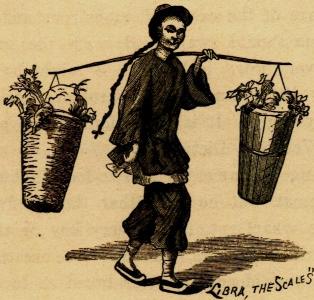
88 BETWEEN T$E GATES.
white Christians who toil with their hands, and leave Midases at one end of humanity and heathens and slaves at the other — a social state that is a libel on the age, a disgrace to man and a dishonor to God.
"HOODLUM," THE CHRISTIAN?
Should a skittish horse come suddenly upon the word "Hoodlum," and it looked and sounded to equine organs as it looks and sounds to mine, that horse would take fright and run away. You instinctively infer it names some creature of the cat kind, monstrous and anomalous, as if a puma should swap heads with the great horned owl. The very word looks as if it might have a verbal lair all by itself, and prowl through the unprotected language by night. It is never found in a place so reputable as Webster's Dictionary.
The thing it names is a two-footed, human, semi-tropical animal, but he is neither the rowdy, the Five-Pointer, the wharf rat, the Bowery boy or the bummer. They are his congeners, but he is a creature of finer grain, of hotter blood, of better breed as breeds go, and infinitely more of a power. He roams San Francisco like the ownerless dogs of Constantinople. He is never alone. He goes in packs. He is from twelve to twenty-two years of age, and seldom gets any older. He doesn't die, but, like the fawn, he loses his spots. I beg pardon of the fawn!
You see him, a slender, wiry, active fellow with some affectation of style, a jaunty way with his hat, a saucy jerk with his elbow, an alert and saucy eye; a free, letall-go stride like a panther's; a sharp-edged chin that can pull out upon occasion like a wash-stand drawer;
THE ANIMAL, MAN. 89
lean in the flank and lean all over. As Christopher North would say, he is " scranky." A fat Hoodlum would be as great a curiosity as a plethoric greyhound. He often wears good clothes, and may be the son of most respect-able parents. There is about one flight of stairs below him in the cellars of human degradation. He has a ready tongue, a ready knife, and a hand that turns to knuckles any minute. Always reckless and shameless, often desperate, tyrannical by nature, and apprenticed to the devil by his own consent, he makes night hideous and darkness dangerous. No roystering sailors ashore, no bullies on the rampage, can compare with a pack of Hoodlums.
He is a creature impossible in any country with a New England winter and the homes that are born of it. He is the product of two causes: an out-of-door climate where January and June are all one, and the loose, nomadic life of the Restaurants. Home has neither charm nor restraint for him. He eats where it chances, he sleeps where " the wee sma' hours ayont the 'twal" overtake him. The Chinaman is a heathen at one end of the human race, the Hoodlum is a heathen at the other, and extremes meet. In their knowledge of Jesus Christ they are a match. Should the Hoodlums increase like the wielders of joss-sticks, it would take a standing army to keep the peace. A home-made. heathen in a Christian land is an utter heathen.
But the Hoodlum may partially atone for his damaging existence, by furnishing the only check to excessive immigration that exists. John fears him, and rumors of his fame have gone back to the Flowery Kingdom. The representative of "cheap labor" is the object of his malignant abuse, in part, perhaps, because John will do man's work '
4*
90 BETWEEN THE GATES.
at boys' prices, and in part, because of the devil of which the Hoodlum is seized and possessed. He rings John by the cue as if he were a fire-bell. He jostles ,him from the sidewalk, robs him, and occasionally kills him, to keep his hand in. It is a. little as if the government kept a pack of dogs to worry John out of America.
Yesterday I saw a ten-year-old Hoodlum in a narrow street with a troop of urchins of low degree. He had a pistol and a chin, and just as I passed, he ground out through his set teeth, "I'm a bloody robber!" and fell upon one of the boys and stole his hat. The villainous look on that lad's face was twenty years old if it was a minute. Altogether, San Francisco has two sorts of heathen — the domestic and the imported. If she could only trade with China six Hoodlums for one John, she would be doing a living business, and ameliorating in a local way the condition of the human race. As it is, what with debarking from foreign ships and clambering out of home cradles, " the Greeks are at her doors," and on both sides of them at that!
I have before me a characteristic visiting card that illustrates the possibility of eyes changing color, though the Ethiopian must keep to the shady side and the leopard stick to the old spots. It runs thus:
BLACK EYES,
OR ANY DISCOLORATION OF THE FACE,
CAREFIILLY PAINTED OVER.
PARTIES TREATED AT THEIR RESIDENCES.
What a card for a Donnybrook Fair, and what a trump this frescoer of human top-lights would be, to be sure! I know few better places for such a card than the Hoodlum letter-box.
PICNICS.
The weather has a singular effect on the calendar. Thus a California week begins on Monday, and the rest of the days are Tuesday, Wednesday, Thursday, Friday, Saturday, and Picnic-day. Picnics are as sure as a Sharpe's rifle, and no rain ever wets the powder. A girl can go in satin shoes with impunity, and her "fellow" wear a sky-blue necktie that, if it could rain, would make the front of him look like a blue gum-tree in full leaf. He has as little need of an umbrella as a rainbow. Nearly all the picnics go by water, but never in it. They cross the Bay to all sorts of resorts and parks and gardens, but they never get wet—outside.
Californians are gregarious as pigeons and clannish as Highlanders. Everybody is sorted out, from tinkers to architects, and distributed into Societies, like so much type, apparently to be semper paratus for a picnic, as the "Minute Men" of Concord were for a fight; and, like printers' types, they sometimes get " set up" just to carry out the figure, and are carried out themselves. There are three hundred and eighty-five Societies in San Francisco, every one of which is bound to picnic at least once a year, and they bear all the names ever known on the Atlantic seaboard, and some besides. There are " Foresters," " Red Men," " Knights of the Red Branch," "Caucasians," " Janissaries of Light," "Oak Leaf," "Ivy," "Pioneers," " Kong Choiv," " Twilight," " Greek Russian Slavonian Society," the names of its officers all ending in vich, as Zenovich, Radovich; and those amiable animals, "The Benevolent Elks"—think of amiable elks! and then the Sons of nearly everybody — Liberty, Golden States, Golden Gate, Golden West, Faderland, Motherland, Revolutionary


92 BETWEEN THE GATES.
Sires; and closing up the column with Patrons and Sovereigns and Grangers and Ranchers that seem about as much in place in the city as a camel would, swimming the Hellespont. This passion for cutting people up into orders is carried almost within range of the atomic theory. If one man could be subdivided into several orders and institutions, by reducing him to vulgar• fractions, and giving him all sorts of names, such as the order of the Red Right Hand, The Good Liver Club, The True Hearts, The Knights of Shinbone Alley — could this be done without killing him outright, they would have put him in a condition to envy the unhappy man who used to stand with his feet apart like the Colossus of Rhodes on the first page of the old almanac, to be butted by Aries, gored by Taurus, roared at by Leo, shot at by Sagittarius, and abused by the whole twelve signs of the Zodiac.
One of my first experiences countryward was a church picnic, by steamer and rail, to a lovely place called Fair-fax, owned by descendants of the Fairfaxes of old Virginia, and neighbors within breakfast range of George Washington. The boat swarmed with men, women and children. The church. sang hymns, and the band played " The Devil among the Tailors." Arrived at the grounds, the crowd scattered away in groups, some to eat, some to swing, some to dance. The band struck up while sinners danced and saints looked on. The instruments of brass and the instruments of ten strings whirled away in the dizzy waltz, and " Hold the Fort" and " The Evergreen Mountains of Life" floated up from the hollow of the little valley's hand, and were swallowed by the big bas-soon. Sunday-school children ran round and round and
TILE ANIMAL, MAN. 93
in and out among the whirling sets like squirrels in a wheel. The church drank coffee and the world drank lager, the song went up and the band went on. Nobody quarreled or collided. If Jonah was in the crowd no-body threw him overboard, for the heavens and the earth were fair and calm as old Ben Adhem's dream of peace.
It was a curious spectacle. It was a sort of Happy Family. It was a little as if the leopard lay down with the lamb and didn't eat it, and the little child interviewed the lion without a scratch, and the fatling became a great calf. What sort of vignette for a Millennium Hymn the scene would make, would take an artist's eye to see, but at least it was worth the record, as showing how climate expands latitudes until every degree is a hundred miles long.
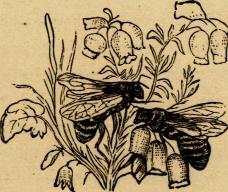
COAST, FORTY-NINERS AND CLIMATE.
THE geographies have been amended so that there is but one ocean, and the ocean has but one coast, and the coast is California—the widest, longest, liveliest, richest, grandest coast that ever had an edge in salt water—nine hundred miles one way by a thousand the other. It would seem to a modest Eastern eye that nine hundred thousand square miles of nothing but continental selvedge must lap inland territory pretty broadly, but it does not. The world is divided into Europe, Asia, Africa, South America, Madagascar, British America, the United States and California, and the last is like charity—it is the greatest.
" The Coast." That is what they call it, and to him who sees it to-day and remembers it twenty-nine years ago, the sublime assurance of the emphatic phrase seems pardonable, and resentment is succeeded by an amiable smile. A sort of defiant self-reliance characterizes your genuine Californian. He was educated to it in the toughest and rudest of schools. He found himself divorced from the world—and sometimes from his wife—by an ox-team trail of two thousand miles through deserts and over mountains on the one side, and a voyage on two oceans through a couple of zones and around Cape Horn on the other. He was about as naked-handed as Robin-
94
COAST, FORTY-NINERS AND CLIMATE. 95
son Crusoe before he caught his first goat. From the time he wanted it to the time he got it made everything a year old when it was born into California. What he did, this great city, this marvelous country shows forth on every hand. He fell to and made everything himself. You find San Francisco, in art, invention, production, science, about as self-sustaining as an independent planet. He began with tents. He ended with palaces. His wife wanted silk for a dress. He made it. His daughter de-sired a piano. He made it. His children play "jack-stones " with agates. He grows gold. He cultivates silver. He bottles mercury. He raises stock country-ward and stocks cityward. He has gone to manufacturing doctors, lawyers and preachers. He has raised Mil-tons that are " inglorious" because they are not "mute." He has not reared anybody to his prime yet. He hasn't had time. You can raise perfect women in twenty-five years, but men that are going to stand late -frosts and blights and early Autumns and Northers, do not get ripe at twenty-seven. They taste of the rind, the husk, the shell, or whatever kind of human fruit they are meant to make.
The Californian twenty-two carats fine is twenty-nine years old in this year of grace '78. No matter how old he was when he came here. If he came in '49, that's the year of his birth by California noon-marks and calendars. He forgets that he was ever born before, or born any-where else. He forgets what he left behind him, even to the girl, sometimes, and like the last fowl that left the Ark, he never returns. You meet him every day. He tells you he has not been East in twenty years, and he has no idea of going in twenty more. He knows as
96 BETWEEN THE GATES.
much of the trans-continental railroad as he does of the stage-route to Jericho.
There is an association of Forty-niners called The Pioneers. " The king can do no wrong," and they all be-long to the royal family, eldest sons, every man of them. They have kept pace with " The Coast," and it has been a round one, but they have not marched abreast with the Eastern world. They are ignorant what gigantic strides the Atlantic coast—let us be modest, and bridle it with an adjective and humble it with a little " c "—and the inter-ocean empires are making. They came when California was not a State, but a predicament; when it was a Spanish-Russian-Indian-Mexican wilderness, and about as hideous and inhospitable as an Hyrcanian tiger. They spoke of home as "the States," and it has descended as a tradition, and so you hear the suckling California neophytes of half-a-dozen years talk flippantly of " the States." The impudent infants should be sent, but not exactly with palm branches in their hands, supperless to bed.
But for your genuine old Forty-niner, covered with Spanish moss and mistletoe, there is some apology when he says " the States." It is a fragment of his ancient talk. And yet there is an evident relish in it to him, as if California were not in the Union at all, but an in-dependent existence. He scorns its greenbacks, its nickels and its copper goddesses of Liberty. He is impatient of criticism. He thinks you an infant, and therefore speech-less, because you are new to California. Should he find a toad in the center of a Coast boulder, he would doff his hat to him as to a Californian older than himself.
The hearty, enthusiastic, unreasoning love of California that inspires almost everybody in it is refreshing be-
COAST, FORTY-NINERS AND CLIMATE. 97
cause it is genuine. You cannot be around with it a great while without catching it yourself. It is a sort of condensed abridgment of old John Adams patriotism, bound like a book in the covers of California. They cheer " old glory" with the ardor of a perennial Fourth of July, but it looks grander and lovelier, flaring like a flame of fire in the gales from the Pacific, than drooping from its staff over the dome of the Federal Capitol. It quite startles you to hear a band strike up " Hail Columbia," as if they knew it, and not "Hail California," as if it played of its own accord. The wonder is, that there has not been a Coast Anthem before now, a sort of private " Marseillaise" of their own.
The climate of the Coast stimulates men and women like wine. It gives them courage that is not Dutch but weather, and confidence that is not conceit but intoxication. It quickens the pulse and the step and the brain. It sends them wild for pleasurable excitement. It strengthens the passions. It keeps everybody under whip and spur. It makes him impatient of patience. You live ten years in five, and it is scored against you. It is a debt with inevitable payment. A man who has not attained his mental growth can come here and shoot up for ten years like a rocket. But alas, when he comes down, it is sudden, abrupt, like " the stick." A man who has reached his law of limitation can migrate to California, and flash up brilliantly a little longer.
Watch bricklayers, brisk in their motions as busy ants. Those men at the East would move with the de-liberation of an old hall-clock pendulum with the weights just running down. It,is the climate. Seventy miles in twenty-four hours at the East, over a satin road in De-
5
cember, is a Jehuc of a drive. Here sixty miles before sunset hurts nobody. Your horse has been drinking California air. He will do his best, or die a-trying. But he will not last, any more than his master. He will want an extra feed. The driver will want an extra drink. He cannot be a chameleon. He cannot live for-ever on air. He looks in a tumbler for a stimulant. By-and-by he flickers, and it is "out, brief candle!" It is the climate. It sharpens appetite.
Boys and girls are born with percussion caps on. Touch them and they explode. They ripen early, in this sun and tonic air, into manhood and womanhood. You can see mothers of fourteen, and see no marvel. About forty thousand pupils are enrolled in the fifty-six public schools of San Francisco, and seven thousand in the hundred and twenty private schools and colleges. It is quite as difficult to govern the young human California animal as it is to catch up a globule of quicksilver from a marble table with a thumb and finger. Is it a boy? He shouts, runs, leaps, struggles, just as his pulse beats—because he cannot stop it. He has- opinions, though his beard is a peachy down. He is as positive as a trip-hammer. Is it a girl? She is as volatile as Cologne, her voice is joyous, her step a dancer's, her laugh contagious. She is as dashing as a yacht in a white-cap breeze.
I live neighbor to the Lincoln School, as fine a structure as you will find anywhere, and set in the midst of a semi-tropical garden. You should see the twelve hundred boys and girls "let out " at noon, and then let themselves out. Swallows coursing a mill-pond; ephemera dancing in sunbeams; bees swarming when the hive is full; happy as speckled trout in the spring brooks, Izaak
COAST, FORTY-NINERS AND CLIMATE. 99
Walton dead and the anglers gone away; not boisterous, but breezy; not rude, but effervescent. You would not be surprised if the mercury in their veins should distance the mercury in the thermometer and stand at 110°. Quick-eyed, quick-footed, quick-witted, they are forever on a " spree," they exult in a state of chronic climatic intoxication. They are languid as lizards, clumsy as humming-birds, and idle as beavers in high water. Laziness is tried out of you and blown out of you by cloud-less suns and trade-winds.
The weather is as varied in California as the mind of desultory man. Three hundred heroes at the Pass of Thermopylae withstood a hostile world. Excluding those that wear wool, there are as many weathers on the Pacific Slope. When the king of Dahomey and an- Arctic bear can breakfast together in the morning, and each reach his own climate before decent Puritan bed-time without leaving the State, the man who fails to be suited knows too little to be happy, and the bear should be eaten by the " forty children " who alluded to the Prophet's capillary destitution. All the zones come to California for rehearsal, and then they go home to delight Hottentots and Laplanders, eider ducks and cassowaries, and all the sons of Shem, Ham and Japheth.
Nowhere in America are the seasons so neighborly as in California. The impropriety of Winter sitting in the lap of Spring has made a public scandal, but when September is on whispering terms with May, and January borrows June's clothes, and July gives all her rainbows to November, it is high time to talk! The Winter is in the Summer and the Spring is in the Winter, and harvest is in seed-time, and Autumn is lost out of the calendar
100 BETWEEN THE GATES.
altogether; and the siroccos blow from the North and the cold winds from the South, and you must sail by the almanac or lose your reckoning and get lost in the weather.
The effect of this loose state of society among the Seasons is delightfully apparent. You never saw such ignorant roses in all your life. They bud and blossom the year round, and never stop to undress or take a wink of sleep. Ripening fruit and baby blossoms show on the same bush at once as they do in well-blest human families. Cherry trees go into the ruby business in April and keep it up until October. The hills are emerald in the Winter. Ireland would glory in them, and the shamrock grow as big as burdocks. The hills are tawny as African lions or Sahara sands in the Summer. The grasses look withered and dry as tinder, but they hold the concentrated richness of the year cooked down by fire. Turn out an emaciated old ox that resembles a hoop-skirt with a hide on, and though you would make affidavit that on such fare he will resemble a hoop-skirt with the hide off in six weeks, yet the old yoke-bearer will grow fat, smooth and round as a silk hat. The cattle of California are unexcelled for breed and beauty. Go where you will, the splendid " milky mothers of the herd " look handsome enough to sit to Landseer. Rosa Bonheur would be tempted to desert her kind and live with them. The butter of the Coast is as sweet as the dew of June.
The dry spiry grass you see is hay. You do not think that Balaain's beast would covet it. It was cured without cutting. There is no rain to wash out its strength, and it just stands there, desiccated grass, waiting for somebody to eat it. You do not have to tickle
COAST, FORTY-NINERS AND CLIMATE. 101
it with a fork and toss it about the lot, and comb it with a rake, as they do at the East. Wheat cut green and stacked is used in place of timothy. California is the paradise for laziness and grangers. There's a field of wheat ripe unto whiteness, ripe unto redness. No rain to rust it, no thieves to steal it, no touch to shell it; there it stands waiting for its master. It would stand all summer. It is faithful as Ulysses' dog. It is not lugged to the barn, and tugged out of wagons and " boosted " in again. In this field they are threshing. In that field they are bagging, and those plethoric sacks will lie there as safe from rain as a heap of boulders. That grain will never know its owner has a barn.
THE PACIFIC BREEZES.
For Eastern blood the continent has no Summer climate equal to that of San Francisco. No languid days, no enervating nights, no steam to breathe, no lightning flash to dodge. It is in the route of the trade-winds, that make a friendly call every day for half the year. They come through The Golden Gate like the king's trumpeters, in a hurry, but never hurry enough for a hurricane. More tonic weather passes that gate in the afternoon than all the lungs and windmills in America could dispose of. To the stranger it is at first a little strong. Cold catches him. He growls and barks. He thinks he has that musical instrument called catarrh, but wait awhile, and it will turn into something pleasant: the catarrh is a guitar, and the cheering, invigorating wind welcome as the " one blast upon his bugle-horn
that was worth " a thousand men." Often in the morning it looks like rain and you think umbrella. You fancy









102 BETWEEN THE GATES.
the dark and angry clouds are threatening, but they are no more clouds than a Scotch mist is a thunder shower. It is only fog from the Pacific that rolled in last night. It will all be neatly reefed by ten o'clock in the morning, like a ship's top-hamper, and out of sight. You see it coming in, leaving the tops of the hills and swinging about below in wreathy, gray gauze, like a woman's veil in the wind. It settles upon the city. You button your overcoat against it. You walk briskly and breast it. It does not taste like the fog of " The States." It comes from the salted sea, a sort of pickled relish, as if Lot's wife should become deliquescent; not close and smothering, but crisp and bracing. And this fog is the summer rain of the Pacific. The spotted flowers revel in it like speckled trout in brook water. It washes the air out as a dexterous hand wipes a crystal globe. This is all true of San Francisco, but right in the midst of the afternoon zephyr, you can go to Oakland in thirty minutes, where there is not wind enough to flutter a flounce. The suburbs are fairly dappled with weather. Take your choice and be happy.
The tourist to California is anxious about what he shall wear, and the writer being here to tell him, is bound to be explicit. Leave all your Winter clothes at home and bring your Summer clothes. To be emphatic, let me say it again: Leave all your Summer clothes at home and bring your Winter clothes. If a month's travel in the State could not make this vexatious pair of contradictions as harmonious as the Four Gospels, then leave all your clothes at home and stay to keep them company. You see furs, feathers Ind gauzes, shirt-sleeves and overcoats all Summer long, but nobody in San Fran-
COAST, FORTY-NINERS AND CLIMATE. 103
cisco ever has a chilblain or a sunstroke. The mercury ranges from 60° to 75° during the average year, and it never drops down cellar or flies out of the chimney. Once acclimated, people change little but their linen and their opinions during the twelve months.
WEATHER ON MAN.
Having always had man on the weather, why not reverse the authorship and have weather on the man? It has become an axiom that " circumstances make the
man." Have you not
been puzzled, some-times, to think how one of these sayings got a seat among the axioms and nobody objected? And then you felt a little as Haman did when he saw Mordecai, the Jew, sitting in the
king's gate. If climate o'~ESFO
is a circumstance, then
the axiom is an axiom. A poet of the rude Northern frozen nations is called a scald, because, perhaps, that is the pleasantest thing a man can think of who has to fight frost for a lifetime; but did you ever hear of a great Laplander or an intellectual Hottentot? Neither refrigerators nor furnaces are precisely the places to develop standard men. Now California weather will make a man belligerent and aggressive. It will put new springs in his temper, and make it as quick as a steel trap. It will take your Eastern neighbor, who used to go about
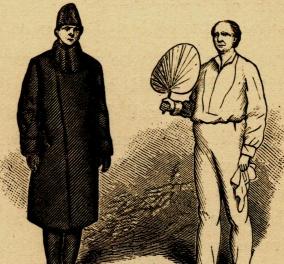


104 BETWEEN THE GATES.
with his long gray coat, like old Grimes's, " all buttoned down before," and compel him to unbutton that garment, and exchange a heavy waistcoat for a white vest, and set him sailing down the street like a sloop with a brand-new foresail. He was a trifle too affectionate to the American eagle, especially when that bird was perched upon a coin, but the weather makes him generous, opens his heart and band as it opened his overcoat. And there is the other roan who went about from June to September, his shirted back marked with the visible X of his suspenders like a cask of low-grade ale, and looking for cool places, and what with being dizzy in the sun and lazy in the shade, was quite unable to master anything but fans and ice-water. He would be delighted to look for truth in the bottom of a well if he could only stay there. He is energetic as two hundred pounds of putty. Now this other man comes to California, and the next you know of him he is up and clothed and in his right mind, marching in the blaze of noon as happy as a sunflower, and never dreaming that oranges grow golden in the very weather he exults in, and he mentally adapting the beatitude of Sancho Panza upon the man who invented sleep: blessed be he who invented a San Francisco Summer! But even the perfect weather does not make a heaven.
San Francisco is "of the earth, earthy." It has two atoms of things that are both in a lively state of unrest in Summer time. They are fleas and dust, and both products of the blessed weather; but the first are only innocent dots of acrobats, the mustard-seed of full-grown circuses, and the last will leave no darker trace upon a lady's garments than a pinch of salt. The first day of your arrival, when you are filling and tacking and
COAST, FORTY-NINERS AND CLIMATE. 105
beating up the breeze, and bowing to it as if it were a friend, and blinking at the dust that waltzes at you round the corners, and bears down upon you at an anapestic gait, as Byron's Assyrian came, and you winking at it all as if you had just made a joke and were pleased with it, you vow you will go home to-morrow. And when you are hunting from chin to gaiters for the prince of leapers, and assuring yourself that "the wicked flee when no man pursueth " is not the kind of insect that has just doubled the cape of your left shoulder, and taking yourself to pieces at all hours and never catching anything but a cold, you declare you will go home to-night. But the weeks go on, and the winds blow on, and the fleas leap on, and you stay on, at first resigned, at last delighted.

CHAPTER IX. GOING TO CHINA.
YOU can reach China and not "go down to the sea in ships." I went one night and returned before the cock crowed midnight. Missionaries used to sail away to Pagan lands, and drop slowly down into the underworld behind the great waves that lapped the horizon. Now, they can visit the " Central Flowery Kingdom" without wetting their feet. We boys used to fancy that somewhere or other there was a hole through the globe direct to China, if only we could find it—a sort of flue for the fragrant cloud supposed to rise from the world's tremendous teapot. I remember looking for it in boyhood, and flushing with a discovery supposing myself a small Christopher Columbus. It was not a Chinaman at the bottom of that burrow, but a woodchuck.
That hole has been found. The city of the Golden Gate happened to be built just around its mouth, and John has swarmed up out of it like swallows from a sooty chimney. Through the courtesy of the chief of police a party of friends, of whom I was one, was furnished with passports to Hong Kong or Peking or Nanking, and with a special officer of intelligence, we sailed. Fancy yourself walking along the gay streets of San Francisco in the edge of the evening—streets bright with light, pleasant with familiar forms, musical with English speech,
106
GOING TO CHINA.. 107
and feeling all the while, that under the patriotic flight of July flags as thick as pigeons and as gay as redbirds, you were still at home though thousands of miles away — fancy this, and then at the turn of a corner and the breadth of a street, think of dropping with the abruptness of a shifting dream into China, beneath the standard of Hoang-ti who sits upon the dragon throne — that triangle of a flag with its blue monster rampant in a yellow sea. And it is China, unmitigated, debased, idolatrous; unmoved as a rock in the ocean, with the surges of Christian civilization washing the walls of its dwellings.
A strange chatter as of foreign birds in an aviary con-fuses the air. A surf of blue and black shirts and inky heads with tails to them is rolling along the sidewalks. Colored lanterns begin to twinkle. Black-lettered red signs all length and no breadth, the gnarled and crooked characters heaped one above another like a pile of ebony chair-frames, catch the eye. You halt at a building tinseled into cheap magnificence, and hung with gaudy paper glims. The old, far away smell of the lead-lined tea-chest comes back to you—the pale green chest, of whose leaden cuticle you made "sinkers" when you fished with a pin, that used to be tumbled round the world to reach you, with Old Hyson, Young Hyson old Hyson's son, Hysonskin and Bohea.
The creak of a Chinese fiddle shaped a little like a barometer all bulb and little body, scrapes through a crack in a door, as if it was rasped in getting out. Lights stream up from cellar stairs. Odors that are not light steam up with them.
A CHINESE RESTAURANT.
You enter the Restaurant. It is the " Banquet Saloon " of Yune Fong. And there is Yune Fong himself, a benign, double-chinned old boy who is of a bigness from end to end. He sits by a counter, at which small bits of human China are busy setting words on their heads. Under his hand is a well-thumbed arithmeticon, a family of boys' marbles strung like beads upon parallel wires and set in a frame, wherewith Fong cyphers out your indebtedness and his profits. This floor is a helter-skelter of store-house, kitchen and reception room. China jars and things in matting and things in tinsel and things in packs, and seats as hard as the fellow's perch who was " sitting on the stile, Mary." It is the eating place for the sort of people we are said to have always with us, to wit, the poor. Things have a smoky, oleaginous, flitch-of-bacon look. The lights are feeble, as if there were nothing worth their while to shine on. You climb stairs into an improved edition of the ground floor. The furniture is faintly tidier and better, the table-ware costlier. This is the resort of the happier John whose "short bit" is a quarter. One more lift and you are in large and elegant apartments with partitions of glass, a sort of oriental Delmonico's, gilded and colored and flowered and latticed like a costly work-box or a fancy valentine. The furniture is of Chinese wood dark as mahogany at a hundred years old. The chairs are square and ponderous as those at Mount Vernon, their seats inlaid with marble and covered with mat-like cushions; the tables, rich marble mosaics. Lacquered boxes and curious cabinets abound. Musical instruments, of patterns as quaint as any that Miriam ever sang to, hang upon the walls. There is one

GOING TO CHINA. 109
of them. You can get an idea of it by fancying a paddle of a pudding-stick turning into a fiddle. The Chinese like to have their ears abused while they regale their palates. A carpeted platform at one end of a banqueting room is a couch, and garnished with two cubic pillows of some sea-grass material, about as hard as Jacob's pillow in the Wilderness, and ingeniously uncomfortable. But you can see a ruder sort down-stairs: hard blocks scooped out to fit— a kind of wooden dish for a block-head, and nearer like Jack Ketch's execution block than anything else an unhappy man ever lay down upon and fell. asleep.
" WE'LL ALL TAKE TEA."
You call for tea, and a couple of waiters border a circular table with a Zodiac of tiny blue-flowered cups each with a cover, and a China spoon as broad as a boy's
tongue. Pale cakes with a waxen look, full of meats, are brought out. They are sausages in disguise. Then more cakes full of seeds as a fig. Then giblets of you-neverknow-what, maybe gizzards, possibly livers, perhaps toes, but not a rat. You must be as crazy as Hamlet to fancy you even hear one in the wainscot. Then preserved ginger and Chinese chestnuts and prepared rice. Last and greatest, TEA. The drawings are in the cups, and Aquarius, the water-bearer, floods them with hot water, replaces the covers, and then a fragrant breath as from a rare bouquet fills the air. This is tea, genuine, delicate, strong as old wine of the cob-webbed vintage of '36. This is what our grandmothers who chinked up their hearts on
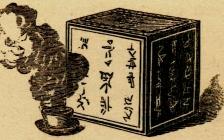
" washing-days" with Cowper's "cup that cheers," sighed for, and like the ancient leader, died without the sight. It sets tongues running. The weak are mighty, and the weary comforted. The precious leaf is worth five dollars a pound. This third-floor restaurant is for magnates; it is a region rarefied to " four bits." What you leave of the tea descends to the next floor, takes another dash of hot water and is served up again for "two bits." The unhappy grounds drop another flight of stairs, the last pennyweight of strength is drowned out, and "a short bit" will buy the syncope of a dilution. Everything goes down this curious thermometer in the same way, and, among them, they come within one of eating what has been eaten before.
THE JOSS-HOUSE AND THE GODS.
You descend to the fresh air. Fong smiles you graciously out; you cross a street and enter a narrow and noisome alley. It is Stout's alley, and the scene of most of the murders in the Chinese Quarters, and the causes are women and gambling. The alley grows dimmer, and full of Chinamen as an ant-hill is of ants. Doors to little bazars, to nooks of sleeping places, to alcoves of shops, stand wide. You count ten in a den where Damon and Pythias could hardly have dwelt a week, unless they were both bed-ridden, without quarreling about cruelty to each other's toes. Here, they are fluting clothes. There, a Chinese tailor is chalking a pair of trousers on a table as if he were drawing a map. John does everything backward. He is the dorsal fin of man-kind. He is a human obliquity. He might have attended a school for crabs. In fact, he is one of " Crabb's Syn-
GOING TO CHINA. 111
onyms." Yonder, a fellow is cooking in a dog-kennel of a place. Unmusical sounds from unmusical instruments abound.
Just here you fraternize with the policeman and pluck his gray coat by the sleeve. You see he wears no star. You ask him if he doesn't have that silver bit of astronomy? He laughs. " Oh, yes; here it is in my pocket; but all the Chinamen know me." And you see they do. They crowd up toward the party, but getting a glimpse of him, they execute a concentric as the water in a mill-pond does when a pebble strikes it. They give us an horizon of shirts with legs to them. The white soles of their shoes show in the uncertain light. It is the only soul about them of just that color. We are lost in a zig-zag of dingy stairs. We are surrounded by dark walls. We look down into courts that are black. Twinkles show faint like fire-flies in a cloudy night. The murky air reeks like Gehenna. Like the city of Cologne, there are seventy smells, and not one is cologne. Within the space of a few squares are twenty thousand Chinese. The place is a live honeycomb, barring the honey. They are packed like sardines in a box. Our guiding star whips out a candle he has bought, strikes a match on the toe of a heathen god and lights it. We are reduced to the glimmer of other days. In a city filled with light and beauty and Christian churches, we are groping around in the dens and cul-de-sacs of a foreign and idolatrous land by the flare of a tallow candle. It is gloomy as grim Charon's ferry-house.
Up a few steps, down a few steps, round a corner, up a whole flight, along a gallery as dumb as a tomb, we reach the door of the Joss-House, one of eleven heathen
112 BETWEEN THE GATES.
temples in San Francisco. It is never closed, and we enter. Floating lights in glass tumblers but dimly reveal the place. " Dim," but not " religious." Gothic flower-supports of white metal, resembling square candlesticks for giants, stand in rows. The inevitable flare of brilliant red and gold and silver tinsel, and gew-gaws, and huge paper bouquets, and black writing on the walls, and sparkling rosettes all about, as if everything had been washed out in rainbows and the tints proved fast colors. In the great shrines are rows of sinister gods with trailing black beard and moustache. One of them, a truculent fellow, in an embroidered night-gown, who might have been modeled from some Chinese-Tartary brigand, is the god of War. Here is a life-size figure holding a small grape-shot between a thumb and finger. He is the deity of Medicine, the Chinese Esculapius, with a most bilious and unhealthy look himself, and that missile is a pill. If it ever found a lodgment in the stomach of any-body blessed with only ordinary powers of deglutition, it must be from the mouth of a howitzer. There is the god of Fortune, with a nugget of gold in one hand, and John sacrifices to him with great fidelity. You pass into another apartment where are two lay figures of young women in gorgeous apparel, canary-colored and gold. They are the goddesses of Love and Beauty—but which is which? One of them is watching the bridge of her own nose with both eyes, as if they kept toll-houses at both ends of the bridge, and were looking out, or rather looking in, lest somebody should " run the gates." And the other looks as if she had been dragged up from the Chinese heaven by her hair, and she had no time to fix it; but there she sits with her lifted eyebrows as if her
GOING TO CHINA. 113
head-dress were sleek as patience and pomatum could make it.
And now we come to three idols—they are the elements. That party with the florid face, like a harvest moon, is supposed to be Fire. Seated next him is the dropsical divinity of Water, and the unethereal neighbor at his right is the deity of Air. As for Earth, there is quite enough of her in the form of dust. Possibly they made a grist of the goddess and sprinkled her over the whole. In a corner low down, is a cross between a small scare-crow and a Dandy Jack." It is the great Ground Devil, and looks as if he might be his own rag baby. He can raise the mischief, which is the devil, with sick people, if he does not receive proper attention. Before him is a little altar, whereon food designed for invalids must be placed, and whence he adroitly extracts all deleterious qualities. Thus colic is eliminated from withered cabbage, dyspepsia from toasted cheese, and shark's fins are made to agree charmingly with the eater. Near the entrance is a sort of mongrel Vishnu, seated cross-legged like a journeyman tailor.
In a large shrine sits the god of Beasts, a sort of Nimrod, and beside him a brindled cur of unamiable mien, who accompanies his master when he goes out upon mythological business. But, as orie of the party remarked, " a little of this will go a great way."
Not a window visible in this China Closet of gods supernal, infernal and mixed. Doors are open on one side and another, where by the feeble lights you see John watching you, or walking near you as stealthily as a shad-ow. One scene, framed . in a doorway, might have been painted by Rembrandt: already: a Chinese Doctor in his
5*
114 BETWEEN THE GATES.
robe bending over a book, and resembling a piece of dumb bronze in meditation.
And this is what men are left to do! These garish figures are actually worshiped here and now within an hour, by human beings in their blind gropings for superior powers. You cannot believe it. Here are the little altars of sand wherein the small gummy cylinders of fragrant woods, called joss-sticks, are set up and burned before the gods. Here are some now but half consumed. Their worship is of the economical order. They give the divinities what they themselves can neither use nor give away. Their board does not cost them a copper cash with a hole in it.
"TWELVE PACKS IN HIS SLEEVE."
John has a cunning hand with a good memory. Cards are his affinity. He does not laugh in his bell-mouthed flowing sleeves, but he shuffles cards into them with the adroitness of a wizard. You see the smoky dens as you pass. The gamblers sit around the table which is classic but fallen, covered, as it is, with grease, " but living grease no more." His features come to a focus like a fox's as he watches the play of the cards. His mouth puckers with expectancy. He is furtive but fierce. His eye never brightens. It snaps its delight when the four bits are his by the turn of the game. He will wager everything he possesses, wife, children, friends, anything but his cue, when the "cash" gives out. He is not fair. He is not square. He doesn't read Latin, and so he misunderstands the difference between meum and tuum. He thinks meum is his and tuum his own, when he can get it. His " pickers and stealers" are deft and adroit, and you are daft
GOING TO CHINA.
if you trust him much beyond the range of an ordinary telescope. He will wear a close cap under a hat, and when, having committed a theft, he is pursued, he pockets his hat and, behold, he is another manner of man. He is John with the skull-cap. His tricks are as old as the dynasty of Hoang-ti, and he plays them well.
AN OPIUM DEN.
Blundering our way out we pass a hanging gallery, and, as the song of Captain Kidd has it, "down, down,
derry down" stairs that are crooked and dark, into a court black as Erebus, by the one light, but " how far a
little candle throws its
beams," and the place looks better in the dark
than in the blaze of chandeliers. The odors fi creep up from the dingy floors as we walk.
The royal Dane, had he been of the party, would have repeated a phrase of his talk in the graveyard, " and smells so! Pahl" Our trusty guide went right along with an assured stride. Black figures were stealing about in the gloom. Nobody would wish to be an owl anywhere else. It gets inkier and murkier, but the policeman pushes open a door and lets out a little light.
-'e enter a small box about eight by ten, not much larger than some window-panes. As for window, this room has not so much as a snuff-box has. Compared with
it the tomb of the Capulets is light and airy as a belfry. A table in the center holds a lamp. The sides of the
room are fitted up with stationary bunks. The proprietor










sits curled up in a lower one, smoking tobacco, for even this cul-de-sac of creation has an owner. You are in an opium den. A guest lies at length upon his shelf, cunningly taking up on a wire, drop after drop of crude opium, black as old-time molasses, and by the flame of a little lamp beside him he heats it and rolls it round the point of the wire, until at last it is a little bead the size of a marrowfat pea. The bowl of the rosewood pipe has a cover perforated in the center, with a hole somewhat smaller, if anything, than the room you are in. He thrusts the bead into the aperture, lights it, and then putting a stem like the little end of a fife to his lips, he pulls for a breath of the drowsy god. The drug hisses like a fragment of frying meat, but he draws steadily till the narcotic smoke begins to roll from his mouth and nose in clear blue volumes.
THE OPIUM-SMOKER'S DREAM.
His head reposes upon the block. He begins to be at peace. You ask him, " How many smoke?" " Ten mo'," he says. The night's luxury will cost him " six bits," which includes bed, board and bliss. He has visions, but he never tells them. He sees a pagoda of gold that is his, and the gods that are in it are his, and they rustle in cloth of gold, and jewels glitter like restless eyes upon their breasts. For the little insignificant box, he has great jars of opium in his cabinet, and the mouth-piece of his pipe is of amber, and the bowl has the name, which is his, of See Ling, in mother-of-pearl, and he rides in a palanquin with curtains of silk and fringes of gold, which is his, with six coolies to bear him and two maidens to fan him. He dwells by the Kin-sha-kiang,
GOING TO CHINA. 117
which is the river of the golden sand, and his wife has the feet of a mouse. The fragrance of bird's-nest soup is in his nostrils and the voice of the fowls of the nankeen legs makes music in his ears. His tea is brewed from the chests of the king. And then the visions are all folded in silk that is crimson, and the music of cymbals is faint, and he lies upon a cloud that is silver and down, and floats gently away, and with a murmur of " blessed be poppies!" the last whiff of forgetfulness gone out, he lapses into a sleep that is dreamless, and strange as the rhythm of Coleridge,
" In Xauadu did Nubia Khan
A spacious pleasure-dome decree, Where Alph the sacred river ran From caverns fathomless to man
Down to a sunless sea."
The den grows heavy with the ghost of opium. Your head seems inflating like a balloon, as if it were about to make an unauthorized ascension and leave you to look after yourself. The forms of your friends, albeit some of them are " reverend seigniors," begin to sail off in a solemn waltz. You are a second-hand opium smoker, and so, none too soon, the creaky door is pulled open, and we go out into a darkness that is cheerful compared with the drowsy haziness within, and breathe undiluted what De Quincey calls " the mephitic regions of carbonic acid gas."
You push open the door of a second den where every head has come to the block of oblivion, give a look and move on.
There are dens and dens. Once more in a choked alley that seems a Broadway to the dungeon behind, you see a fresh young face, wily as some of those in Rem-
brandt Peale's "Court of Death," framed in a little wicket window, which is also a wicked window. She is one of more than a thousand women, few of whom bear the least resemblance to what Ceesar's wife should be; degraded, shameless and, strange to say, content. Woman must have something to cling to. She is naturally religious. She believes in an ideal world. From before Ruth's time she has craved something to trust. Recall the monsters of the Joss-House, and tell me if a woman kneeling at the shrine of such pitiful idols, with not a touch nor a trace of the classic grace of Venus, or the severe purity of Diana, or the manhood of Apollo, can be anything herself but a wanton and a wile? And the girl you saw is as much a slave as ever gathered the snow of a cotton field. There are dens with a " lower deep" than the gloomy chambers of Papaver.
"THE ROYAL CHINA THEATRE."
With a sense of relief we slip out of the alleys that, with their narrowness and darkness and abomination, seem to catch us by the throat, but we have by no means got back to America. We are in China still. Entering a well-lighted hall, garnished on one side with all sorts of celestial tit-bits and relishes, we pay our four bits and enter what great gorgeous letters over the proscenium give a kind of typographical shout at us and name " The Royal China Theatre," and the royal is less apparent than the China.
It has a gallery, but we go into the pit or the dress-circle, or what, with the black heads and the black blouses and the black hats, looks most like a parquet filled with mourners at a funeral. Not a trace of color in that
GOING TO CHINA. 119
audience, not a streak of white. It is a case of total absorption. Nothing lacking but weeds and weepers.
The play is in full caper. I use the frisky word after considerable meditation. It is the right one. The play is a compound of tragedy, comedy, farce, caravan and circus, and the last was the best. I think celestial Thespians' strongest theatrical hold is their feet and legs. And the name of the play was a compound of pork and carbonate of lime, for it was " Horn-Mun-Sow." I know what it was about, but I never mean to tell. They began it at seven o'clock, and they played right through to one in the morning, which is nothing for them. A drama has been produced at that theatre consuming three weeks in the performance, seculars and Sundays, in sessions of five hours each; a solid week of histrionic distress.
The price of admission to the theatre is graduated by the time you endure it. First of the feast, four bits; ten o'clock, three bits; midnight, two bits; and when it gets down to the very toes of tragedy or the heel-taps of comedy, it is a dime.
Apparently it was a troupe where the women were all men and the men were all women, though you doubted at last whether either were either. Of course there was no curtain to fall upon anything, and the actors entered from apartments at the sides. Of course the orchestra was not in front and below the stage, but upon it and beyond the grand stride-ground of sock and buskin. What would you have?
"THE PLAY'S THE THING."
If you can fancy a flock of gorgeous cockatoos in a state of anarchy, and nobody to read " the riot act, " all

120 BETWEEN THE. GATES.
chattering in falsetto—not an honest, manly bass tone the whole night; if you can suppose the chief of a band of robbers, with the tail of a bird-of-paradise waving from the back of his head, and a pair of white wings at his shoulder-blades, and a fan in his hand, and whisking about in an embossed and brocaded petticoat, with a cackle of a voice, as when a hen lays an egg or sees a hawk or tries to crow, and a face painted to counterfeit a death's-head moth, and finished out with the beard of a billy-goat; if you can picture a bench of high officials in the full " pomp and circumstance of" a state council, all at once setting off in pirouettes and pigeon-wings, and whirling like teetotums, and swinging round like boomerangs, and frisking away in fandangoes, attacked with Saint Vitus's dance, spouting a tragic passage and executing a double shuffle in the same minute; hopping off in a toupee, which means doing your walking on one leg, and then, with the knee of the other a little bent and the foot lifted, advancing upon nothing with a continuous and imaginary kick; swinging two swords like the remaining arms of a dilapidated windmill; then abasing themselves with their brows upon the floor of the sanded stage like worshiping Orientals; then snapping erect like so many spring-bladed Bowie-knives, and all appareled in variegated macaw,— then you will have a genuine spectacular Chinese astonishment.
After that, a battle, when, with the most wonderful crowing and cackling that Reynard's advent ever roused in a populous barn-yard, they flew at each other like enraged and rampant butterflies, with a blending and confusion of tints as if the seven primary colors had been struck with a chromatic Babel, and would never in all this world be sorted out into rainbows again.
GOING TO CHINA. 121
Had you fallen down and worshiped the whole thing it would have been no sin, for it was the semblance of nothing "in the heavens above or the earth beneath or the waters under' the earth."
After that the entire talent broke to pieces and exploded like fireworks into wheels and rockets and flying leaps. They turned into acrobats, and the circus began. And it was truly wonderful. Fancy a man throwing himself from the height of a dozen feet awl falling flat upon his back and as straight as a rail upon the uncarpeted floor. The dull thug as he fell was unmistakable. And then he was not padded, unless with a mustard plaster, for he was about as thin as a Johnny-cake. Or fancy three or four of them in the air at once, turning over and over as if in pursuit of their toes. How they could be wheels and not turn on an axle and not be driven by wind or water or something, nobody can tell.
THE ORCHESTRA.
But that orchestra! Hogarth's enraged musician never heard its match. There were ticks and clucks and jingles and squeaks, and tinkles of bells, and a frog-and-locust interlude, and emaciated fiddles; but when the battle began they all struck out like Sandwich Islanders in the surf, into a roar of gongs and a clash of cymbals shining and ringing like the shield of Achilles. Sometimes the tune seemed to be " The Arkansas Traveler" or "Old Rosin the Bow," and then those instruments leaped over the musical bars and ran away. The music and the acting were alike—a marvelous jumble. It was as if a medley had swallowed itself.
I am inclined to think that this fashion of mingling 6
122 BETWEEN THE GATES.
heterogeneous elements, a kind of miniature " chaos come again," is contagious. Thus, the last Independence Day was observed with splendid pageantry and fine literary exercises at the "California Theatre." They had " The Star-Spangled Banner," and Drake's bugle-voiced address to the Flag, but between the "Long may it wave o'er the land of the free and the home of the brave" and the solemn, almost sublime, words of the Declaration, beginning "When in the course of human events," something was sandwiched; and what do you think it was? Not " Yankee Doodle," or "Hail Columbia," or " The Red, White and Blue," but the little Julietish song of " Good-by, Sweetheart"! Could they do anything better in China?
While I have only made a faithful record of the dramatic scenes and sounds, with not one touch of exaggeration, a fact to which one Doctor of Divinity, two traveling missionaries and one neophyte can bear witness, yet it must be frankly admitted that, on reading it over, I hardly believe it myself; but it is severely true for all that.
Out at last and for good and all, we cross from China into America, under a starry sky, and breathing an air fresh and free from beyond the Golden Gate. It was like emerging from a total eclipse into broad and blessed day, and I recalled .the words of Tennyson with all the vividness of poetic creation. It was as if I had written the lines myself:
" Through the shadow of the globe we sweep into the younger day,
Better fifty years of Europe than a cycle of Cathay.,"
Harems in Utah and idols in San Francisco—idols set up like ten-pins, and no man bowls them down. Who says this is not emphatically the land of latitudes? There
GOING TO CHINA. 123
have been ages when the Crusaders would have effaced them from the continent, like a writing from a slate, with a wet finger, albeit the finger was wet with fresh blood. We sailed to Pagans, and now Pagans sail to us. They have dropped into Christendom like a great black diamond. They are anthracite.
We have regarded John as a sort of overgrown boy, a kind of cushiony creature. You can thrust your finger anywhere into his character. You withdraw it, and it retains no print of it, any more than the water into which you plunge your hand. Within that apparently yielding characterlessness is a spine of heathen iron, and tough as the worst of it. A bridge made of such material would last the world out. And as for that rigid, jointless spine, who can wonder that it exists? Here, now, is a man who represents and believes a religion that runs back to pre-historic ages; to whom the name of the Chinese Moses is as familiar to-day as the name of Jesus Christ in Bible lands; whose eye brightens at the syllables Kung-fu-tse, as at a welcome household word. It names Confucius to Chinese ears, a man who died twenty-three hundred and fifty years ago, whose descendants, in undoubted line, live to-day, the eightieth generation from the great philosopher who died before Socrates began to teach, and his works remain " even until this day." Is it any marvel that a religion indurated through the ages, unyielding and change-less as if absolute truth, wrought into the life, thought, custom and tradition of this man John, should .harden into a firm and almost sullen disbelief in all the world besides? That there should be hardly a vanishing point of contact between him and the out-world races, to make him a full and free-born member of the human family?

CHAPTER X. MISSION DOLORES AND THE SAINTS.
0-DAY there are one hundred and ten churches, T chapels and missions in San Francisco, giving one place of worship to every three thousand people, exclusive of "the strangers within the gates," and services are conducted in French, Spanish, Russian, Scandinavian, Italian, German, Hebrew, Welsh, English and Chinese. You should hear the Chinamen in full tongue in a Sunday school. After that you can tell where the idea of a gong came from. It is as original as a tremendous echo; and sounds as if the names of all the rivers had got away and ran in together—Yang-tse-kiang-Hoang-ho-kiang-ku-Kin-sha-kiang-Ya-long-kiang-Ding-Do ng !
It was one of those perfect San Francisco days with which the year is almost filled, when the sun and the ocean conspire to sweeten and temper the air with beams and breezes, when the hills grow friendly and draw near, and so we went to the Mission Dolores, founded by the Spanish Friars on the 9th of October, 1776, when much of . the land on which the city stands had not yet come out of the sea, and the shore was a wide waste of dunes.
Here, one hundred years ago, civilization's farthest outpost, half church and half fortress, was established, and its patron Saint Francis was to give the Yerba Buena of the old maps the new name of San Francisco. Built
124
about by spacious structures of modern date, faced by the Convent of Notre Dame, the old church remains like a rusted hatchet struck into some sapling in the elder day, and grown around by the living column of a stately tree. Here two ages meet. You see the recent redwood dwelling, and the old adobe house of brick baked without fire standing by its side, whose walls resemble the swallows'-nests that dotted the rafter-peaks of ancient barns as with cottages of mud. You see roofs fluted with red tiles resembling organ-pipes that have tarnished and rusted in a thousand rains and suns.
And there is the old chapel, with its columned front fair to see as a white nun, and there, in three square port-holes, hangs a chime of three bells brought from Castile many a year ago, rung, perhaps, within hearing of the sunlit towers of my Chateaux en Espagne—ah, those castles in Spain!—and now green with rust. Those bells rang out the old century, rang in the new. You enter the low-arched doorway into the chapel, a hundred feet from altar-place to threshold; and where are the hands that set the keystone, and where the priests that blessed the place, and where the hidalgos that stood around? The hands held flowers that drank them up.
"The good swords rust;
Their souls are with the saints, we trust."
But here are the walls of stone and unburned clay, four feet thick, and here the mullioned windows, woven with fan-light sash like spider's web; and here the Spanish linen canvas with its pictures of The Last Supper and the saints; and here two grand shrines of painted wood from Spain, with figures of Saint Francis, Saint Joseph and all; there the Madonna and the Christ that came over the


126 BETWEEN THE GATES.
sea. And beyond is a heavy arch bearing the legend: " How terrible is this place. This is no other than the house of God and the gate of heaven." You sit in a wooden chair as hard as stone and older than our Fourth of July. Above you is the gallery floor tessellated with a paint-brush — a puncheon floor hewn out with broad-axes.
Here, for a hundred years have matin prayer and vesper song and grand high mass been rung and chanted, said and sung. Here, priests from Spain, from Rome, from France, have lifted hand and blessed the people, while Indians and Mexicans and old Peruvians stood around. Here brave nuns have breathed their Ave Marias in the wilderness. Vanished all, like light from dials when the sun goes down. Think of the long-dead day when a Spanish guard was stationed here to protect the Mission. And the desert is a city and the city a mart, and Spain has ceased to be the Motherland, and Mexico her Daughter-in-law, and no blue-blooded Castilians come to their outlying dependency any more. The face of the world is changed as if fire had swept and God created it anew.
THE OLD GRAVEYARD.
The graveyard of a hundred-and-one years adjoins the church. You pass under the cross that surmounts the gate, and are in the city of " the houses that shall last till doomsday." The earth is rich with the uncounted dead. You tread upon them in the alleyways. There are hundreds and then hundreds. Nameless Indians with their heads to the rising sun lie here by bands and tribes. The old sexton unearths them sometimes wrapped in the hides of wild cattle for shrouds. Soldiers of the blue and the scarlet, English, American, Russian, Spanish, Mexican,
MISSION DOLORES AND THE SAINTS. 127
have bidden " farewell to the big wars," and gone into camp together. Descendants of Spanish willows vainly weep over alley and grave. Irish yew and English haw-thorn are ever " wearing of the green." Trees in ever-lasting bud and bloom give Christmas roses, and bouquets for June. The ivy's glossy leaves caress the graves. How rich and rank they grow! Let us hope the dead have gained the crown, for behold, the crosses they have left behind. And still they come ! There goes the sexton with his spade. The place is full of angels, altars, lambs, tombs, urns and shrines, in wood washed blank of letter and device, in marble and in granite. You stand by the grave of the first Spanish Governor of California, and you read: "Aqui yacen rectos De Capitan DoN Louts ANTONIO ARGULLA, Prima Gohernador del Alta California." He lies in the sacristy of the old church, the granite chamber where they kept chalices and censers for frankincense and wine; a right stout lodging, and time-proof as the globe. Reading monument after monument, you feel as if in a foreign land. The names are no "household words" of ours. Here is a slab bearing the name, "James Sullivan," the "Yankee " Sullivan of whom the world has heard, and the words, " who died by the hands of the V. C. 1856." That V. C. is graven upon other marbles here, and means Vigilance Committee, and revives the memory of wild and lawless times. Following the name are these significant words: "In Thy mercy Thou shalt destroy mine enemies!"
At last, beside the old adobe wall, the sexton shows an unsuspected grave, no slab nor mound nor coverlet of grass. Beside it is another, with turf subsided like a tired wave. It is surrounded by a bleached and sagging fence of pickets. Over these two graves a small historic
128 BETWEEN THE GATES.
war has been waged. Within six months after the Signing of the Declaration they had two funerals; an Indian and a Spaniard were buried here. Now, which was buried first? One has one grave, and one the other—and which the honor of the first inhabitant? Over what trifles will even wise men fight! The name and story of each had fallen out of human speech and memory as long ago as gray-haired men were in their swaddling bands. What matters who or when? The poet Montgomery wrote the epitaph for the broad world's men: " THERE LIVED A MAN."
As you turn to leave the place, the marble figure of a suppliant woman with lifted bands and sad and sight-less eyes turned heavenward, impresses you like a spoken word. So are these all beneath the sod, all but the lifted hands. Speechless, helpless, front-face to Heaven, here they lie and wait. God save the world! Let us go out at the time-stained gate, and into the ever-flowing tides of living creatures. We had almost forgotten the glad sun and the crystal air, and even the roses the sexton gathered from some graves to give us, seemed to shed a sad, funereal fragrance, as of crape, and the vexed and troubled earth that, for the graves they make within it, has little rest.
Quick! There's a Valencia street car. " So dies in human hearts the thought of death."
THE SAINTS.
California geography has the true old Mexican and Castilian stamp upon mountain, town, vale and river. It is genuine as the silver Spanish quarter of other days. To be sure, it does not bear the pillars of Hercules, but the Saints have stepped down from niche and shrine, and
MISSION DOLORES AND THE SAINTS. 129
seated themselves in the open air. Thus you have San ' Quentin, with a prison on his shoulders, Santa Rosa, the city of the holy roses, where we saw a rose-tree twenty feet high, with a sturdy trunk, and starred like the Milky Way with a thousand full-blown flowers; San Jose, with a city in his lap. Then there are San Benito, San Rafael, San Diego, San Pedro, San Leandro, San Juan—not the Don,—San Mateo, San Andreas, and the rest. Sometimes they take to the water, as San Joaquin River and San Pablo Bay. Then Santa Barbara, Santa Clara, Santa Cruz and San Francisco. The principal part of the population of the Calendar seems to have been lured out-of-doors by the weather and never gone in again. Then if they are not saints they are angels, as Los Angeles, and if neither the one nor the other, then an Island in the Bay talks English and says "Angel," and a city and a river cry out in concert, " Sacramento!" Altogether, if a man meant to make a compact sentence unburdened with adverbs, he could say, California is a country where the places are all Saints and the people are all sinners.
The names the miners gave their camps and claims are almost always hooks to hang a history on. Hell's Delight and Devil's Basin are an antipodal offset to Christian Flat and Gospel Gulch. Slapjack Bar and Nut-cake Camp commemorate some dainty dishes. Shirt-tail Cation and Petticoat Slide belong to the wardrobe, while Piety Hill probably christened a vantage ground that no Christian ever went to if he could keep away.
It is easy to see how, as among the old Saxons, names grow out of callings. Thus in Sonoma county there are four John Taylors, and not one of them "John Taylor of Caroline." Three are known by the way they
BETWEEN THE GATES.
made their fortunes, and the roster runs thus: Whisky John, who never drinks; Sheep John, who is bold as a lion; Hog John, who is no miser; and John. Abolish books and records, and let these names go down tossing carelessly about in a traditionary way for a couple of
generations, and the children of the first would be Whiskies; of the second, Sheep, if not lambs; of the third, Hogs, if not pigs; and the fourth, undoubted
descendants of plain John Taylor.



CHAPTER XI. VALLEY RAMBLES AND A CLIMB.
TF you wish to be acquainted with California, fall in love with its valleys, smell its flowers, taste its fruits, know its people, breathe its air, you must not sit in a railroad car contemplating somebody's back-hair, or wondering whether the observer next behind you sees any-thing wrong in the nape of your neck; but you must. go in a big covered wagon as strong as a mill, with a pleasant company, and such a friend and Palinurus as I had, in the person of a gentleman who can preach a sermon, give a lecture, edit a paper, build a temple, found a college, and run a railroad. But none of these abilities would have mattered the crack of a whip if he had not known how to drive, and how to " suffer and be strong." He could drive, he did suffer, he was strong. It is curious how many-sided a man may be, a human dodecagon, if you will, and yet be put in a place any minute where he is as useless as the half of a pair of shears.
Crossing San Francisco Bay, all snug and stowed, full of lunch-baskets and expectation, we struck into the Sonoma Valley, bound for the Petrified Trees and the Geysers. Though it never rains here except by programme, yet it rained. They tried to persuade me it was a fog, but a fog that has a body to it and tumbles all to pieces in rattling saucy water, inspires the hope that there will be no such
181
132 BETWEEN THE GATES.
thing as California rain until I am safe beyond the mountains. As a boy would say, it was a level rain. The wind blew it straight out, and the couple on the front seat were blue likewise. Those behind, all snug and dry as chickens under a hen, were as merry as grigs. When the water goes drip, drip, upon your nose from the fore-piece of a cap, and spatters from that promontory into your eyes, and runs down your indignant bosom, you feel like praying for a longer visor or an abridged nose, but if anybody thought good words in bad places, nobody said them.
It had only been a day since I was wishing for the fragrance _ and the music of a dear old June shower, bound about its forehead with a rainbow as with a fillet; the flowers nodding sweet approval and the leaves lap-ping it like tongues that are athirst, and here it was, all but the fillet, and I was not content. It is hard to tell precisely what we do want. But it is due to the blessed Coast to add that you might live on it for ten years and see no such misplaced rain. The winters, with their long and amiable rains, would have been a paradise to the frogs of Homer, and they would have broken forth in Greek more eloquently than ever: " brek-ek-ek-koaxkoax." But riding through the valleys in the summer, where it has been as dry as the shower on the old cities of the plain, you will marvel at the glossy green and fresh look of shrub and tree, as if everything, like the rose of the " English Reader," had been washed,
"jest washed in a shower, That Mary to Anna conveyed."








VALLEY RAMBLES AND A CLIMB. 133
A DEAD LIFT AT A LIVE WEIGHT.
At last, on a slippery grade, the near-wheeler sat
down, inserted two feet between the spokes of a fore-
wheel, two more right under the vehicle, and had he
been as well off for legs as a house-fly, and had another
couple, they would probably have got into the carriage.
As it was, they were distributed about like the multiplied
codicils of a legacy. That wagon was emptied as green
fly out of a pod, and there
the angels stand," for if anything will dispose a woman to wickedness it is when she gets damp around the ankles, and her skirts swash about her footsteps like a frantic dishcloth, and her watery gaiters squeak as she walks like a morsel of cheese curd. When we overtook her the bright smile that she wore should have kindled a rainbow.
There lay twelve hundred pounds of horse and no derrick. The party stood about like monuments dripping in the rain, while °the many-sided man addressed himself to the stern reality of the occasion, or to be accurate, of the wheeler dormant. He bowed himself like Samson
peas pursued by a thumb-nail
they stood like so many bedraggled poultry, all but one mother and two chickens who scudded away through the driving rain to a distant cabin for help. I wish to place it upon record just here, that in fifty or sixty years
that mother will " with
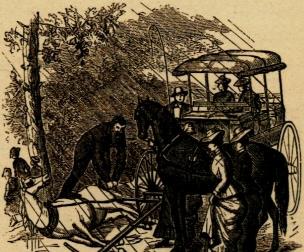




134 BETWEEN THE GATES.
upon the pillars. He emulated the "I am thy father's ghost!" of Hamlet, and did that horse's " tail unfold." It was a stern pull, a long pull, and a pull• in detail; and that beast, suspended like several swords of Damocles upon hair, swung slowly round as if he were on a rail-road turn-table, scrambled up lookinr; as if the wagon had been drawing him, not he the wagon, and we were once more under way. The misery of it was the music of it, and various versions of the story were retailed about to beguile the long day we sat under the rainy eaves of the sky, and I hereby entail it on the heirs and assigns of the Star who played " the heavy part."
The next morning was a delight. The valley swept out twelve miles to the mountains that were draped in their Sunday blue. For the first time in my life I walked among the peach's first-cousins, the almond trees, the orchard of Ecclesiastes, but the blossoms had ceased to shine, and the limbs were full of fruit. Five varieties of stately oaks stood around the house, but the live-oak was the grandest. Spanish moss hung in festoons and lambrequins of gray lace from the limbs, and solemnly swung in the morning air. They gave a weird and graceful, but a sad look to the landscape, and reminded me of faded mourning, draping some old manorial hall for the dead lord or the lost lady.
"0, the mistletoe bough!" and there it is. All about upon the oaks hang globes of the Druidical parasite, like orreries of green planets, and I felt that I was in a foreign land. I had seen a parasite in the army that showed gray on the blue blouse, but failed to show well; and a parasite at the table of his friends; and never one before that kindled a spark of poetry; but those little
VALLEY RAMBLES AND A CLIMB. 135
emerald worlds on the oaks lighted the way through the halls of deserted years, and with the Hebrew backward step I walked near enough to hear a voice, clear as a meadow lark's, strike up, when that old song was new,
"The mistletoe hung in the castle hall,
The holly-branch shone on the old oak wall,"
but the cry of "All aboard!" scared the voice away, and the light of the green planets went out.
The children of the party gathered a heap of moss that would fill a bed fat enough for a Mohawk Dutchman, in the vain hope of carrying it home. Do you know that children are capital baggage to take along upon a journey? They ballast the grown people, and keep them on an even keel. It took two to steady our craft. They are full of exuberance as picnic satchels are of luncheons, and you can take a little out now and then, when you feel old about the heart, to make you young again, and nobody will miss it. Let their names be " entered of record": CARRIE, the lassie with the gentle grace of patience, and KNAPP, the lad who was never caught napping. May they live to be gray as the Spanish moss they coveted.
The contrasts of scenery in California are as wonderful as if you should enter a house by one door and leave it all wilderness and winter in the front yard, then go out at another to find it all summer and flowers in the garden. I had such a transition within an hour. We climbed along the edges and shelves of rugged mountains, above rivers in everlasting quarrel with ragged rocks; below heights walled up with stone ruins from the beginning, and finished out with the shaggy, russet backs of a thousand dromedaries; meeting nobody but horsemen with lariats swinging at their saddles; seeing no human dwelling;
136 BETWEEN THE GATES.
fearing night would come down upon us and no " pillar of fire" to guide. A few rattling downward dashes, and we descended into Knight's Valley, with its homes and its harvests, its fruits and its flowers, its broad parks peopled with the weeping oaks. Fancy a fragile, feminine English willow, drooping, swaying, married to a husband to match her, and that husband would be the weeping oak. It is the blended grace and strength of the vegetable world. A sturdy trunk, a broad crown,- a dense foliage, and then that pendent fringe of green, almost sweeping the ground as it swings in the wind. The level rays of the sinking sun touched everything with the hazy glory of a gold-dust air. You wonder how many years it is and how many degrees away, since you were cautiously creeping along the brinks of cafions, and it was only an hour ago.
Santa Rosa is a city lost in a flower-bed. You can find it by climbing a rose-tree as high as a house, and obeying Sir Christopher Wren's marble injunction, "Look around! " It has a congregation of three or four hundred, that, like Zaccheus, worships in a tree, only his was a sycamore tree. It is the Baptist church, a quaint edifice of unpainted wood, pleasantly suggesting a rural chapel in England, and you think of the ancient .yew-tree and the rooks that should be calling. That house was made of a single redwood; and the interior, from the floor to the ribbed ceiling, was once wrapped in the same bark jacket.
And then you cross a street to see a friend of childhood, a bush that grew by the roadside and showed its sweet white umbrellas of flowers in spring, and its dark red berries in fall, whereof a wine was brewed, harmless as the milk of old Brindle; a bush of whose wood you made
VALLEY RAMBLES AND A CLIMB. 137
your first "deadly weapon," the pop-gun—the elder of the East. And here is a tree more than four feet in circumference, and shading the eaves of a two-story dwelling. It is the elder of the.old days.
You traverse the Santa Clara Valley, where adobe dwellings linger still, through Alameda avenue of poplars and willows planted by Jesuit hands a century ago, to San Jose, and from the vantage-ground of the Court-House dome you see the horizon of mountains rising, sinking, receding, nearing, like the billows of the sea, and just one little way through, down the royal road you came; and circled by that turbulent horizon, you look down upon a thousand square miles of semi-tropic beauty. You see the sinless inhabitants of the Indies, Australia, Mexico, the Sandwich Islands and Peru, from the stately palm with such a far-away look that it would hardly surprise you to , see a castled elephant move out from its shadow, to the painted leaves of Brazil, appearing as if leopards and tigers had lain down upon them and printed them off in duplicate.
You look down upon the plaza which is the public square, rich as the National Conservatory with foreign loveliness. You gaze away at the checker-work of ranches which are farms. The mallows—the humble thing that grew about your feet in the East, with its tiny blossoms no bigger than a vest button, the dairy plant of childhood, whence you used to gather the little green " cheeses "—is grown into a tree, and the birds'-eyes of flowers have flared out like wild roses, and challenge you on tip-toe to reach them. Booted boys swing by vines an infant could have broken. You look at familiar things through a mysterious magn4er. Like urchins you have not seen
6*
BETWEEN THE GATES.
in ten years, they have all grown out of your knowledge.
A Yankee examines the soil and despises it. He prefers th.e hillsides of Stonington. The man from Illinois prairies, who lugs a couple of pounds of mud into the house to his wife every time it rains, remembers his level acres in their total eclipse of Ethiopian richness, and regards with contempt the tawny, dusty landscape before him. He shall see it in winter time, when the Lord works miracles with the treasures of His clouds; when the miracle at the wedding in Cana, where "the conscious water knew its God and blushed," grows familiar and annual, and the water is turned into the wine of the vine, yea, into bread and to wine. He shall see an electric energy in this soil that will startle and charm him; at night that the grain has visibly grown—has made a Sabbath-day's journey toward the new harvest;. at morning he shall see that the plants that went only budded to bed have blossomed out in the dark. He wonders if Jonah was not here before Jason, and if seeds from his gourd yet remain. Why not? Grains of wheat three thousand years old, taken from the robe of a mum-my, were sown and were grown, and were molded into bread.
And writing of times so long gone they get new. You may see at the United States mint in San Francisco a golden spoon, of as quaint and delicate workmanship as any of the trinkets of Her Majesty of Sheba. Its bowl is a leaf, and its handle the wreathed stem it grew on. It is frail and exquisite enough for the tea-set of young Cupid. Now the numismatist, if that is the man and I have not mistaken the name, declares he has evidence



that the spoon was among the belongings of Solomon! If so, have those pennyweights of pale gold come back at last, after all the centuries, to their native land? Did Solomon's ships ever beat up the Pacific coast, and lie off and on in sight of the sands of San Francisco? As the Spanish would say, Quien sabe?
" Cherry ripe!" her lips do cry, and here you are in one of the great cherry orchards of California. The trees are shaped like little Lombardy poplars, with dense dark foliage growing down the trunks like green pantalettes. You see thousands of them of as uniform height as the Queen's Highlanders. The inevitable John is picking the fruit and white men are boxing it for market, in black, red and gold tinted mosaics. They handle each cherry tenderly as if it were glass. Twenty tons have been forwarded, and they will gather thirty more during the season. By the little hatchet of Washington, fifty tons from a single orchard, and not a cherry too many, at the highest of prices. What an Eden for the robin to rob in!
One or two of the party who disposed of a dollar's worth of rubies at a sitting, suffered a slight unpleasantness that could have been covered by an apron without. being alleviated. Those cherries tasted like the little book that John the Revelator ate, " sweet as honey," but—alas!
There is a thistle. At least it would be in the East, and the farmer would be after it with the hoe of destruction, but here it has expanded and brightened into a brilliant scarlet flower, large and handsome enough to trick out a general's chapeau with a feather. Now, if a New York girl had that thistle she would welcome it to


140 BETWEEN THE GATES.
her flower-garden, give it a new name ending in "ie," like her own, and make a prince of it.
The air is sweet with the yellow glory of the Scottish broom and strange with the odor of the Australian eucalyptus, with its leathery leaves held both sides to the light; a tree that does not grow soberly, but springs to the height of fifty feet while your boy is reaching three. The valley is Elysian, the day is Halcyon, as we set forth for a mountain ride. The grain in green, yellow, white and gold unrolls on every hand. We pass farm after farm rich with the evidences of high cultivation, and not a laborer in view; home after home with their broad verandas, and window and door wide open, and not a soul in sight. Horses by scores, cattle by hundreds, sheep by thousands, and not a master or a shepherd visible. Flowers that seem to be keeping house, their pleasant faces toward the road; vines that show the gentle lead of woman's hand, and not a chick of a child or a flirt of a petticoat. It is as if everybody had gone in a minute, "died and made no sign." Notwithstanding the lovely landscape and the bright air, a feeling of loneliness " o'ercomes you like a summer cloud"—and an imported cloud at that. You are in a land where weeds are in the minority, and Nature does the work. The country in the wildest places, where man never scarred it with plowshare, seems to be a thousand years old. You cannot abandon the notion that this field has been tilled and that grove planted by human hands.
ON THE HIGH SEAS.
The road grows narrower and more rugged. We go down ravines that spread out into little bays of greenery,
VALLEY RAMBLES AND A CLIMB. 141
and then commit suicide by throttling themselves into gorges. We begin to climb. The mountains grow saucier and wilder. They act as if they would be glad to shoulder us out of existence. The ledge of a road is notched into precipices that tumble a thousand feet down. It looks like a clock-shelf. It is now rock at the right, abyss at the left, and now rock at the left, abyss at the right. The mountains are executing a solemn dance, and as they cross over and back we are lost in the mazes of the measure. Tall trees lift their crowns almost within reach, as if they grew from the under-world. Somewhere below, their roots are holding on with the clutch of a mighty hand. Rocks hang poised midway above, only waiting for the passage of the carriage to let all go, and be aerolites. You fancy the tremendous ricochet when, with thunder and fire, they shall crash down the gulf, through splintering of timber as of hurricanes, and rushing of leaves as of driving rains. Then come the zigzag lifts one after one, and when you reach them you have reached the last letter in the alphabet of free-and-easy traveling. They are the Z's of all thoroughfares.
You see that little nick on the brow of a loftier Alp, like the scar of a sabre-stroke on a trooper's forehead. That little nick is the road you are going! It is getting to be nervous work. In places, you can drop a lead and line plumb down from the wagon's side into the sunless depth. All along, fearless flowers, the Indian pinks, the wild roses, the honeysuckles, the violets, the azaleas, the blue-bells, the giant asters, cling within reach of your hand on one side, and smile in their still way as if they said, " Who's afraid?" but on the other—thin blue emptiness. The old familiar horizons, that have always clasped you
142 BETWEEN THE GATES.
and kept you from being lonely in the wide world, have grown alienated and deserted you. See them retreating away at your left and behind you, slipping off from the planet and revealing something of what Satan showed the Savior, " the kingdoms of the world and the glory of them." And what a stormy world it is! And you climbing a mighty surge and looking across a tumbling ocean of troubled mountains. You feel as if you were some-how escaping from yourself into the rarer atmosphere — a kind of dying without death. Here and there little cities, the spangled breast-pins of civilization, glitter in the troughs of the sea. It would not surprise you much to see them riding the next wave that comes. Russian River trails along like a streamer lost overboard. The shaded greens and blues of oak and evergreen, and vines and flowers, are " worked down," as painters say, like an ivory picture. Yonder is old Saint Helena, in whose shadow you traveled for hours, and then climbing over his hip slipped down on this side of him. You thought him mighty, but every ravine is dwindled to a wrinkle, a mere bit of deeper color, and altogether he is shriveled down to the haystack in the home meadow. Here are tawny sweeps with the green spray washed off, and you think of streaks of lurid light from a sun you can-not see. There, tall cliffs in ethereal robes azure as a bluebird; yonder, the horizon has broken utterly away, and the world dim and dimmer is flowing through like the floating of a veil of gossamer. Pine Mountain in his dark cloak is in sight. He is a monk among them. High up the acclivities are scars, as if received in some old bombardment. They are entrances to the quicksilver mines. The roads to them are hair-lines in the distance.
THE HOG'S BACK.
Five miles across, and apparently within the toss of a stone, is the Hog's Back, a spine of a mountain bridging the valley from side to side, and standing at an angle of forty degrees. Some hirsute keeper of swine must have named this gigantic highway. It is complimentary to the hog, but a libel on the mountain. Think of a mastodon
weighing a hundred million tons forever crossing the valley and never leaving it, his gray sides and ridged back lifting vast and bare amid the visible thunders of
the gorges — for have you not seen mountains that looked thunder as you watched them, as if any moment they might give tongue and go bellowing down the world?—and then think of riding after a four-in-hand lashed out to the reckless, rattling gait of the wild steeds of the pampas, down that lifted and angry spine, with a sway, a swing and a sweep, the slopes falling away like a horse's mane from the ridge, and no more chance of a halt than if you were riding a cannon-shot. If you can do it and not feel a cold wave shudder down that spine of your own, you are fit to sit upon the box with Phoebus, when he drives his golden chariot down the sky.
The road comes to emphatic pauses before and above you. It runs out into the air every little way, and disappears like a whiff of yellow dust. You meet it coming back with a bewildered look on the other side of a gorge, as if it were lost or discouraged, and were making the best of its way home. You are sorry for the road and a little sorry for yourself, but you double back on the trail as if the dogs were after you in full cry, and follow on. Some of the party are afraid to look down and afraid to look up, but nobody is reluctant to look off. It


144 BETWEEN THE GATES.
is going to sea without leaving the shore. At intervals there are ticklish turnouts projected over the precipice, with exactly as much railing to them as there is to Cape Horn, where you doubt whether you want either the rock side or the air side. What if we meet somebody on the tape-line of a road between! And we do! Around that headland come a pair of noses, and there is a simultaneous cry of "team!" The witch of Endor would have been a more welcome apparition, for we could have driven through her and not broken a bone. The noses' owners tugged a wagon into sight with a man and woman in it. It looked like a dead-lock. Were it not for somebody else the writer might have been there yet. You should have seen them lift that wagon, woman and all, and set two wheels of it just over the edge of the precipice. Had so much as an eye snapped with the quick winks some of us executed, and started those horses, that woman might better have been dropped from the talons of an eagle into its nest, for then she would have been some comfort to "the young eagles when they cry." She was as indifferent as a lay-figure at a dressmaker's. It seemed to me like threading a needle with only one chance to do it, and a stitch lost a life lost. But they hemmed the edge, and as she rode around the rocky elbow, that woman's square flat back was as full of expression as her face. They were a match.
Then we made a plunge down the road, and began to learn our letters on the other side of the mountains. It was the mightiest hornbook that ever went without covers. The many-sided man had a foot on the brake, for they drive with brakes and not with reins in California, and the horses traveled around the outer edge of visible things with great humility. In these tremendous ups and downs
VALLEY RAMBLES AND A CLIMB. 145
I think the downs have it. There is such a tension of feeling about the ascent; such a twanging of violin strings in the nervous music, as the keys go around and the wheels go up; such a thinking that you are climbing away from home and out of the solid world; that you are losing your standing-room on the planet every long and creeping minute, as you take the bold diagonals of the mountain stairs;— all these things temper the grandeur with a touch of awe, and render the exultation something too solemn' for delight. But your eyes are couched in the clearer air, and the winds sweeping from crag to crag again, the broad-winged free-commoners of Heaven, inspire you with a kind of Independence-Day elation. You set Byron's live thunders to leaping, The Vale of Chamouni subliming, " The waters coming down at Lodore," and the Waldensian Song in full chorus; but you are not apt to do it until you have gotten a couple of miles nearer the earth's center of gravity, and are regaling yourself with coffee and tongue-sandwiches by the roadside.
7

HAVING ridden for hours the mountains' heavy seas, all at once, with slackened trace and tightened rein and brake hard down, we begin to sink without drowning. It is something like driving a four-in-hand of nightmares. Down we go, a thousand feet a mile, now circling a hill, now balancing as if on the left wing and now on the right; then with swift dashes and pounces, another thousand feet another mile, and then a final plunge, and we bring up with a rattling of bolts, a jingling of chains and a sense of satisfaction at the mouth of Pluton Cation, and in front of a spacious hotel, with its broad hospitable verandas, and its doors and windows all set wide in welcome, like so many pleasant faces under two rows of broad-brimmed hats. In all California you will find no house of refuge combining more of restful comfort, courteous attention, lavish abundance, and the neatness of a young Quakeress. Amid great oaks and beautiful flowers stands the very inn the poet Shenstone would have loved.
So this is The Geysers. You have descended to it with a bold flight, and it is seventeen hundred feet yet to the level of the Pacific. You are in a nook of the world. Around you the mountains lift three and 'four thousand feet above the sea, and watch each other across
146
THE GEYSERS. 147
the three-mile chasm. Before you is a gulf with zigzag paths hidden beneath a luxuriant wealth of foliage. Laurel, oak, fir, madrona, vine, shrub and flower, are fairly wrangling together in their rivalry to see which shall grow the fastest. You take an alpenstock and a guide, a garrulous old fellow, who has looked into volcanoes and groped in caves, and turned his memory into a laboratory for all sorts of loose mineral specimens and facts. You settle down in your holdbacks, and walk on your heels. The mountain shows its elbows all along, as if to nudge you off the path. You come to a rustic bridge across a lively stream of clear cold water. It is the Pluton River. There are " books in the running brooks" that swell it, and, what Shakespeare never saw, the speckled trout.; for if he had, he would have named it on some of his lords' and ladies' bills of fare. The flash of its dappled beauty might have diverted Ophelia from her " rooted sorrow," and even my Lady Macbeth forgotten for an instant that "damned spot," as she freed with her little hands the rich flakes from their crisp and golden binding. There are "sermons in stones" withal, for the Pluton lifts its voice in loud and cheerful talk as it runs on. A stealthy, speechless river, like a spy in moccasins, never commanded my admiration.
You stand upon the bridge and look. The mountain seems shut before you, and no " Sesame" at hand where-with to open it. But you listen. The rumble of a grist-mill, the tumble of a water-power, the hissing of an engine, the bubble of boiling caldrons, the jar of a distant train. It is as if the murmuring echoes of a live world were locked up in the heart of these mountains, and the disembodied voices were clamoring for escape.
148 BETWEEN THE GATES.
You listen as at the sealed den of some mountain monster with eyes that light his gloomy cavern. You hear the craunch as he grinds a bison's bones, and his heavy snuffing breaths of satisfaction as he rolls them over.
A sudden turn, and the mouth of the canon swallows you before you have quite made up your mind that " Barkis is willing." You follow the crooked trail and reach the Geyser River, warm for water but cool for tea, that seems in a tumultuous hurry to get away, for it tumbles down the giant stairs like the rabble rush of an unruly school. The great green bay-trees, that flourish like the wicked, roof you in. The crooked way grows narrower and wilder. You enter a craggy grotto of romance, and from ledge to ledge pursue your upward way. The California fashion of giving everything to the devil prevails here—a fashion "more honored in the breach than in the observance." The air begins to smell like the right end of a lucifer match. You are in the " Devil's Office." It is an apothecary shop. Epsom salts hang in crystals from the walls of rock; rows of mineral springs, some of sulphur, some of salt, a trace of soda here, of iron there, of alum yonder, each more unpalatable than the other, no matter which end of the stock you begin at. Here is a stone pot of eyewater that, like the widow's cruse, never gives out. People think it strengthens the eyes, and " as a man thinketh so is he."
GOING UP THE CAON.
The narrow cafion opens like a fan. Leaf and shrub disappear. It is getting serious and sulphurous. Rock and earth break out with a most extraordinary rash. The whole family of sulphur, ates, ites and ets, black,
THE GEYSERS. 149
yellow, white and red, are everywhere. All tints of copper, all shades of iron, strong with ammonia, white with magnesia, gray with borax, crystal with alum. It is as if there had been a universal wreck by earthquake of all the chemical warehouses in America, and the debris had been tumbled into this canon right over an everlasting furnace, and kept hot, like the restaurants that promise " warm meals at all hours." The rocks that bound the narrow gulf are as full of holes as a bank-swallows' village. Puffs of steam issue from them like breath from the lazy nostrils of slumbering mastodons. You are climbing all the while from crag to stepping-stone, up rude stairs of rock, around sharp angles, by boiling caldrons, over streams of smoking water. The ground is hot under your feet. Volumes of steam rise in everlasting torment. Here at your right, in a room without a door, and no place for one, somebody is churning. You hear the dull thud of the dasher. You stand by a stone hopper whose jarring, rumbling jolt assures you they are grinding a grist that nobody has sent you for. As for the miller, he is not in sight, and you are not curious. His punch-bowl is even full, his alum kettle on the boil, it makes your mouth pucker to smell it ; his arm-chair of solid rock is empty, and you occupy it, the only thing among his possessions you seem to covet, except his ink-stand, a broad, liberal piece of furniture filled with a liquid as ebony as " Maynard and Noyes' best black." We come to the miller's family kettle, the Witches' Caldron, twenty-five feet around, with a temperature of a couple of hundred degrees, and filled with a tumbling ocean of smut tea. It is the busiest place you were ever in; a paradise of a kitchen for an imps' boarding-house.
150 BETWEEN THE GATES.
Under every foot of ground, behind every rock, within every crevice, something is frying, simmering, boiling, gurgling, steaming, fuming. You think the spoons for supping here should have long handles.
Here is the escape-pipe of a Geyser steamboat. It rejects the sticks and stones you throw into it, and blows off steam at times with great resentment. They set it to playing a boatswain's whistle, but it piped " all hands on deck " so relentlessly by night and by day that the weary guests at the hotel, a half mile distant, petitioned that the miller's trumpeter be permitted to lick his lips and smooth them out of pucker for a long vacation.
The soles of your feet burn. Some chemical rodents and mordants are gnawing at the leather. And then you go up a flight of stairs cut and nicked in the face of a - rocky promontory, and climb to the top of a stone column with a pulpit upon it a hundred feet high, and rugged as any a persecuted old Covenanter ever preached from. A flag-staff is set up therein, but the flag that floated there grew as yellow in the brimstone as a pestilence signal, and frittered away.
Not satisfied with endowing Satan with everything, they have proceeded to ordain him, for this is the Devil's Pulpit. You gaze down from the lofty look-out upon a winding hall sloping rapidly away toward the bottom of the cafion, and showing the unrailed galleries and slippery stairways whereby you came, and all one blotch of confused colors like a wagon-painter's shop-door. You look through spirals, wisps 'and clouds of steam, of whiffs from rocks that have sat down on themselves and fallen to smoking their pipes. Your mouth tastes as if you had lunched from a box of matches. You smell as if
THE GEYSERS. 151
you had been out in Sodom's brimstone rain without an umbrella. You feel as if you had escaped from Tophet's open mouth; and if not quite so intensely, then as if you had been basted with brimstone for the cutaneous effects of that uneasy animal called acarus scabiei. How much more harmless a thing may be when disguised with words of which nobody knows the meaning!
The scene is weird. Macbeth's witches, anybody's witches, would be at home there, and set about making broth of " eye of newt and toe of frog " without so much as a hint from the miller. Leaving the pulpit, you go down over the shoulder of the mountain by a pleasant shady way to Temperance Spring, an artery of splendid water that the roots of the big trees have vainly tried to hold in their crooked fingers. You are in a cool and unsuggestive atmosphere. Some crimson linnets are singing in the trees, but no bird ever flew into the grim cathedral or rested in the blotched cloisters of the canon you have left. You halt at the Lovers' Post-Office, where a rustic seat and a bended tree and a gracious shade invite you. The great hollow of an oak is filled with cards and letters deposited there by travelers from all the world; you read names from New-Zealand, Australia, Brazil, Hong Kong. It is a cousin of the Charter Oak of old.
Then catching up the broken thread of the trail, you descend into the unshapely dish of a dead volcano. You walk on the lava beds where the earth yields noiselessly to your foot. A cane is thrust into it as easily as into so much bakers' dough, and when withdrawn a puff of steam lazily follows. It would hardly surprise you to hear a discontented snore at the disturbance. One of the ladies cries " Don't," and you don't. The volcano may not
152 BETWEEN THE GATES.
be dead, but sleeping; let us treat it with respect. We walk amid the gray flour of calcined rocks that would have held an inscription for a thousand years, but they came centuries ago grists to this mill. True it is, " the mills of the gods grind slowly, but they grind exceeding small." You walk across the debatable ground of the crater with the tiptoe feeling with which you used to teeter into church in prayer-time, and come on the side of the volcano to a hot sweat-and-mud bath where the Indians used to bring their sick to be healed. It must be the original office of Dr. Thompson, the ancient prince of steam-doctors, and himself in high esteem. The miller's tea-kettle with its rattling lid above, and its rush of steam and its tumbling brewing below, is the last of the miller's hardware that we visit. The orderly strata of the rocks are torn and twisted out of shape, like a book of tattered leaves. Bleached, encrusted, spangled like nuggets, resembling petrified honeycomb, slate, sandstone, everything, all tumbled out together.
People come here and take a hurried look. They lift their skirts, and worry about their boots, and fresh from Icelandic Geyser pictures with their hundred feet of col-
. umned water, they think this but a wreck of a chemist's kitchen. But let them linger; see that mountain fairly cleft from peak to lowest depth; watch these rocky books rent from their covers and tumbled into heaps of chaos; sift through their thoughtful fingers the pale affrighted dust of stone, ground fine as pollen from a flower; struggle around these quaking, trembling, rumbling, stifling crags and peaks, like a little steamboat shaking with the ague of an engine too big for its body; think of these mountains " rock-ribbed and ancient as the sun," riddled
with fires and forces no man can estimate; imagine the intensity of the agencies that keep this wreck of matter glowing, and these rocks bubbling like the sap in the sugar-camps in spring; fancy what ruin would be wrought were these safety-valves to shut; go to the bath-house beside the Pluton, and grope in the chamber gray with clouds of steam; or plunge into water hot from the boilers of a thousand years; — think, see, and do all this, and you are inspired with a reverence for these reserved powers that mutter beneath your feet. See the trees that stand like tall hall-clocks upon the very rim and wreck of volcanic ruin, and time the long-gone day when its grim thunders ceased, for lo, they have grown grand since these giants always turning over fell into restless sleep!
BEAUTY IN THE CANON.
But even the grimmest deep of the canon gives birth to beauty. I first saw the steam's white plumes drooping and drifting away over a mountain shoulder, and touched with the morning sun. There was the suspicion of a bow of promise on the clouds. I saw them again when the day went down the western slope. There was a flush of glory on the smokes of the old camp-fires.
And all around this place are nooks and alcoves, picturesque and beautiful. There is one, " The Lovers' Rest," a sort of shrine beneath the laurel's royal roof, where sun and shade play hide-and-seek together, and floor the alcove with curves of green and gold. It hangs like a balcony above the Pluton River, whose voice comes up with laughter from its rocky street. Vines drape the trees, and wild flowers smile from rugged clefts and swing above the water. Gray rocks lie quietly about like flocks




154 BETWEEN THE GATES.
in the fold at night. A mountain clad in broidered uniform stands guard to keep the grim-mouthed canon out. You could not tell it is within a thousand miles.
• It was just here that an anniversary overtook us so strictly personal that the writer hesitated to name it, until he remembered it was an offense he could commit but once in a quarter of a century. His Silver Wedding-day found him and his at the Geysers, and their kind fellow-mountaineers made it memorable with cordial words and pleasant deeds, and under the shade of the laurel, the voice of mountain birds and Geyser river clear and strong, the air bright with sun and sweet with flowers, the seventh of June straight down from Heaven, the wedding feast set forth, the valued friends around, these lines, written where the miner's wash-bowl used to be in the old song, "upon my knee," were read, and then " The 'Lovers' Rest" was left to its loveliness and loneliness, and the wedding guests are scattered from the Atlantic to the Pacific. "Here's a health to them that's awa' ! "
Five and twenty years ago
And two thousand miles away, With a mingled gleam and glow As of roses in the snow,
Shines a day!
Only day that never set
In all this world of sorrow,
Only day that ever let Weary, wayside hearts forget To-morrow.
All the world was wondrous fair
To the bridegroom and the bride,
With the lilacs in the air And the roses all at prayer Side by side.
In the door stood golden day,
Washed the noon-mark out with light, Larks half sang their souls away
Who dreamed the morning would not stay Until night?
Dim and bright and far and near
Is the homestead where we met—Friends around no longer here,
Rainbow light in every tear
Together yet!
Ab, the graves since we were wed
That have made that June day dim—Golden crown and silver head
Always dying, never dead,
Like some hymn
Some sweet breath of olden clays:
Lips are dust—on goes the song! Soft in plaint and grand in praise, Living,,brooks by dusty ways
All along!
Wandered wide the loving feet,
Some have made the lilies grow, And have walked the golden street Where the missing mornings meet
From below.
Night the weaver waits to weave,
Facing north I see unfurled Shadows on my Eastern sleeve—Crape of night. but never grieve
For the world.
Now, dear heart, thy hand in mine,
Through clear and cloudy weather, Crowned with blessings half divine We'll drink the cup of life's old wine
Together.
In this "Lovers'" perfect "Rest,"
Beside the Geyser river,
Where mountains heap the burning breast Of giants with the plumy crest
Forever,
New friends grace this Silver Day, Apples gold in pictures fair, Bringing back a royal ray
From the everlasting May
Over there.
We lift the prayer of tiny Tim,
"God bless us every one!" Crown life's goblet to the brim,
While across its Western rim
Shines the Sun.





CHAPTER XIII.
THE PETRIFJED FOREST.
DELIGHTFUL as it is to go a-gypsying by private conveyance, you want a touch of the four or sixin-hand broad mountain stages, good for a dozen and no crowding. I had such an experience with W. C. Van Arnim, a knight of the road, not a brigand, but master of the whip and ribbons. He can play on the reins as if they were harp-strings. He gathers them up until he feels every mouth with his fingers, and is en rapport, as the mesmerizers say, with all of the six. Then that whip throws out fifteen feet of lash with an electric explosion at the end of it done up in a silk snapper, and he flicks the near leader's ear as accurately as you can lay an argumentative point on one thumb-nail and secure it with the other. The team gives a step or two of a dance, and is off. It plunges up the pitches like a charge of cavalry. It dashes around the capes as swallows over a mill-pond. The leaders have doubled a cape that juts out above a precipice. The wheelers are making straight for the chasm at a swinging trot. The leaders are nowhere. You clutch the seat as the man overboard grasps a hen-coop, and shrink to the rock side with a pinched feeling of apprehension.
And yet it is wonderful to see the earth letting itself down two thousand feet, and holding on with scarred
156
THE PETRIFIED FOREST. 157
fingers and rocky knuckles to the shelf you are riding upon. You look down. It has taken a river with it, and never spilled a drop, and there it is hurrying along as if nothing had happened. You look across the aerial gulf all free and clear to another world beyond. Sometimes you feel a disposition to fly, and sometimes you feel as if you should fly in spite of yourself. You thought all this since we lost the leaders, for a man thinks fast when he is going to be hanged or drowned, or tumbled from a precipice. Those leaders are headed for a point at right angles to the stage. They must not pull a pound, and you see why—should they draw, the hind wheels would be swung around over the gulf, and so you watch the driver as he fingers out a pair of reins and hauls them taut. The next pair are slackened upon the wheelers' backs.
Yonder are four great S's in a row, two boldly curving toward the gulf, and two hugging the mountain with the convex side. We strike the first and swing in on a scurrying trot ; the next and sweep out ; and so till we have dashed off the S's. It is alcove and column, column and alcove; we whirl around the cornices and dodge into the recesses, but the gulf fits the scallop like a glove. There is no getting rid of it.
You say to Van Arnim in a deprecatory way, a sort of pray-don't-laugh-at-me air, " Isn't the road pretty narrow?" giving a furtive look at the wheel under your hand, that rims along the very selvedge with a little crumbling craunch.
" I have all I can use," is the common-sense reply, as he touches up the off leader. By-and-by we meet a heavily-laden wagon in the narrowest of places. Its
158 BETWEEN THE GATES
driver sees our cavalcadb of horses, halts square in the road—as who would not? — and nervously jerks the lines this way and that, and his horses swing their heads from side to side like a garden gate with a boy on it, but the bodies never move an inch.
" Well," says our driver in a generous way, " which side of the road do you want? Take your choice, and get out of the middle of it." That sounds fair, but then—. At last, after some backing and sheering and muttering, the wagon is shelved, and the stage just sways astride of the gulf's brink and pulls through. Who ever heard of breaking a precipice to the saddle! And so, up and down, in and out, over and under, we go. It is as graceful as flying.
The road from the Geysers to Cloverdale is like the undulations of a strain in Homer. I think a Grecian could learn to scan it. And there were curious things on the way. Perched upon a tree over the road is a specimen of the peacock of the West—a rare bird, and larger than an ostrich. This one had been repeatedly shot at by ardent tourists, but they never ruffled a feather. It is perched there yet. It is a formation of a redwood limb, and a most remarkable portrait, even to the tail and the detail of Juno's favorite poultry. Farther on, at the left of the road, is a lean mountain, its spine showing sharp as a wedge, and gaunt as a starved wolf.
At the end of this spine, about five hundred feet in the air, is the profile of a Turk. The face is about five yards long—face enough for a vender of lightning-rods. The low forehead, the aquiline nose, the moustached lip, the imperial on the chin, and even the eye
THE PETRIFIED FOREST. 159
lashes, are plainly seen without the help of keen optics
" To see things not to be seen."
The whole is surmounted by the folds of a turban wound about with Oriental grace, and Nature has thrust a little evergreen in it for a plume—or for a joke, either or both. What innumerable rains have trickled down that patient nose, is the first thought; and the second, what touches of wind and water have .shaped those features into everlasting immobility; of what earthquake shock was that old man of the mountain born, who keeps end-less watch and ward over the brawling canon. It might have been there when King Alfred was making lanterns. And it is less than a dozen years since the Turk swelled the census by one. When the laborers were building the road, the foreman used to watch the cliff as you would the gnomon of a garden dial for the time. The sun struck a little promontory at eleven o'clock, and one day, in an instant, he discovered the whole face, and found it was the tip of another man's nose across which he had been taking sight for noontime.
We rattle down the last declivity of the mountain, ford the Russian River, and are again within lightning-stroke of the world; for yonder is a telegraph wire, and this is Cloverdale and dinner, where the food was cooked first, and the guests were cooked just after they arrived. The land-lord, who called himself a double-headed Dutchman, which means he was High and Low, if not Jack and the Game, had hidden his thermometer for the comfort of his patrons, but it would have read the temperature up to par in the shade, if it could read at all.
The day. we reached the Petrified Trees was a glar•er.
160 BETWEEN THE GATES.
The sun blazed steadily down upon a responsive earth that blazed back again, and we were between two fires. It is the cemetery of dead redwoods, solemn as the catacombs and looking older than the pyramids. It is a graveyard where every fallen giant is struck with a rocky immortality. You are back in the Stone Age. You look upon the seamed, arid and naked hills covered with unlettered monuments, for the face of some Sphinx that has been staring the centuries out of countenance with its unspeculative eyeballs. You are met by Evans, the Petrified Charley of the tourists, whose fathers were subjects of the Great Frederick ; a tough old sailor aforetime, who having tossed about upon all seas has anchored here and turned Sexton. His home is a bit of a ship's cabin, snug and holy-stoned. His slender-waisted fiddle and some nautical instruments garnish the walls. The bunk where he "turns in " is neat as a new tablecloth. His companions are a dog, " Rascal," and a venerable, inquisitive and aggressive goat, called " Billy."
Now there was a lady in the party as active as an antelope and enduring as young hickory. In the best of senses she would make a "daughter of the regiment," that would carry the boys by storm if the enemy failed. Sparkling with vivacity, ready to scale a mountain or catch a chicken, she was an antidote to the blues and a dyspepsia exterminator. Baron Munchausen would have delighted in her, not because she told stories, but because she told facts as if they were fictions. " Billy" was especially deputed to meet this lady, and they met. The meeting was touching in the extreme. She sprang from the wagon and grasped him saucily by his venerable beard — a salutation to which he sternly replied with
THE PETRIFIED FOREST. 161
bowed head, she having given him the cold shoulder an instant before. She indulged in a slight retrospect, and Billy gave her a lesson in disjunctive conjunctions beginning with " but." For a man who owns no cow, Evans has an abundance of butter. The lady sat down upon the impression her lesson had made, and meditated. I could hardly abridge my story without omitting the abutment.
A kind of reception-room—or, to carry out the figure, a receiving-vault—is filled with curiosities of redwood
mortality. Here is
a coiled snake, the blood-vessels distinct, every detail perfect, struck with petrifaction while taking a nap. Twigs, walking-sticks, knots, bark, all as stony as if Medusa had given them one of her lithographs of a look. There is no
revelry here. You
3
would as soon think
of waltzing with a mummy that had dined once or twice with one of the Pharaohs. Around us are wooded mountains that' shorten the sunshine a couple of hours every day, relieving the place of a whole month of glow and glare in a year.
You climb rocky paths, and up and down over knobs and, knolls of bare earth, grass and shrub, and reach the cemetery, a rough area of twenty acres, where three hundred stone redwoods—sequoias—lie heads down from
7*

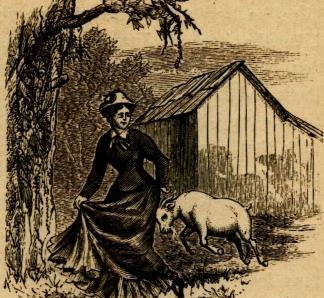

162 BETWEEN THE GATES.
North to South at an angle of 35°, the roots all being up the mountain sides, and unpleasantly suggesting apoplexy had there been any blood or any sap or anything alive in centuries. Some of them have been exhumed from the ashen and thirsty soil by the industrious old Sexton, and some resemble long graves with their covering of earth. The old man regards these stolid logs as a shepherd so many pet lambs. He sees grains of gold in them where you only see streaks of gray. They are his bread-winners. He lives with them summers when you visit him; he lives with them winters when nobody visits him. Like the hero of Juan Fernandez he has a goat and a dog, but no " man Friday," and no more wife than Mungo Park had in the African desert. He pinches in an affectionate way the corrugated bark of these tumbled monoliths that once had life, as if they could take a joke. He picks up a few little stone chips and gives you, but he is prudent, for he sees thousands like yourself who will come for more chips.
You clamber upon a fallen monarch with its thirty-four feet girth and sixty-eight feet exhumed. Here are the bark, the scars, the knots, as in life, and its rings chronicle a thousand years! In its glory it must have been two hundred feet high. Where are the birds to fit
this monster—the birds that nested in its branches—. and what their length and strength of wing and talon?
The breezes that waved its foliage may have been dead five centuries when the little fleet of Admiral Columbus felt for wind with their mildewed sails in 1492.
Some of the trees were scathed by flames before they put Insurance Agents at a discount and became fire-proof, and here are blocks of charcoal turned to stone. Noth-




ing was spared by the solemn, silent spell. The scene brings back the fable of the enchanted palace of Arab story, where all was stricken with a paralysis of marble. Several trunks are divided into sections of equal lengths, and about right to build the generous fires of our grandfathers; the yule logs of old English Christmas Eves Some say they broke in falling, driving, drifting, but there is too much "method in the madness." Those trees were severed by human hands. Whose hands? God only knows. By what gales of the elder time, blowing
out of the fierce North, were those gigantic corpses of ashen gray uprooted and swept South? Did a volcano shroud them in immortality? Did a cloud from some mysterious alembic chill and deaden them to stone? If these desolate heaps of flint and pebbly sand and thin pinched soil were once a volcano's troubled mouth, the furnace fires went out perhaps before the Conqueror's curfew rang in Saxon England. What a rocking of the cradle there must have been when the earth quaked, and lava put these trees in flinty armor, and transfused their


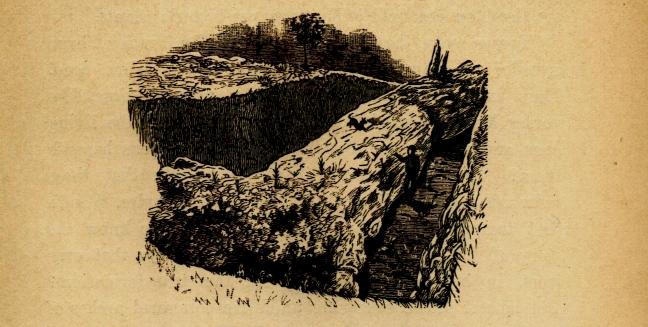
164 BETWEEN THE GATES.
veins with dumbness! If Agassiz could have been pilgrim here before he went abroad, we might have known —perhaps:
You pick up chips that are rocks, write your name upon bark as upon a slate, and your first feeling as you traverse the graveyard is disappointment. But the grandeur of the scene grows upon you as you look and think. Here is something out of the common reckoning. The silence of the place is eloquent as speech. These head-long trees are the heroes of old elemental wars. They are dead on the field. They are pre-historic giants.
Young oaks, but older than the Declaration, have crowded up through the shattered and helpless dead. They exult amid the wrecks of a grander time, like young Mariuses amid R,ome's ruins. They are the living dogs, and are they not better than the dead lions beneath them? Then, all at once, it occurs to you that these redwoods are the fallen columns of classic temples, "God's first temples." What would you not give to know the story of this necromantic place ! Did any eye that ever wept in human sympathy behold the transformation ? Did mortal music ever ring amid the columned arches of this wood? Who sang, what tongue, what theme?
You turn from the rent and rigid earth, no springs of living water at your feet, no shadow overhead; from a spot where some mysterious force in the gone ages cried " halt!" to life — and life, with pulses turned to rock and pliant limb to adamant, obeyed. Life halted, but death did not succeed it; death which is change, which falters at time's touch into dust that is driven to and fro of winds in helpless, hopeless atoms. They are old as the hills, and yet were born into the knowledge of modern man but
THE PETRIFIED FOREST. 165
sixteen years ago. You are glad to get away from Nature out of business; Nature that has closed accounts with life and time.
Altogether, to a thoughtful man, the Petrified Trees are the most impressive things in California. They overwhelm your vanity with gray cairns of what once danced in the rain, whispered in the wind, blossomed in the sun. We need not go to the realms of spirit to apply the words of Hamlet. The royal Dane would have said them here had he walked in this graveyard: " There are more things in heaven and earth, Horatio, than are dreamed of in our philosophy!"


CHAPTER XIV,
HIGHER AND FIRE.
THE Russian River Valley is fertile as Egypt and fair as Italy. It is two hours from San Francisco, but two weeks nearer the Equator. We halted at Healdsburg, a pleasant town that gave us a welcome_ warm enough to cook an omelet. "Sotoyome" names a hotel, but as it means valley of flowers, it might well christen the whole region. We stopped at the " Sotoyome." There is a funny little affectation of grandeur in the way of announcing arrivals at modern caravansaries. Thus you read that A B has " taken rooms" at the Cosmopolitan. You call on A B, and you find him in number 196, fourth floor back, quite above the jurisdiction of the State, and higher than you have ever gotten since you took the pledge; one chair, one pillow, and eyed like a Cyclops with one window; a room as hopelessly single as Adam seemed in his bachelorhood. But " rooms" is statelier, and we all enjoy it except A B, who skips edgewise to and fro between trunk and bed, as if he were balancing to an invisible partner.
The Russian River, which is not a rushing river in Summer, courses its way oceanward. This country has a history. As late as 1845 the Russians laid claim to it and erected a fortress and raised wheat, and placed a tablet upon Mount Saint Helena that shows his blue-caped shoul-
166
HIGHER AND FIRE. 167
der at the eastward, and inlaid an engraved plate of copper bearing some household words from Moscow, and pronounced it a goodly land and desired it for their own. Meanwhile the Spanish Governor down the Coast was fulminating with his Toledo blade, because of the inroad of the furry bears of the North. The subjects of the Czar have gone, but they left their name on the river.
Thermometers run highest in low latitudes. Once find out that people Atlanticward go into country places to get cool, and you may be sure that on the Pacific they will travel in the opposite direction for the same purpose. They do. We had left blankets by night and flannels by day for several degrees of the temperature that all Christians pray against. That ambitious young man, Longfellow's Excelsior, must have fired the mercury with a passion to look down upon him. It ran up the degrees as the nimblest member of Hook-and-Ladder Company Number One climbs a ladder at a fire. It stood on the hundredth round in the shade, and everybody shed his coat and jacket. Like an onion, he came off rind by rind. He husked himself like an ear of corn.
I sat under the vine and fig-tree of a friend—it was a Smyrna fig and full of fruit, and I fancied I was in Smyrna. "In the name of the prophet, figs!" His first look at a fig-tree takes a man back to the day when, with his two unclouded eyes even with the counter, like a pair of planets just ready to rise, he produced a cent and demanded a fig. There were more cents'-worths of comfort in that drum of figs than in a whole orchestra to-day. The tree was Eve's live clothes-line. She found her aprons on it, though she never hung them there. Its name has been upon the Savior's lips. It is a Bible tree.
It is strange to see it growing by the roadside, with its dark green grape-vine leaves and its pear-shaped fruit. You smile t6 find the little figs, each with its own apron, come right out of the tree complete from the first, and no announcing flourish of blossom. Once a fig, always a
fig.
Oranges were ripening near by. I made believe I was in Florida. The thermometer went up to 106°, and I saw
a cactus that had grown by diagonals, until the topmost pin-cushion was eighteen feet from the ground, and edged with a fringe of pink tassels of flowers, and I dreamed I was in the Bishop; s garden in Havana. The silver marrow in that glass spine stood at 110°, between two thicknesses of trees and a vine. A thermometer is a damage in hot weather. It heats and aggravates the observer with a sort of metallic maliciousness. I put it in the sun to kill it. There it stood, straight as a bamboo, not ten feet from my chair, and grew to 140° in six minutes, and was as sound as ever. I brought it back in my wrath and watched it go down, and so did a crimson linnet who sat on a cherry-tree, with his wings at trail arms and his mouth open. The volatile god sank to 110° and— stood still. I thought of going for a piece of ice to make him reasonable; thought if I could only see that glittering column at a comfortable ninety, I should be more comfortable myself. There was a pomegranate in bright blossom at my left, and a nectarine doing its best, and I was away in Palestine in a minute. That thermometer embraced the opportunity to try another round, and stood at 112°.
A tree with its fruit of violet green was not far• off. It was an olive. Noah had seen a branch from another



just like it, borne back by the bird to the boat that was waiting for land. It has ever been the emblem of peace since it brought joy to the heart of the first Admiral that ever floated. What are olives in pickle and olives in oil to the living tree! And while I was gone to Italy, the mercury watched its chance and the premium on quick-
silver was fourteen per cent. It
stood at 114°. I looked between
13o-
the trees upon the plaza and saw _
the hot air dancing up and down j20-
in the sun as if, like some old ns-/au-
Peruvian, it was a worshiper of fire.
I thought I would go to the next 90 corner, took an umbrella and went two rods. Nobody could tell which was the hotter, the sun or the earth. The ground flared like the throbbing breath of an engine with the furnace door open and its red vitals inflamed by a gale of forty miles an hour. Then I knew I was in Arabia, and looked out for some stray sheik with a fleet of the " ships of the desert." It always appeared to me a piece of cruelty
to make a beast of burden of a camel, when the poor animal has to carry the most of himself packed in bales upon his own back. It is an ungenerous indorsement.
As I went that two rods, and it seemed as if my umbrella would wilt like a poppy, I understood for the first time the dignity of the African potentate, one of whose titles is " Lord of' the Four-and-Twenty Umbrellas."
8




170 BETWEEN THE GATES.
I knew why he has so many. It is the census of his entire wardrobe. With the air at 145° and the earth you walk on trying to get as hot as the sun, one poor little parasol is worthless. What you want in such a country is a pair—an umbrella at each end: one to keep the earth off, and one to keep the sun off. It was some comfort when the -lightning came along the wire with the word that at Cloverdale, sixteen miles distant, the mercury was 118° and everybody alive but those that were dead before; and that at Skagg's Springs, where people go to be happy, it was 100° at bed-time, and bed-time was postponed till morning.
It helped me, too, when a lady of our party, a moral niece of George Washington, and as incapable of telling a lie as her uncle was, assured me that it has been hot-ter out of the place that the Three Worthies occupied, and in this region also, than we were being "done brown" in; that she saw a little prisoner of a ground-squirrel, whose cage was hung in the sun against a wall and forgotten, actually melted to death by the blaze, like a candle in the fire.
How much better we can bear other people's sorrows than our own! How resigned we are at their bereavements, and how nobly we withstand their temptations! If, with the same set of qualities, we could only be " other people," what a model of human kind every one of us would be!
Some fruit was baked on the sunny side, some flowers wilted, but altogether those furnace days spurred vegetation into a Canterbury gallop. And the wind blew out of the North, and the harder it blew, the hotter it grew. It was as enlivening as the Sirocco. It was the Sirocco if it was not a Simoom.




HIGHER AND FIRE. 171
Going that two rods, I saw two young human animals; one had legs like a pair of parentheses ( ), and an abridgment of a blue calico frock; the legs of the other were straight as the arrows of Apollo, and her dress was bright and gauzy as a June cloud. The first was a Digger Indian's papoose, with beady eyes, a crafty look, hair cat-black and " banged." The last had eyes blue as a lupin and clear as a China saucer, wavy hair almost the color of corn silk, and the complexion of a sea-shell. I felt in the case of the papoose that it would hardly be a sin to set a trap for it, and yet the dusky mother flung it over her shoulder and nursed it as if it were worth saving! What numberless degrees between the pet and the papoose, and where shall we look for the link? They were both fire-proof, played bare-headed in the sun and were not consumed.
A band of Digger Indians in the valley gave an opportunity for the pursuit of Natural History. Several squaws were pursuing minute specimens of it also, as, like deck-passage ideas, they swarmed the heads of the papooses. But there is no room for anything in the hold. I saw foreheads belonging to stalwart fellows that were barely an inch high, and the hair grew boldly down, like a bison's, almost to the brink of the eyes. It is surprising that John has not caught one of them and made an idol of him.
We hear of people dying violent deaths. Under the impulsive temperature of some California valleys, I think it may be said that the animal and vegetable world live violent lives. Something bit my hand under a snug kid glove one of those torrid days. It was a vicious bite, sharp as a trout's. The glove came off, and there was a
172 BETWEEN THE GATES.
little beast that looked like a flax-seed, but the hot weather had given him the vorlcity and vivacity of a shark. He didn't mean anything. It was only his incisive way of speaking to me.
We boys, you know, used to thrust a sprig of live-forever in the crack of the wall to see it grow, and thought it wonderful that a poplar whip or a currant slip would furnish its own root, and go into the business of independent living. In California you can thrust a peach limb in the ground, and it will turn into a tree. An old resident on the Pacific Coast and an older friend of mine, set a bit of a budded branch in the earth one November, and the next July it bore a peach as large as a big fist. A cast was made of the prodigy, and when I saw it a sentiment of gratification possessed me that my cane is tipped with an iron ferrule, lest it should take root while I halt to greet a friend, and give me trouble! If there is one place better than another for people given to lying, it is California; for no matter how strange the story they tell, it is pretty sure to be verified somewhere in the State. Example: A calla-lily may be in full chalice out-of-doors, and the ocean fog may case its leaves in ice till it. looks like a lily of glass and frail as a damaged reputation. But that lily is no more harmed by it than it would be by a summer dew in New York. The sun comes up and the ice melts, and the flower is as fresh as ever. And thus you have a sort of January-and-June Millennium.
There is no gradual shading out of anything in California. The rapidity of the contrasts is the wonder of them. A boy is a man, a girl is a woman, before you know it. You are kept in ceaseless astonishment because
HIGHER AND FIRE. 173
everything young is so old, and everything old is so young. It is quite impossible to.tell what anything will be till it is.
In San Francisco there is no long-subsiding Eastern twilight, that goes down like a great maple-and-hickory fire, to a bed of glow, then red shadows, then memory, then the dead past, then night, without startling you. It is the turn of a wrist. Day is shut off and darkness turned on. You wake up in the night, and all at once it has got to be day. There are no twilight lovers on The Coast. The whispered momentous nothings, that seem to require a little toning down of the light in other countries, are uttered here in broad day, without so much as the protection of a parasol. It is an open-handed, open-spoken, open-hearted land. There are fewer back-doors than elsewhere. Vice goes in and out of mansions whose tenants' names are done in silver upon the panels of the front entrance: " Rose," " Jenny," "Kitty"; but not the names their mothers called them by, and a " rose by any other name smells" just the same. People see more and look less than in lands nearer the North Pole.
Elsewhere people covet the shade. Here they sit in the sun. The beautiful parks where trees shed grateful shadows are not resorts, unless they can find some happy spot just ready to take fire with the noontide blaze. They are baskers, and when the stranger thinks It a perfect temperature, San Francisco goes countryward to boil its blood down in a semi-tropical kettle, and make it a little thicker and richer.
And it was at Healdsburg that we got into the kettle !
CHAPTER XV. A MINT OF MONEY.
MY rooms front a massive building of British Columbia and California granite. Its severe and classic facade with six huge stone columns like fluted and petrified pines, and its ponderous doors of iron, contrasts too violently with the light and uncertain architecture of a city of wood. There is rock enough in the steps to make a score of Plymouths, a geological fragment that, according to the euphemism of the poet, " welcomed our sires." It was about such a greeting as the royal boy with his clever sling and a paving-stone from the brook Kedron gave the giant.
The building is called by one of Juno's nicknames. Like the modern young woman that can afford it, she had several surnames.— her mother never knew the half of them,— and one of them was Moneta, corrupted by her intimate friends into " Mint." When the Caesars and the gods were in power, money was coined in her temple at Rome, which was handy for her when Jupiter fulminated about her pin-money. From this bit of Latin history anybody can see that it' is the United States Temple of Juno of which I am writing. It is one of the largest and most complete in the world.
Sometimes the gray front, as you watch it, takes a yellowish tint as if a marked case of jaundice had struck
174
A MINT OF MONEY. 175
through three feet of stone from the bilious treasure within. It is the reflection of a cloud overhead. You look up and see plumes of golden smoke floating from one tall hat of a chimney, and silver ones from another. There is a laboratory suspicion in the air as if there were trouble in the acid family, and Nitric, Sulphuric and Muriatic were quarreling with somebody. To talk of gold and silver smokes from a mint is no cheap magnificence. That smoke starts for the outer air with precious things that do not belong to it. Silver and gold get wonderfully volatile when you crowd them with fire, and become " the riches that take to themselves wings and fly away." Before that smoke escapes, they tire it out by compelling it to travel a zigzag hall of a flue, and drown it two or three times in reservoirs on the way, so that the precious particles tangled in its folds may drop down in the water, and leave the impoverished vapor to take care of itself. A mint chimney is a sort of pipe for Midas to smoke.
The precious metals are baking, boiling, frying, in the furnaces below. To call the smoke golden is no fancy. Little fortunes go up in those cloudy volumes sometimes. The dust that had settled upon the asphalt roof of the Philadelphia Mint in a quarter of a century was recently removed, and almost a thousand dollars in gold and silver that had fallen out of the smoke were obtained. But then you have seen plain blue smokes issuing from a man's mouth, that in three years carried off a thousand dollars, though not a dime of it ever fell anywhere.
I watched the Mint several days before I ventured to go into it, lest it might make me covetous, or avaricious, or discontented with the sort of postal-currency fortune
176 BETWEEN THE GATES.
I possess. There was always something going up and coming down that cruel pile of stone steps. Every day, Express wagons and huge drays with elephantine horses came and went. They brought tons of silver bricks and loads of gold bullion. They drew away hundreds of thousands of dollars in coin. I saw the great horses gather themselves up for a scratch of a pull when they started the solid load on the level pavement. Every day, men and boys with shouldered canvas bags of coin went
OLOFNCfllARACT CF THE DOOR STEPS
up and down. A bag of bullion on a shoulder is as common as a gold epaulette was in the Mexican war. Every day a wooden spout, a great eaves-trough, was laid from the top of the steps to the waiting wagons, and bags of silver and boxes of gold were shot down the trough with a metallic chink sweeter to most ears than the chimes of old Trinity, until the great dray was packed as snug with bags as ever was a miller's wagon with flour. I noticed that pedestrians hastening by came to a halt and helped me watch; that horsemen drew rein
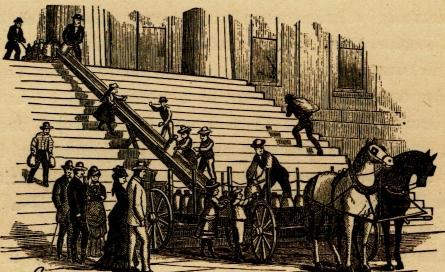


A MINT OF MONEY. 177
and looked; that eddies of people whirled around the wagons and stood still, like friends reverently regarding the face of the dead; that little girls and boys ran up and down the steps beside the auroduct — that word is private property—the treasure-spout, and touched the bags as they tumbled their way down, as if there were healing in them like a touch of the king's garments. Gold and silver inspire profound respect. They are the better part to most men as they are the better part of some men. It may be true that " a fool and his money are soon parted," but it is equally true that a fool married to his money ought to be divorced.
For twenty-five years the Pacific Slope furnished four-fifths of all the gold produced. For twenty-seven days of July, 1877, there were one hundred and sixty-five meltings of $60,000 each, giving sixty-six hundred ingots, or almost ten millions of gold. During the four years ending July, 1877, thirty-five hundred and twenty-two tons of silver were received, and eight hundred and twenty-three tons of gold. The coinage for 1876–7 reached fifty millions of dollars.
But you do not wait for me, but cross over to the Mint.
ALADDIN'S CAVE.
You climb the pyramid of steps and enter halls and rooms that with their stone floors, walls and ceilings are rocky as the Mammoth Cave. Everything reverberates. The voice has a sepulchral ring. If you can fancy a vehement ghost calling the cows, you know how it sounds. Your gentle-spoken friend talks so loud you cannot hear him. You are in the mill where money is made. You see the raw material, fresh from the mines, piled around like








BETWEEN THE GATES.
bricks in a kiln. They are bricks. Here is enough in this vault to build a stone wall of gold around your gar-den spot. It is an Emerald bull, but it gives the idea. The precious metals run to brick here—brick without straw. Ah, if the poor Israelites had possessed such material to work, there would have been no complaint in Pharaoh's brick-yard. Here are four gold cubes. They weigh about ninety pounds apiece. You can carry a couple for the gift of them, and you would have fifty thou-sand dollars. Yonder are two pieces of hardware from Mexico. They are gold and silver together, and shaped a little like blacksmiths' anvils before their horns are grown. They are awkward things to handle, for they have no bails to them, and they weigh more than five hundred pounds apiece. They are made to be robber-proof, for if Mexican bandits attacked the train, they could not very well get off with such hardware at their saddle-bows.
You get used to the solid real of poor Clarence's dream —" great heaps of gold "—in an astonishingly short time. The avaricious man who sees blocks of silver piled as high as his head, and double bricks of yellow gold heaped about, is apt to swallow a little, as a hungry dog does when he sees his master eating a good dinner and never tossing him a bone. But the ordinary soul grows familiar with it at once. You see a million in one little windowless chamber, a half million in another. You see it in grains, dust, ingots, chips, nuggets, bars. You see scalloped sheets of silver and gold, resembling the tinner's scraps when he has been cutting out the bottoms of little patty-pans. Out of them came the birds called eagles, and the bantam poultry of fives, trade dollars,


A MINT OF MONEY. 179
halves, and the chickens of quarters and dimes. You see little iron-wheeled one-man-power trucks called coaches, drawn about from room to room. Here are two laden with gold bars. You are engine enough to draw the two en train, and your freight is worth $250,000. You see every day silver sufficient to make a new sarcophagus for St. Alexander Newsky, at Moscow, the solid silver trinket that weighs three thousand two hundred and fifty pounds.
Nothing here puzzles you like values. They are condensed into a wonderfully small compass. You are in the gold ingot room, and you pick up a bar about a foot long, an inch and a half wide, and three times as thick as the snug-setting maple ruler with which you used to be ferruled. You could slip it up your sleeve if that gray-eyed man, who would be your " man of destiny " if you did it, were not looking at you. You mentally cut it into eagles as you hold it, and it turns out sixty of them, but the melter quietly tells you it is worth fifteen hundred dollars. I laid mine down immediately. Diamonds never impress me at all. When I hold one that is worth twenty thousand dollars, it inspires no respect. I am not well enough acquainted with the pure carbon, but gold in any unfamiliar shape perplexes me. You see little wedges of gold weighing five or six pounds, that could split a tough knot of financial difficulty for you without a blow of the beetle. Here is gold in amalgam. Quicksilver, or lead, or something base, lurks in it. Every-thing that lurks is base. It has about the glory of yellow ochre, and looks a little like a cake of beeswax. The average weight of a silver bar is twelve hundred ounces. If you can get away with one, you have stolen thirteen hundred dollars, but so long as it is bullion it is an ele-
180 BETWEEN THE GATES.
phant. You cannot pocket it, nor chip it for daily use, nor put it in your hat. You dislike to leave it at home, and you cannot take it abroad. You can do as " the People" did—set it up and worship it, and make a calf of yourself. It is merchandise.
IS IT WORTH IT?
Go down into the mine for treasure. Consider the blasting, the digging, the groping in the sunless dens of Plutus. Think of the slippery Grecian god, lame in the feet and slow to come to you; swift in the wing and fast to fly from you; blind in both eyes and weak in the head. See the cradling, the panning, the crushing. Hear the craunch of the quartz mills that grind the golden samp. See it subjected to fire and water, moulded, weighed, stamped, packed on mules, borne in great wagons through gorges, down mountains, until at last, the next heaviest thing to sin, it is delivered at the Mint, to be turned into the magic something that will off-set all the products and possessions and covetings of man, from a violin to a vote. There are four things it will not pro-cure, because they are never for sale: honor, honesty, happiness, and content.
And here we will take it at the door of the Mint and follow it through sultry baths and glowing fires, and crushing presses and gentle touches, where strength handles it, and science assays it, and law adjusts it, and skill finishes it into the sparkling clean-cut disc at last, and we shall say that the stricken coin is the perfection of human handiwork, and shall almost doubt whether it is worth the toil and time and danger it has cost.
You enter the Receiving Room, where the precious
A MINT OF MONEY. 181
metals in every form, from ponderous brick to little packages of scraps, grains and dust, broken rings, trinkets, everything in gold and silver, are received, weighed, checked and recorded. Before the counter stand miner, Chinaman, messenger, agent, with bags and purses, each waiting his turn. If he comes to-morrow, he can get the value of his venture in coin of the realm, sparkling and bright. Here they can weigh the hundredth of an ounce. No sooner do a few grains of gold enter here than they are beset and followed and watched every step of their travels, by check, tag and way-bill, " up-stairs, down-stairs and in my lady's chamber"; when they go into the little iron boxes, when they are locked in the little trunks; when they tumble into the crucible; when they come out of the fire; when they flow into the mould; when they plunge into the water; when they roll out into ribbons; when they are cut into wheels.
In twenty-seven days there have been nine hundred and sixty-seven deposits. They involve eleven thousand six hundred and four records, entries, checks, tags. They appear in all sorts of books, big and little, expressed in all sorts of ways; their chemical biography is written out, their weights and values are computed. They assume Protean shapes. They are solids, they are fluids, they are almost volatile. They boil as water, they float as vapor, they bend as steel. They change colors as chameleons. There is a glass of green liquid—it is silver. Here is a little bottle of red wine—it is chloride of gold. It would cost eighty dollars and a life to drink it.
You follow a brick of gold into the Melting Department. Here is weather for you ! The twelve furnaces are glowing all about you. The iron eyelid of one of
182 BETWEEN THE GATES.
them is thrown up, and the very essence of fire winks at you. When you are 108° it is your last fever. When the steam is 212°, away dashes the locomotive. But here is a crucible in the heart of a fire urged to a volcanic glow of 2112°. In the crucible is gold, and the gold boils like a tea-kettle. If you are curious to know what the salamander of a crucible is made of, it is sand and plumbago. The air you breathe before the furnace doors is 130°. The men, some of them are giants, are stripped like athletes. Sweat rolls off like rain. The floor is stone, and carpeted with iron lattice. Every day this is removed, the dust swept up and saved for the precious particles that may be in it. There is no such thing as a trifle in this mint. A grain of gold inspires as much respect as an ingot.
WASHING DAY.
Gold and silver are in unsuspected places. They are in the air, in the water, under foot. There is little you can call " dirt " in most parts of the Mint without being guilty of a misnomer. And just here we may as well gossip by the way about the curious domestic fashions within these walls. For one of them, they wash their clothes once a year! The rough dresses of the men in the furnace rooms, and out of which they husk them-selves daily after the work is done, never leave the Mint after they enter it, until they have been washed span-clean. The aprons worn by the seventy ladies—to whom you will be presented by-and-by — are also washed in the Mint laundry. The method of washing is unique. They just put them in the furnaces, and they are cleansed in a twinkling. A ten-dollar suit may be worth five after it
A MINT OF MONEY. 183
is burned up, and an old apron bring money enough to buy a new one. When they take up carpets they do not chastise them with whips and broomsticks, after the manner of good housewives, filling their lungs with dust and the premises with confusion, but they just bundle them bodily into the fire; and it is generally calculated that the destruction of an old carpet, after three years of wear, will about buy a new one. A mint is the only place in the world where a conflagration produces its own insurance money. The ashes of these clothes and carpets are carefully gathered, sifted and washed, and out come the truant gold and silver they contain. This will seem strange to nobody who remembers how the Pillars of Hercules on the old Spanish quarters were worn away, particle by particle, by thumbs and fingers.
MIDAS'S KITCHEN.
But we are yet in the Melting Department, which is a melting department. They take the pots of fluid gold and silver out of the fires with tongs. They pour them into iron moulds. They stamp them with a number. They refresh them with a bath. They scrub them with diluted sulphuric acid for soap, as zealous mothers wash their children on Saturday nights with Colegate and water. They are ingots at last. Here a man is sweeping up the dust and ashes before a furnace. He is scraping out the dross from the empty crucibles. They are ground under a pair of iron grindstones, called a Chile-mill. It looks like an awkward cart forever starting to go somewhere and never going. The crushed rubbish is swept out into copper wash-bowls, water is let on, and the old twirl of the pan clears the metal from dust and disguise. It is
184 BETWEEN THE GATES.
the process of the early miners. The " color " begins to show. White and yellow particles sparkle in the basins. It " pans out " well. And that is melted and follows the bar as a jolly-boat tags a frigate.
BRICKS AND HOOP-POLES.
Here are gold and silver bricks. Two little chips have been nicked out by the assayer and tested. He knows their fineness to a thousandth. They are parceled out each with its little red copper cake and crumbs of alloy, that look good enough to be eaten. They come out of the furnaces and turn into ingots which are rulers. They are the color of Gunter's Scale, but four times as thick. You follow them to the drawing room.
A wry-mouthed machine, looking as if an effort to laugh was distressing it, is waiting there for a bite at one end of each ingot. The monster being satisfied, the unfortunate ingots are then run over and under by two cylinders, that draw them into hoops three and a half feet long and one and a half inches wide. You fancy Bacchus's private keg might be girded with them. They are locked up in copper tubes, that might be the corpses of telescopes, thrust into ovens and baked till the yellow gold is white with wrath and caloric. They are relieved with a cold bath, which comforts you, and then are drawn into splendid ribbons, richer than any in the window of the Queen's milliner, and worth, some of them, five hundred dollars a yard. Not satisfied yet, the workmen throw them into another annealing fever, to warm all the brittleness out of them. Then they anoint the silver ribbons and wax the gold ones, that they may run with-out complaint between a pair of steel rollers that travel
A MINT OF MONEY. 185
as true as a consistent christian, and are at last finished to a mathematical nicety. You follow the ribbons — as you have often done before you ever saw a mint—follow them to the cutter, where the little white and yellow wheels are riddled out that keep the great world rolling. You may talk of machinery, but the motive power of the commercial world is a wheel without steam, axle, crank or patent, that you can carry in your pocket.
The wheel of the magnificent engine in the Mint, the heart of all its mechanical motions, and as good as a team of two hundred and forty horses—an engine that looks like the portico of a Greek temple—that wheel weighs forty-five thousand pounds, and the double eagle in your pocket has more power than the wheel.
The little wheels are called planchets, but they resemble big blind buttons more than money; of course I mean buttons with no eyes. You watch the four cutters that play like the tick of French clocks in a race. See the silver for dimes dance out like rain drops, two hundred and sixty in a minute. Watch the double eagles rattle down in a golden shower, at the rate of fourteen thou-sand an hour, two hundred and eighty thousand dollars in sixty minutes. Yonder, smooth-faced quarters glitter like the scales on a whitefish.
The planchets pursue their pilgrimage to the wash-room, that, with its copper tubs and steaming suds, is a great laundry. Here their stupid faces are washed, then shuffled into pans filled with sawdust from the German linden, as country girls wash their faces in bran to get off the tan. Then they are shoveled up and borne away to the Adjusters. There are seventy of them and they are ladies. There they sit in long rows before tables,
8*
186 BETWEEN THE GATES.
each with a little pair of scales before her, like so many goddesses of justice, only they are not blindfold, as you may know by the glance of their eyes. Each is armed with a file. She weighs each piece. If too light she casts it aside. If too heavy she cunningly twirls it between a fore-finger and thumb and touches the edge so delicately with the file that it would hardly rasp away the dust from a butterfly's wing. An instant touch brings the piece to the standard. The dust of the filings falls upon an apron and into a zinc drawer. At the year's end the contents, finer than pollen, are made into a bar. Thirty ladies will adjust two hundred and twenty-five thousand dollars in a day, and thirty-five will bring forty thousand trade dollars to the standard. The trade dollar is a large silver coin, as handsome as a medal, chiefly used in the traffic with China, and worth nearly a hundred and nine cents. Women's fingers grow wonderfully swift. Three ladies sit in that corner who assort the planchets, throwing out the defective ones, at the rate of twenty thousand half dollars in eight hours; sixty thousand pieces for the trio.
You follow the planchets to the milling machine, where they are squeezed in a half circle of a waltz so vigorously as to raise the edge on the two sides of the coin. In the Mint vernacular it has ceased to be a planchet and becomes a blank, takes another washing to make it tender-hearted, Ind here it lies at last with a face and no more metal-:ic lustre in it than an ivory button. It has been fright-3ned white by an acid, and is ready for the great trial of its life. It is to be coined. There stands the machine to give " head and tail to it," endow it with the angel of Liberty on one side and the eagle on the other, and
A MINT OF MONEY. 187
fit it with its corrugated edge like one of Queen Elizabeth's collars, all in an instant with a single motion, and a pressure of one hundred and seventy-five tons. A pair of automatic steel fingers seizes each piece, passes it for-ward to be stamped at the rate of eighty a minute. There the half dollars come sparkling out, pressed into brilliance and beauty. They have ceased to be blanks. They are money at last, and eagle and angel are ready to fly. You stand by a stamping machine that has been kissing gold for twenty-four years, into double eagles. In that time it has osculated four hundred millions of dollars into being. You saw it kiss a blank just now with all the perfection of its first touch. And that gentleman with silver in his hair has superintended for all these years these tremendous salutations, and he is as true as the dies of steel.
Yonder is a counting board. It resembles a great motherly washboard. It holds a thousand quarters in the furrows between the little ridges. The coins are shoveled upon it, and the operator just shakes the board this way and that, and the glittering discs arrange them-selves in columns as if they were alive. The board is filled and he has counted a thousand in a minute; sixty thousand an hour.
Nothing impresses you so forcibly as the relentless pursuit of gold and silver, from rock to coin. Science with its most delicate manipulations is put upon their track. Silver is united with gold in a union apparently indissoluble. Nitric acid is sent to look for it. It eats it out of the gold, leaving its hiding place as porous as a sponge, and you have nitrate of silver. It is yet as far off from being the familiar metal as a dish of soup
188 BETWEEN THE GATES.
is from being a soup-ladle. You set chloride of sodium, which is Lot's wife after she was halted into a monument, which is common salt, to catch that acid. The silver tumbles down in a milky sediment. You have chloride of silver. You put zinc on the track to work out the salt. You have a white curd. You drench it and dry it, and you have a crumbling brown sand, with the precious look of an ash-heap, for your trouble. Unscientific man would feel humbled at this " dust to dust" ending of the whole thing. But that dirt is silver at last. It is put into an iron hoop and receives a pressure of four hundred tons in a hydraulic press. It comes out a thirty-five pound cheese with the dingiest, dustiest rind you ever saw. The dairyman scrapes it with a knife, and there is the shining metal. It is a silver cheese. It is worth four hundred dollars. It goes into an oven to be baked, There is moisture in it that if not banished would make a way for itself in the furnace and explode like a shell. The baking done, the cheese is sent to the Melter. He brings it to its right complexion. It becomes a bar. The bar is an ingot, and the ingot travels away on the road we have gone, to be money. At first a fugitive, then a liquid, then a sediment, then a whitish cloud, then a curd, then plain brown earth, then a cheese, then the standard metal nine hundred strong. Who says Proteus is a myth?
The assay room is the Detective Office of Science. It puts cheap rogues of chemicals together with suspected silver and gold. When the rogues fall out, the treasure is detected, analyzed, rated. You see pellets as big as a June pea in the bottom of little bone-ash cupels, which are nothing more than tiny flower-pots, about right for
A MINT OF MONEY. 189
Lilliput. You see little green and red liquids bubbling away in rows of glass flasks. You see them patiently standing in sand baths. Everything is done to extort the truth, and the truth is pure gold and clean silver.
WEIGHING LIVE STOCK.
You see scales, the most delicate pieces of mechanism. The wave of a butterfly's wing could blow the truth away from them. They hang in glass houses of their own. I said to Alexander Martin, Esq., the Master Metter and Refiner, who kindly exhibited the balance, and daintily picked up little weights of silver with steel fingers, six of which could be packed in a dewdrop, " Let us weigh an—animal ! Let us go hunting. Let us catch a fly." We captured a victim and drove him upon the scale as if he were a bullock. A weight was put in the other dish, and our mammoth made it kick the beam. The long, slender index depending from the balancing point, and describing an are on the graduated ivory when the scales are moved, swung through ten spaces when the monster was put aboard ! The brown house-fly pulled down the dish at thirty-one thousandths of seven and a half grains—and he was only in good flying order at that ! Then one wing was lifted upon the scale, and it astonished us to see what a regiment of heavy figures it took to tell how light it was, that bit of an atmospheric oar.
Have you never thought that things may be so enormously little as to be tremendously great ? We go to the Assaying Department, where they weigh next to nothing and keep an account of it. Here are scales where a girl's eyelash will give the index the swing of a pendu-
190 BETWEEN THE GATES.
lum. The smallest weight is an atom of aluminum, the lightest of the mineral family, that you could carry in your eye and not think there was a beam in it. Its weight is ia- of 1 „ of i of 4 of one ounce! It would take ninety-six hundred of those metallic motes to weigh a humming-bird.
"THE GOLDEN DUSTMAN."
To go out at the door of the department of dust and ashes is an inglorious exit, but you are in the basement, surrounded by sheet iron pails and barrels filled with cinders, ashes, and broken crucibles. It looks like the wreck and refuse of a fire. A pair of great iron wheels, an overgrown Chile-mill, is grinding dirt. If not that article, then you are no judge of it. It is a mill where the grain is trash and the grist the ashes of mortification. The courteous millers are clothed with them, but dispense with the sackcloth. They are the sweepings of the floors, the scrapings of the crucibles, lumps of slag. Possibly Dickens' golden dustman would offer one pound ten for the total contents, barrels and all. Stray gold and silver have been searched out and chased all over the building, until it is fairly run to earth in the cellar. Here the refuse is ground, drowned, sifted and washed, until the last precious grain that will come to terms here has surrendered. The remainder is barreled, and probed and tested as they try butter in the firkin, and then sold to smelters and refiners. In the year 1876—7 five hundred and forty-three barrels were sold, producing gold and silver worth seventeen thousand dollars. Some one said to a card player with hands heavily shaded, " If dirt were trumps, what a hand you would have!” Here dirt is
A MINT OF MONEY. 191
trumps, and you leave the Mint with an increased respect for dust and ashes.
As, standing in the engine room, you admire the elegant power that graces it — for, after all, what is handsomer than steel when wielded or fashioned in a good cause?— perhaps you see a tablet on the wall, bearing a medallion portrait, a name, some words of birth and death. It is the record of the one sad event that forever connects itself with the Opening Day. John Michael Eckfeldt, whose name you read, was the man who devised, arranged and adjusted much of the exquisite mechanism you have seen, and perfected its connections with this noiseless giant here; mechanism so wonderfully ingenious, faithful and true, that it fills this great building with the wit and force of two thousand busy men.
He had brought it all up to the starting point. Band, shaft, axle, all in place. It was an untried problem. It had cost him toil, anxiety, sleepless thought. Would it spring to harmonious life at the word of command, or would it jar horrible discord ? Ten o'clock one morning would have seen him a glad, exultant man. But the more delicate and subtle machinery of his brain gave way too soon. At eight o'clock that morning, he had gone beyond all earthly triumphs, and here these wheels revolve to-day, these engines do their perfect work. It is the one story of human sadness linked with all this heartless mechanism and these glittering piles of gold and silver with their chill and pulseless touch.
CHAPTER XVI.
BOUND FOR THE YO SEMITE.
BOIIND for the Yo Semite! In the Indian tongue the Great Grizzly Bear, but a zoological blunder, for among the zodiacal wonders of California it is "Leo the Lion." Hardly had I reached the Coast before they began to say with all sorts of rising and falling slides known to wonder, surprise, persuasion, indignation: "What! Not yet!" "Not been to the Yo Semite?" "Not going to the Yo Semite?" "Leave California and not see the Yo Semite!" I saw there might be a virtue in not being a pilgrim to this Mecca of the mountains, and a chance for a bit of originality, but being equal to neither, I went.
Through the courtesy of Mr. Secretary E. H. Miller, jr., of the Central Pacific Railway, which means three thousand miles by rail and steamer, and Mr. O. C. Wheeler, an officer of the same great thoroughfare, who cleared the way with all sorts of " open sesames" known to liberal souls and gentlemen, we could have gone like the traveling preachers of the first century of the Christian era, with no scrip for the journey, nor "two coats apiece," unless a linen duster, the kind of shirt that strikes through your clothes and appears upon the surface like a case of well-developed nankeen night-gown, be a coat within the meaning of the sartorial statute. The great steamer El
192
BOUND FOR THE YO SEMITE. 193
Capitan took us across the Bay of San Francisco like a sea-gull. The Central Pacific train bore us swiftly to Merced, where the capital hotel El Capitan gave us "rest and shelter, food and" — a fan. Merced is the place whence we leave for the Sierras, though, except in one direction where a dark blue looming behind us, a sort of everlasting outlined night, betrayed Mount Diablo a hundred miles away, there is no suspicion of a hill. It is the grand valley of San Joaquin.
After a toaster of a night, the morning sun blazed us awake before light, as an Irishman would say. The bulging hats of wasp's-nest gray, the leathern saddle-bags, the strapped blankets, the Babel tongues, proclaim tourists from many lands. We have a special coach with a four-in-hand, and a four inside, and crack, dash, in a feu-dejoie of a style, and a cloud of tawny dust, away we go, and out upon a plain about as flat and dry as a Fifthof-July oration. Nobody could dream that this thirsty, dusty, stone-pelted plain would glow with green in the October rain, but it will. You wonder where the ground squirrels, about the size of an Eastern gray, that track the desert everywhere, get their plumpness with such a dust-and-ashes fare, but somehow fatness has slipped out of their side pockets and lined their whole persons. You wonder whether the poor hare in the distance, that one of a brace of dogs has just run down to death, is not a little glad for his tragic taking off. You wonder where the hounds got their viciousness and vim. The wind is astern and the dust travels with us, gets into the stage and rides. The sun beats down and the earth strikes back. Everybody's face is covered with maps of inky rivers. We are a four-spot of dirty spades. For once
9
194 BETWEEN THE GATES.
we "see oursels as ithers see us," for we all look alike. One or two of us are in good order. We have equatorial dimensions. We clamber in and out of the coach like seals up and down a rock. The curtains smell of leather, the wood-work smells of paint. The rough road jolts depravity out of us. Amiability is smothered like the little princes in the tower. It costs nothing to be good when it costs nothing, and so there is nothing to credit on the book of your behavior. The frequent fording of dry creeks does not appear to refresh us. These rough McAdams seam the rolling plain, showing where the water and the warble go in the rainy time. Big pebbles worn into spheres lie in the dimples of the landscape, suggesting " the pocket full of rocks" the old miners told of.
We meet a freighter with two wagons en train, and by the count of the ears drawn by twelve-mule power. Our driver is "a whip" of twenty-two years' sitting. He is lean and long—should he grow longer he will be leaner —and one of the kings of the road, and his name is Buffalo Jem. He is full of strong horse sense and knowledge of human nature. He measures his passengers as accurately as he does the length of his whip-lash when be flicks the off leader's nigh ear. If you ride in the stage make friends with the driver. It pays.
We are stumbling over the toes of the foot-hills. "Jem" is full of quaint phrases. He says " the horses pant like lizards." Watch that nimble fellow as he halts a minute on a rock, his sides palpitating in the sun, and you will see how true is the driver's simile. He picks up his rhetoric as he goes along.
A jarring, rumbling sound proclaims a stamp-mill for trampling gold quartz into powder. It is the Washing-
BOUND FOR THE YO SEMITE. 195
ton Mill. It has twenty iron tramplers. They are churn-dashers. Chinamen, clothed principally with perspiration, are shoveling the quartz to be trodden. Water is let in upon it and thirty tons flow out in a chalky stream every day. It is a place filled with din, dirt, gold, silver and discomfort.
Domes begin to rise beyond us as if somebody had been mowing the big hills and heaping them into cocks for easy handling. The earth is burrowed all along, carved with ditches, hollowed into caves, scooped out in 'cellars. It is the visible route of the old gold hunters. If these ghastly scars could talk, what tales of hardship, heart-ache, death, they all would tell! There is a lonely grave this minute, surrounded by a fence. He that lies there was waited for by somebody beyond the mountains as if she could never give him up. He was mourned for as if she would always wear the willow. He was forgotten as if she never loved him. And it is well. It seems to get hotter. It really grows rougher. Have you noticed how a man in a sultry day will take off his hat, look into it for an instant as if he expected to find some-thing refreshing, then don it with a disappointed air, only to doff it again? So my vis-a-vis interrogated his hat and said nothing. But a disappointed air is better than none at all in a dead calm.
The landscape is getting full of tombstones. The rocks are set up on edge by thousands; tablets and monuments. The gray slabs, mossy, sculptured, stained, need some Old Mortality to work upon them. You listen for the clink of his hammer and chisel through the silence. You look about for his shaggy pony snorting the powdery earth from his nostrils as he nips for a
196 BETWEEN THE GATES.
spire or two of yellow grass. These stones were set up in a convulsive time; crowded from the ledges where they lay by the shouldering lift of some Lieutenant of Omnipotence. Lo, a grander than the graves of dead Covenanters are here! They are the tombs of giant forces that have fallen on their faces in the region where they raged, and here they hold their monuments above their prostrate heads in dumb abasement. The splendid sky of California bends over a scene desolate and lone, and you feel that some clouds trailing their dim shadows along, and weeping rain as they go, would soften the ghastly outlines of the picture.
We pass the dismantled buildings of the first mining settlement in all the region; a store with nothing but a pretentious front, like the shirtless man that wears a "dickey"; the dry and broken race-way; the gold mine on the mountain, with its disused road, tacking up the acclivity like a ship that beats against the wind. We plunge down at a roystering rate into rugged Bear Val-ley, a pleasant hamlet in the green pocket of the mountains. We have struck the great Mexican land grant to Fremont, " the Pathfinder" of the old days. Two thou-sand feet above us, his Jessie had her summer residence.
At last, dusty as a caravan of camels, we dash into Mariposa, aforetime the rendezvous of the miners who possessed the town on Saturday nights with bags of gold, long knives and great oaths, swarming down from those burrows you see on the frown of the mountain, but now as deserted as the home of the nursery woodchuck that perished in a spasm " over the hills and a great way off." It is nothing but a shuck of a town, the kernel eaten out long ago. From the door of the excellent hotel I count
BOUND FOR THE YO SEMITE. 197
thirteen mountain peaks investing it so closely on every hand that it puzzles me to tell how we ever got here, and it puzzles echoes to get out, or to get quiet. The roosters begin to blow their "shrill clarions " here about three o'clock in the morning, but how long they keep it up nobody knows, for every height and hollow and cliff and canon begins to crow at the same time, and it takes two hours for all those crows to escape from this horizon.
Pack-horses laden with grapes that " set the children's teeth on edge," come shambling into town. We meet grown girls from the hills bestriding their horses as manfully as the Colossus of Rhodes. We see the dirtiest Piutes with neither second story nor garret to their black-thatched heads, go stealing about.
They have queer ways in the mountains. Wells, Fargo and Company are the great express, mail and money carriers of California. You see their green wood-en, padlocked boxes on every stage. The post-office and saloon may be attended by the same clerks, and highway-men are euphemistically called " road-agents." There was some talk we might meet them, and I rather hoped we would, for it would be something quite out of a book to be bidden "stand and deliver." It -would have been a cheap and bloodless entertainment.
At Mariposa I saw some of the productions of the region. They have a pleasant collection of them at the hotel. Here is a thistle with a blossom two feet and a half in circumference. Scotland should transplant, adopt, and name it the noli me tangere gigantea of California. Next, a family of scorpions, dark-brown creatures two or three inches in length. They are so many pairs of slender forceps — a sort of devilish sugar-tongs — the




198 BETWEEN THE GATES.
handles fringed with legs. Yonder is a hairy-backed tarantula, the size of a large quail's egg, and a spread of eight lovely feet that would stand easily around the edge of a teacup. Its house is an ingenious chamber lined with white satin and closed by a door with a hinge to it, the hardware being made of hair from his own blessed back. That door shuts after him as snugly as the lid of your grandmother's snuff-box. Near the tarantulas is a yellow-winged fly with a black rapier, the sworn enemy of the spider, and so, ex-officio, the friend of bare-footed humanity. It is the tarantula-hawk, that pounces upon his victim and makes a needle-cushion of him at sight. Here is the vine of the mountain laurel with its long thorns, often used for shawl pins. There is a tradition that the Savior's crown of thorns was made of this armed plant, and as it hangs upon the wall, bare of leaf and verdure, its weapons cruel and unsheathed, it resembles the delineations of the crown of Calvary, as painted by the old masters.
And now leaving Mariposa we begin to climb. We have passed the foot-hills. We are nearing the Sierras. The everlasting sun blazes relentlessly. Oh, for a little shadow, a dash of rain, a touch of gloom, to relieve the glare. The glory grows oppressive. I have no envy for the mountain with " eternal sunshine settling round its head." The air is aromatic with the resinous pines. It sweeps right across from mountain throne to mountain throne. It has never been breathed. It tingles in your veins. It is a sort of inspiration. Bevies of mountain quail scud gracefully along in the road before us. The ears of Jack Rabbit, supported by a body and four feet, sprout beside the track, shut back like a knife-blade at
BOUND FOR THE YO SEMITE. 199
hearing the wheels, and away it bounds, ears and all. Loquacious magpies talk baby-crow as they flit about with plumage done like a legal document, " in black and white." The wheels run fragrant and still on the carpet of pine needles. The ground is strown with huge cones. Shadows fall gratefully upon the quivering road. Buzzards sit motionless upon the limbs of burned trees, the only charcoal sketches in all the region.
The trunks of great pines are thickly tattooed with holes like a New Zealander's skin. It is the work of those wild carpenters, the woodpeckers, that drill each hole and drive an acorn into it. It is a boarding-house, but not for birds. A worm fattens upon the acorn, and when he is in edible order the carpenter disposes of him, and a rare morsel he is. This gathering grain and housing it out of harm's way, and fattening stock upon it for home consumption—what does it lack of being the thing called reasoning? There are house-building, harvesting, sheltering, feeding, and waiting, five consecutive steps, and then a feast!
We look across the world that lies embayed in the green surges of enduring Summer, two thousand feet below; across from height to height. Earth is one great rough emerald with uncounted shades. Three kinds of pines run skyward, the yellow, the contorta, the sugar — and the last is the grandest. Imagine a tree as full of plumage as a bird of paradise, straight as an arrow, shot into the air two hundred and fifty feet, and only halting for orders. Think of it surmounted by a great living umbrella of green, and cones a foot in length and resembling roasting ears pendent from its sleeved arms; a tree that talks to you of the most vigorous and luxuriant life you ever imagined, and you have the sugar pine.

200 BETWEEN THE GATES.
TAKING A MOUNTAIN.
Now stand with me upon this daring 'promontory, Point Lookout, where a turn in the road and a lull in the timber reveal the sunken world. There, far below, the Merced River, like a thread of silver clue, makes out its winding way. You gaze down upon the tops of forest monarchs, with their feet in the water. They are two hundred feet high, but they crouch like asparagus. Beside their crowns, another rank is rooted upon the mountain side, and towers away two hundred and fifty more. Above it, still a third line scales the precipice in this excelsior struggle of the serried woods. A fourth, a fifth, begin where the third and fourth have ended, and upon the tops of all the five you look down as upon currant bushes from a chamber window! The summit of the sixth is even with your eyes. The seventh two hundred feet aloft. The eighth is in the van. The mountain is taken at last, and see where the ninth is — a broom to sweep the cobwebs out of the sky. What magnificent apparatus for measuring heights and distances is here! Nine regiments of giants have grown their way up more than two thousand feet from lower earth to mountain, and from mountain-top to sky.
That silent assault of the woods upon the heights I
shall never forget. They had been ages making it, and
they carried them all at last. See where the green ban-
ners toss triumphant. Give one ringing, human cheer
for the giant mountaineers! Tally one ! Tally two !
Think how they measured off the centuries as they grew.
There are oaks, black and scrub; here a fir, there a
Douglass spruce, yonder a chestnut. You miss the elm
and maple, those glories of the East, but what would you
BOUND FOR THE YO SEMITE. 201
have? A thin veil of blue smoke spiritualizes the scene, tones it down from the yellow blaze of day. Four lines of mountain ranges, one beyond another, seem to have been marching down into the valley, and just halted as you look, in the act of passing each other in grand review. Indeed, the martial splendors of this day excel all " pomp and circumstance " of human war.
A MOUNTAIN CHOIR.
There is a hush upon the heights. The signal of the cicada's cousin sounds loud and clear. And now, at last, you hear the everlasting music of the pines; the mournful sighing of which the poets sing; the pedal base of mountain choirs, rolling up from the depths, rolling down from the heights ; the lingering ghosts of winds long gone and died away. It is solemn as all the funeral anthems of the world in one. Of a truth, it is like the music of Ossian, " pleasant but mournful to the soul."
Beside the way are groups of neat, symmetrical little pines, resembling a choir of Sunday-school children, that, standing all by themselves, sing a tiny note or two into the great anthem. Listen, and you shall hear the fine treble of the young pines, like the music of a small bird's wing as it flutters on the edge of a storm.
You see that varnished tree, smooth as a tomato and a rich maroon. It is so crooked you think it must be doubting whether or not to grow all ways at once. It is a Samson of a tree. It has come up through that solid rock, cleft it as it came, and with its claret-colored arms seems struggling like the Old Testament lion-tamer to wrench its jaws more widely apart than ever. Yonder is another rock-splitter. You can almost see the struggle
202 BETWEEN THE GATES.
between the vegetable and the mineral. But life will win. A banyan tree, they say, is lifting the temple of Juggernaut. The name of the maroon is " Manzanita." " Two to one the tree will come out best in the fight! " says a passenger. It is the liveliest picture of still life imaginable. You almost look for an outburst of audible quarrel. Somehow it suggests the statue of Laocoon. On the bark of the conqueror some gallant tourist, when they halted in the shade, carved the name "Maggie Preston." Did he marry her, or "oh! are ye sleeping,
Maggie?" "THE AYES HAVE IT."
We met the out-coming stage and exchanged drivers, taking George Monroe—everybody's George—a capital fellow and a born reinsman, for our Jehu. We halted at a watering-place for man and beast, called Cold Spring, where, under a dingy veranda, sat and stood as motley a group as ever wore clothes. Grizzly men under worn-out straw bee-hives of hats; greasers that " tried out" with-out fire; thin-flanked hunters in belt, knife and rifle; dogs dozing about, working their mouths in dreams of barking that never came true; shaggy ponies and hammer-headed horses that drooped alike at both ends. There was no premium on dirt in the crowd. It was too plenty. Not one of them spoke a word while the stage remained, but just watched us. They counted ears, beginning with the horses—eight equus, fourteen homo, total, twenty-two; and then noses, eleven; and then eyes, twenty-two. After that, they seemed to be gathering up the ayes and noes and 'ears in an unparliamentary way in one grand total, fifty-five. When they were done we were finished. You could feel their silent eyes sliding all over you like
drops of cold rain trickling down your back. They might
have been harmless as doves, but I was privately glad when George swung himself up to the box, whirled his whip from the top of the coach with a pistol-shot at the end of it, and away we went like the king's couriers.
DOWN THE MOUNTAINS.
After a succession of ups and downs, we came at last to the descensus Averni of the journey, and George made it facilis. When we struck the summit and rolled over the verge—have you ever shot the rapids of the St. Lawrence?—well, when we went over the dam, that whip began to fire platoons, and those four horses hollowed their backs and their ears blew flat upon their necks, and we met the great pines and redwoods going up the mountain as if bound to storm something on the top of it. George talked to the four-in-hand one after another, to the tune of " get out of the way, you are all unlucky," and that is it to a minim. That team couldn't run away. It had all it could do to keep the road clear, for the stage went of itself. Wheels, axles, chains, bolts, rattled like a fanning-mill in a fever. The chaff of dust flew out behind us as if we were kicking the mountain to atoms, the curtains blew out like wings. We all sat still as mice. One passenger said it was " splendid," but his voice sounded as if he had whistled it through a key-hole. The Man-not-Afraid always makes one in a full coach. He is the hero that has slid down a rainbow without tearing his trousers.
Most mountains have elbows, some of them like Briareus, a hundred, and they hold their arms akimbo like a nervous woman with a big washing. The mantel-


shelves of roads are built along the edges of these arms
out to the angle zig! in to the shoulder zag! There
were about fifty elbows to that grade, and the horses
made for every one of them at a dead run, as if the
centrifugal force had got away with them. They struck
" the crazy-bone" and George reined them in just in
time—it was crazy-bone pretty much all the way—and
then shot into the
pocket of the arm-pit
like a billiard ball.
First you wince to the
right and then to the
left, as the stage swings
and sways. Given an
old-fashioned rail fence
built
straight up a hill, at
an angle of about forty
degrees, and then scare
a red squirrel down
the top rails from the
summit to the bottom,
and you will know
how we went. But
we reached the last
pocket as safely as if we had been so many young kan-
garoos in the maternal pouch, and we had made the five-
mile run, and taken the chances, in twenty minutes,
which is a geometrical tumble of five miles endwise at
the rate of fifteen miles an hour. Now seven men will
rise up and solemnly say they descended that grade in
ten minutes. No tombstone can possibly object to bear
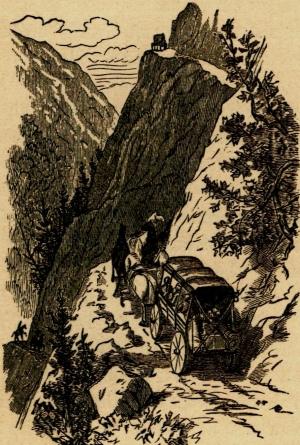

an inscription to that effect, with their names appended. There are Tiers and liars.
The arrival at Big Tree Station—Washburne's—a delightful place, ended the most luxurious mountain ride I ever enjoyed, and " the evening and the morning were the third day." After luncheon the company took a mountain trail as narrow as the path whereon they call the cattle home, for the Mariposa grove of giant sequoias, the biggest vegetables in the known world. It was a ride of fourteen miles, the return through the dense green darkness of the pine woods, with a very timid moon that did not dare to light the way. My next best friend braved the journey like a heroine, and returning ambitiously desired to be placed on some "standing committee" for life.
THE BIG TREES.
The California Indians have a saying that other trees grow, but the Great Spirit created the sequoias out of hand. It is the savage way of calling them miracles. And they are, for how a tree from twenty-five to thirty stories high, and with room, if hollowed, to shelter three hundred guests, and leave stabling quarters on the ground floor for a dozen horses, could have pumped from the earth and inspired from the air material enough to build itself along without waiting, is incomprehensible. To be sure, some of them have been a thousand years going up, and others a score of centuries, which would date them back to the time when Julius Caesar was drubbing the Druidical savages of Great Britain. It gives you a queer feeling to look at a tree in full plumage that might have been flaunting its green needles when there was not as

206 BETWEEN THE GATES.
much as a neck of land in the known world between Liverpool and Honolulu.
Whoever expects to be astonished at a big tree will be disappointed. When your imagination has climbed two hundred and fifty feet of tree, an additional hundred or two will not matter a carpenter's rule to it, nor add a cubit to the grandeur of the vegetable. The truth is, our imaginations have got so snugly fitted to the average of great trees, that they are no match for monsters, and ten chances to one we will find the faculty we are so proud of perched in the first fork for a rest. " I had to look twice before I saw the top of it," is the careless, colloquial way of describing a great height.. Like many another random phrase, there is method in it and philosophy withal. We must look many times to realize how far off the plumes of a sequoia twenty-two rods high really are. The bark is a sort of Indian red from one to three feet thick, resembling butternut-colored shoddy.
Riding along through woods where all is stately, you know a sequoia without an introduction, and everybody calls out, " There's a big tree!" It is not as handsome as the pines, it is corrugated, it lacks the symmetry, and you wonder it is dumb. If ever a tree should have a tongue, it is the Sequoia gigantea, the king of the red-woods. Somehow it seems to you such vastness should appeal to more senses than one. Years ago, I wrote several lines with bells on their toes, about what was misnamed a California oak, to the effect that some Vandal girdled it and it never knew it for three years, but grew right on as if nothing had happened. I have detected the blunder. The oak was a giant sequoia. I saw the tree in the Merced family. It was struck by lightning
two years ago, and twigs three feet in diameter blocked the stage-road. It was scorched and rived, but it lived and was in full feather when I saw it. The pumps were manned so mightily, the tides of life yet flowed up the majestic column. The news had not reached the green eaves, dim, misty, and so far away. It did not know that it ought to be dead. Fourteen horsemen ringed that tree like the zodiacal signs, and no crowding. Set the " Father of the Forest" upright, that prostrate monarch of the Calaveras grove, in the circus ring where master and clown pelt each other with fossilized jests of the silurian age, and there would be scant room for the calico horses to canter round the trunk without tramp-ling the toes of the spectators, or grazing the flesh-colored legs of the centaurs of the circus. Think of taking a horseback ride of five rods into the hollow of a
tree, with head erect as becomes the knight cap-a-pie who enters the redwood hall of a single timber. A cave is burned out of one of the Maraposa family, and seven of our party rode into it.
Fires and fools have wrought sad havoc with these sinless towers of Babel that have kept on growing through the centuries straight toward heaven, and no confusion of tongues to stop the business, but they are now the wards of the Government. A boy — and now and then a man — would naturally suppose that the tree that can hold its fruit three hundred and fifty feet in the air should hold up something worth while, say the size of a bee-hive or, at least, of Cotton Mather's hat, but the cone of the sequoia is not much larger than the egg of a talented pullet, and among the smallest of the conifers. Writers have printed their groundless fears that these



royal dukes of the wilderness will become extinct, but the earth around them is alive with baby sequoias from a few inches in diameter to six feet. Only give them a few centuries and protect them from rogues and. ruin, and the tourists of the year of our Lord 2500, who visit the western slope of the Sierras by aerial ship and electric car, will wonder at the vigorous giants, young at a thousand years old, that lift their green coronals in the thin air, and will talk viva voce across the continent to the friends they left a day or two ago.
" What shadows we are!" But think how the dusky double of a tree four hundred feet high will single you out, while the sun goes down, as if the index finger of purple darkness were pointing the route of the Eastward-coming Night, that shall blot you out like a misspelled word from a day-book. It grows along the landscape. The earth has lost the sun, but there upon the redwood's crown shines a crimson flame. It is the bedroom candle just lighted by the drowsy day.
A man whose ax used to tick like a lively clock in " the sounding woods of Maine" asks " how much cord-wood will one of the big fellows make?" The answer, if snugly piled along the roadside would extend twenty-eight hundred feet, and if twenty-five cords a winter of such fuel will keep his kitchen chimney roaring with satisfaction, one tree would last him sixteen years.
One after another the wonder-stories of childhood prove true. Lemuel Gulliver's talent for vegetable lying in his most Brobdingnagian mood would not have added more than two hundred feet to the tallest sequoia, which is a very short range for anybody with a gift for drawing the long bow.
BOUND FOR THE YO SEMITE. 209
A FOREST RIDE.
" Who's going in to-day? " That is what I heard the next morning after we had slept off the giants. The question was answered in a minute, for Mott, a skilled driver, whirled up to the front of Washburne's hotel, and we were off. California stages are prompt to the minute. They run on schedule time. That " going in" recalls the old army life at the Front. The blue-coats were always talking of " going in," when they waded knee-deep into the thick of the battle. We were nearing the Valley.
Another day of forest magnificence. You can form little idea of the stateliness of these woods. Golden mosses drape and spangle the dead trees with the color of Ophir. For miles, arcades of columns two hundred feet high, dressed in rainbows, aflame with scarlet, afire with crimson, aglow with gold, running up, and up, a thought's flight without a limb. Should an artist paint them as they are, you would doubt your own eyes or discredit the painter. They were the wild woods in a Roman carnival. With the grandeur of the trees, the colored mosses, and the painted creepers, it was a picture all brilliance, as if the columns of a thousand Greek temples, decorated with garlands, bad fallen into lines in a great procession, and were ready to march. Not a brown shaft in sight. It was a sort of revelry of the spectrum. The bark of many of the trees resembles tortoise-shell. It suggests the empty skins of the huge Brazilian serpents you saw at the Centennial Exhibition. You are in a gorgeous land, whither you have sailed without going to sea. You long for a glimpse of an American flag to assure you you are yet at home, and you find it. On
9*


210 BETWEEN THE GATES.
the peak of a little cur of a barn—though what there could ever be to put in a barn but pine cones is a mystery — is a handkerchief of a flag that has about fluttered itself to pieces; but there are a star and a stripe left, and you are comforted.
FIRST GLIMPSE OF THE YO SEMITE.
At three o'clock, afternoon, we had climbed almost to Inspiration Point without knowing it, whence the Valley of the Yo Semite appears to you — there is no other word; "breaks," and "bursts," are terms of feeble violence to express the truth. If day broke in a noisy way; if these pines around us grew with sound of hammers, the grandeur would be gone. We have just seen an amphitheatre ten thousand times as large as Vespasian's at Rome ; have looked across the blue spaces at the semi-circular ranges of rocky seats, curve above curve, sweep beyond sweep, and fancied the pines that fronted them were senators risen to their feet as the Imperator entered the Coliseum. But there was no hint that we were nearing the brink of the valley of the granite gods. The precipices that took our breath away had disappeared. The great chasms of empty azure that we had looked off upon till we felt almost lost in an ethereal ocean, were closed behind us by merciful walls and curtains of dense green. We had blundered up into the garret dormitory where the mountains were lying down all around us in " the sixth hour sleep." The stage crept over a recumbent shoulder without waking the owner, rolled out upon the point where the drowsing giant would have worn an epaulette had he been in uniform, moved a few steps farther, cane to a halt, and there, lighted by the after-
BOUND FOR THE YO SEMITE. 211
noon sun behind us, speechless, near, far, nothing doubtful, nothing dim, the Yo Semite awaited us without warning, met us without coming.
Spectral white in the glancing of the sun, the first
thought was that the granite ledges of all the mountains had come to resurrection, and were standing pale and dumb before the Lord. We had emerged in an instant from a world of life, motion and warm, rich color into the presence of a bloodless world, a mighty place of graves and monuments where no mortal ever died. It looked a little as I used to fancy those Arctic wonders looked to Dr. Kane, glaciers, icy peaks and turrets, turned imperishable in the golden touch of a Tropic sun. For the first few instants I saw nothing in detail. I had been making ready for it for weeks; not reading such dull descriptions as my own; not reading anything; only fancying, dreaming, wondering, and here it took me by surprise at last! It seemed a glimpse into another and an inaccessible kingdom. I am ashamed to say for one moment I was disappointed, for another afraid, in an-other astounded. I had nothing to say, nobody had any-thing to say, but a linnet that never minded it at all.
The driver began to introduce the congregation to us by name. I thought at first he was about to present us to the congregation —and I got out of his reach. It was much as if, when the three angels made a call at Abram's tent on the plains of Mamre, the Patriarch had whipped out a two-foot rule and measured and written down the length of their wings.
Almost four thousand feet below us was the Valley with its green meadows, its rich foliage, and its river Merced. We looked down upon the road we must go,




212 BETWEEN THE GATES.
looped backward and forward upon the side of the wall, track under track, like the bow-knots of flourishes 'boys used to cut under their names, when writing-masters nibbed their pens and boys ran out their tongues. We looked two miles across the air and saw the sculptured fortresses no man had made; saw a great heraldic shield, bare of inscription, a thousand feet from the ground. Upon that shield the coat-of-arms of the United States should be emblazoned. It would be the grandest escutcheon on earth.- We saw 'traced upon the wall beneath it a chalk line that went to and fro, as if, bewildered and dizzy it did not know where to go. That chalk line is a wagon road out of the Valley. If anybody had told you it was an illiterate giant's first attempt at writing coarse hand it would have seemed more probable. Looking down the chasm behind you, the river is foaming on toward the base of a mountain, to escape from the vale of enchantment, till it roars its way into a yawn of a mouth that seems no larger than the entrance to a wolf's den, but which, if you ever escape from this region, you will find is a broad canon.
I noted all these minor things with a strange irrelevancy. It was an instinctive resistance to being wrenched from the every-day world of seeming trifles to which I belong, for I assure you, when the Valley is finally reached, all such things as trifles will vanish away. And while I was doing these nothings, Yo Semite was standing before me and waiting.
I turned to it again, and began to see the towers, the domes, the spires, the battlements, the arches and the white clouds of solid granite, surging up into the air and come to everlasting anchor till "the mountains shall be
BOUND FOR THE YO SEMITE. 213
moved." The horizon had been cleft and taken down to make room for this capital of the wilderness, and for the first time in my life I saw a walled way out of the azure circle that had always ringed me in.
Just then, the coach we were to meet came creeping like an eight-footed insect up the mountain. It cut a poorer figure than the fly that traveled along the curve of the Ephesian dome. The party leaped out with laugh and chatter, and a girl of eighteen ran to this vantage ground of glory, took an instant look and said—her hands unclasped, not an eye fine, frenzied or revolving, it was a saccharine adverb and an adjective too soft to provoke an echo that she used—and said, "It is sweetly pretty!" and with a little cluck of satisfaction she munched a sandwich. Now as between an idiot and an affected. actress there is much space and little choice. Perhaps, after all, it was as well as anything, for I begin to mistrust I cannot make anybody see the Yo Semite who does not go himself. Judge B had been here. He met his friend C, who asked a description of the Valley. The Judge had traveled in foreign lands, and was able to compare, and so he began: " Why, my dear sir, the Yo Semite is as much superior to—as much superior to as— as much grander than — well, than —but what's the use of trying? Let's take a drink!" But who ever was warned and took heed? Not the land-lubbers that Noah left ashore, not Lot's old neighbors, not the pilgrim to the Yo Semite, not anybody.
"Let us down easy, George," for our old driver was going back with the coach. He generally untied the double-bows of the road "by the run," but he just walked the horses every foot of the way, and spelled
214 BETWEEN THE GATES.
down the Z's like an urchin laboring through a hard word by the help of a schoolma'am's index finger. It was easy as swinging down in a basket, but it was not heroic. And to think that when we got down, we were yet four-fifths of a mile above the sea!
THROUGH THE VALLEY.
The ride of three miles up the Valley was restful as " the beauty sleep " of forty winks that girls take after the call to breakfast. The twanging nerves that were keyed to " C sharp" on the heights, let down a little. The Valley, seven miles long, with a varying width of a half mile to a mile and a quarter, is as wild as you want it. The Merced, that crystal river of Mercy, in endless quarrel with rock and rubble, foaming, flashing, roaring, dashing, meets you all along, in its desperate haste to get out of the canon. And when you see what tremendous accidents are always happening to it—now slipping from the verge of precipices a mile high, and tumbling hundreds of fathoms sheer down, with nothing to hold by, till it grows gauzy as a bridal veil and white as silver, you can hardly wonder at its desperation. You are a little sorry for its misfortunes, as if it were some-thing human, and then a little glad it has had the provocation to show its torrent temper and angry beauty. You drive through broad natural meadows, dotted with tangles of shrubbery, feathery with ferns, and impudent with wild flowers that fear nothing; amid pines that are trying to grow up out of the tremendous gorge into the world; beneath avenues of live-oaks, among the junipers, the buckeyes and the buckthorns; here a mountain lilac, a manzanita, or a nutmeg; there a cluster of silver firs



BOUND FOR THE YO SEMITE. 215
or mountain alders; yonder a balm of Gilead, a maple, or a dogwood. Azaleas, bluebells, honeysuckles abound. The woods that grow in the Yo Semite are all precious woods, taking the polish and showing the clouded beau-ties of the finest marbles; mountain mahogany, rosewood, Indian arrow, laurel, ash.
The quaking aspen, trembling like a timid girl at nothing at all, is a feminine figure in the landscape. " What is that shivering tree, shaking without any wind?" asked an English tourist of a raw and ignorant guide. "1 doant roightly know," was the reply, "but it is a wobblin' asp, or somethink that away"; and " wobblin' asp " became a synonym in the Valley for forty-fathom stupidity.
You hasten on ; towers, spires, battlements, castles, dizzy walls, sculptures at either hand; you hear the winds intoning in the choral galleries a mile above your head; you hear the crash of waters as of cataracts in the sky; you trample upon broad shadows that have fallen thou-sands of feet down, like the cast-off garments of descending Night. The three great geological theories of this clefts formation — that the bottom fell out and let things down; that earthquake tongs and volcanic fires melted the crags and rent them asunder; that the softer and more edible parts of rock and mountain were eaten out by rains, and frosts, and rivers, leaving the stupendous bones bleaching through the centuries —you would not toss coppers for the choice of them. All you know is that you are in a tremendous rock-jawed yawn of the globe, and the most you hope is, that it will keep on yawning till you are safely out of its mouth. Jonah was never one of your great exemplars. You pass two or
216 BETWEEN THE GATES.
three inns and modest dwellings, and are set down at Barnard's capital Yo Semite Falls Hotel, where you find a Highland welcome and a bounteous table. Nothing in the whole animal kingdom is recognized here but the tourist. Wells & Fargo have an express-office for him, and a post-office for him, and educated lightning strikes him in all languages. There 'are collectors of ferns and
flowers, cutters of canes X11 ; and workers in woods,
dealers in tit-bits of fern-prints, foot-prints, stone fish, trilobites, stalactites, and bonne-boucices of tarantula nests; there are guides with spurs like game-cocks, scrambling mountain horses, Mexican saddles, and wooden baskets of stirrups: there are straggling Indians
with tangled manes over
their eyes, and strings of
speckled trout in their
hands; there is the ubi-
quitous, aggressive photographer, who is always ambush-
ing his head and taking sight with his Cyclopean eye at
every visible thing that will wait to be looked at. Some-
times I wonder if we really want him; if he is not a
multiplier of illusions, a sort of traveling agent for the
diffusion of delusive knowledge. I am sure he is, when
I compare his Yo Semite with the Lord's. Few photo-
graphed landscapes ever convey a new idea. They only

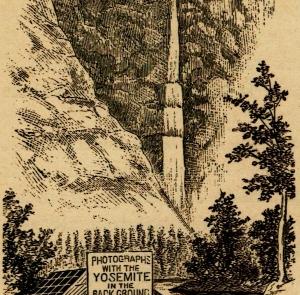
BOUND FOR THE YO SEMITE. 217
recall an old one. One of these artists has set his sky-light kennel in front of the Yo Semite Fall, and blazons in big letters: "Photographs taken with the Yo Semite in the background!"
Think of the impudence of the thing! Offering to throw in twenty-six hundred feet of cataract; pairing off your little dot of a face and figure with a half mile of tumbling glory, and selling cascade and tourist for eight dollars a dozen. The " eternal fitness of things " is a lit, tle out of plumb.
The first thing I did was a sentimental improbability. I ran down the balcony stairs to congratulate the poor River of Mercy on having a few rods of rest. There it was, lurking behind the hotel, as smooth as a looking-glass, and a fleet of ten ducks afloat upon it, ten above and ten below, and not so much as a duckling's breast shattered by wind or water. Listening a minute, I heard it in full quarrel a mile below. Persecuted, perplexed, pugnacious Mercy. No tourist forgets the admirably appointed Cosmopolitan Baths, owned by a gentleman with the singular name of John Smith—'-John Smith sundered by a C. Here is
THE GRAND REGISTER.
It is a ponderous book, containing several solid feet of paper, bound in morocco, mounted with rich plates of silver worth eight hundred dollars, and is a big lift. The pages are apportioned to every State, and almost every country but Patagonia. That book furnishes reading so ridiculous as to be ludicrous — " infinite platitude," rhymes thick as sleigh-bells in New England winters, flashes of wit, and whole nights of stupidity.
10
218 BETWEEN THE GATES.
The disposition to patronize the Yo Semite is remark-able, as is also the fact that almost everybody arrived by the first stage. One tourist with the dental name of Toothakee, and one with the rascally name of Turpin, figure on the same page. The latter writes: "Seen the Bridal Veil. Slept next to the man that snores." Here a tourist declares: " The miteist work of man is dwarfed," unconscious that he is comparing a lively cheese and mountain magnificence.
A writer " made futile efforts to reach the Valley October 12, '75, but in vain." Does the man mean to say that he failed? One mercifully says: "Words fail me"; and a lady declares, sorrowfully: " Can't express my language."
" You need not go round the world. When you have seen Glacier Point and Cloud's Rest, go home and rest yourself." A poor Tray confesses: "Came with three Western legislators—never stole anything—will -never be guilty of the same indiscretion again." A sensible man remarks: "I leave my hard but modest name, A Flint." An impressible young woman is " blissfully happy." Another leaves a certificate: " Not disappointed!" " Top-side below," ejaculates an angular man from Maine.
Massachusetts is very reticent—pages of names, and not a word of comment, only this: "Plymouth Rock to the Rocks of the Yo Semite, which in their grandeur illustrate the sublime events and principles of which it is itself a symbol, greeting!" An equestrian who had been making a hammer of himself asserts: "God made the mountains, but man made the saddles." Connecticut " did not find it more than his imagination had pictured it." New Hampshire leaves a neat sentiment: "The Granite State to El Capitan sends greeting!"
BOUND FOR THE YO SEMITE. 219
Here is verse — Tis-sa-ack is the South Dome:
" Tis-sa-ack's caught the horned moon,
And holds it pendent in the air,
Where calm its silver shallop rests,
By airy sailors anchored there.
Time travels gray-brow'd o'er each height,
And holds his scroll against the sun,
And says, ' come view my heaven born might,
And what my air-edged chisel's done.' "
Little Rhody shouts " Hail Colombia ! " Here is some-thing in Russian, here a scrawl in short-hand, there a capacious Missourian " took it all in!" Ohio's imagination goes by water: "Cannot realize the grandeur of the falls, the water being low." Put in an overshot wheel. A prodigal son of adjectives cries: "Grand, beautiful, picturesque!" fairly offset by an eloquent fellow who says: " Dumb as an oyster." " Superbe, Yo Semite ! " and France salutes. "Hoofed it to the Valley," is an old soldier's memorandum. Who wouldn't be glad that Liverpool is " much pleased so far!" How encouraging to Nature to hold out and pass muster! Some tourist. weaves in everybody's pronunciation of Yo Semite:
"At half-past five o'clock at night, Our party reached the Yo Semite, Glad ere the evening lamps were lit, To see the Valley Yo Semite.
Who that has seen it can condemn it, The wondrous beauty of Yo Semite? This verse I dedicate to thee, Oh, world-renowned Yo Sem-i-te! "
A Baltimore girl effusively exclaims: "Let me em-brace thee, beautiful Valley. A kiss to thee!" " Take off your shoes," quotes another, " for the ground whereon you stand is holy ground." Can there be much doubt that the Mississippian who left the record, "Let us go and see the monkey," is himself the missing link? A
220 BETWEEN THE GATES.
lovely maiden testifies: " My eyes devour the crags!" and a young man makes love to the Bridal Veil Fall. Fancy him courting a young woman nine hundred feet high, with hair all the colors of the rainbow.
The names upon these broad pages represent the world. Here are lords, barons, viscounts, counts, members of parliament, one solitary duke, a sprig of princes, great generals, world-famed savans, statesmen, Lady Franklin, Mrs. Partington, and nobodies. Australia is here with the verdict, " America is the dertiest country in the world." We regret that he put an i out with his adjective. If he will only write it again and put out the other, he will be as discerning a tourist as ever. Peru, Japan, Egypt, New South Wales, are all represented. Ceylon, of the spicy breezes, writes, " Beautifle." New Zealand declares it mathematically: "Switzerland minus its mountains." Pennsylvania gives a good-natured Low Dutch groan: " Weak and wounded, sick and sore "—then down he comes with his avoirdupois—" weight 260 pounds." Then comes a record: " This invalid lady was packed in a chair twenty-seven miles, on the backs of four China-men" — the best proof in all the book of an earnest love of Nature. And so they run. " This day Freddie Strong, six years old, rode thirty-eight miles on horseback." Give the little mountaineer a record.
There is no sin in " a little nonsense now and then," but the Sinbads the sailors, who come hither under pre-tense of seeing the strength of the hills, and bring a sordid " old man of the sea," pick-a-pack, with his legs tied in a bow-knot under their chins for a cravat, and make business directories of the big book, and placard the majestic rocks with cries of "Cream yeast!" "Sewing ma-
BOUND FOR THE YO SEMITE. 221
chines!" "Farm wagons ! " and " Liver pills!" commit an outrage demanding indignant protest. It is the money-changers in the Temple over again, and nobody to cast them out.
EL CAPITAN.
The most impressive granite wonder in the Valley is the great rock El Capitan, gray in the shadow and white in the sun. Standing out, a vast cube with a half mile front, a half mile side, three-fifths of a mile high, and seventy-three hundred feet above the sea, it is almost the crowning triumph of solid geometry. Thirty "Palace Hotels," seven stories each, piled one above another, would just reach the hanging eaves of El Capitan; two hundred and ten granite stories by lawful count. Well did the Indians christen him Tu-toch-ah-nu-lah — Great Chief of the Valley. He fronts you when you catch your first glimpse from Inspiration Point. Had there been any fourteenth-story windows, you would have looked squarely into them. When you reach the Valley he towers above you on the left. He grows grander and more solemn every step of the way. When you stand beneath him he blocks out the world. When you near the base he roofs out the sky; for though the wall seems to stand upright, the eaves project one hundred and three feet, a granite hood five hundred feet thick, but in the vastness you never see it. Get as far from him as you can, he never diminishes. He follows you as you go. He is the overwhelming presence of the place. A record in the Grand Register runs thus: " A lady fellow-traveler, struck by the constant appearance of El Capitan in the Valley, suggested that it recalls the Rabbinical legend, ` The Rock that followed them was Christ.' "






222 BETWEEN THE GATES.
You never tire of seeing eastern sunshine move down the front, like a smile on a human face. You never tire of seeing the great shadows roll out across the broad meadows as the sun descends, and rise, like the tide in Fundy's Bay, till the Valley is half filled with night, and the tips of the tall trees are dipped like pens in ink. You never weary of watching the light from a moon you cannot see, as it silvers the cornices and brightens the dusky front, as if wizards were painting their way down without stage or scaffold. A dark spot starts out in the light. It turns into a great cedar. Pines that stand about the base resemble shrubs along a garden wall. They are two hundred feet high. A few men have crept out to the eaves of El Capitan, looked over, and crept back again. Little white clouds sail silently toward the lofty eaves and are gone, as to a dove-cote in a garret. And yet an earthquake in 1872 rocked him like a cradle, and the clocks in the Valley all stopped, as though when El CalSitan was moved, then " time should be no longer."
THE BRIDAL VEIL.
The Bridal Veil Fall—the Indian Pohono, or Spirit of the Evil Wind—has been talked at and raved about till it is famous as Niagara. A clergyman has been known to take it hone with him, and carry it around to weddings and funerals, and preach it for a bissextile year. As you enter the Valley, you see upon the right almost a thousand feet of unbent rainbow, thirteen yards wide, hanging over the edge of a precipice. In midsummer, when there is less need of a token, the broad scarf of the spectrum is narrowed to ribbons bright enough for a queen of May. It curves out over the cliff and
BOUND FOR THE YO SEMITE. 223
plunges down to the tumbled boulders below, and shatters to spray that blossoms into rainbows, arching the gloom,— a bouquet of flowers for the Spirit of the mountain.
Now the cataract begins to swing majestically to and fro, like a gridiron pendulum, and the tick of a mountain clock would not surprise you. And now it is twisted into colored bell-cords and finished out with downy tassels, as if somebody were making ready to ring the chimes of Heaven. Then the fingers of the wind weave it into a gossamer veil of thirty-nine hundred square yards, that falls with fairy grace over the face of the mountain and down to its feet, and the Wedding March is the music for the moment. Then the veil is swept aside, and lifted, and flung up around the brow of the cliff, in the folds of a white turban, touched up with tints of color like the bead-dress of some queen of the Orient. Nothing more delicate than this veil ever came from the looms of India, and where you stand it is silent as a picture; no more crash than there is to the broidered lace that flows down a woman's arms and falls upon her wrists. It looks aerial enough to be rolled up to the verge of the precipice, and then drift away like a commodore's broad pennant swept from the mast-head in a, gale. It is a tributary of the Merced River in disguise.
And yet, while you gaze upon this glorified Spirit of all cataracts, somebody beside you will be pretty sure to break the spell by saying, " But you ought to see it in May, when there was more water, or in June, when there will be less," or some more blessed time which never happens to be now. Such people should be apprenticed for life as gate-tenders to the flume of a grist-mill, where
224 BETWEEN THE GATES.
they can let the water on at will. " From pestilence, famine and Madame Malapropos, good Lord deliver us!"
MIRROR LAKE.
The professional tourist is a vagrant animal. You know him at sight. He has elbows, and they are never trussed. A place wide enough to let them through will let him through. He dresses to please himself, and never mistakes your eyes for a looking-glass. You see him in a tweed coat, always too short or too long, pantaloons that fit like a couple of extinguishers, gray gaiters splaying out into roomy shoes that would track in the snow like the grizzliest of plantigrades, and crowned with a disreputable hat with a green brim that appears to have been blasted before it could get ripe. The small worry of his life is not that he may be cheated, but that any-body should think it possible. He will forgive the theft but not the thought. His outside is his rough side. Get at him and he is kind-hearted, rich in strong sense and pleasant information. He bestrides a pony with his long legs, and the little beast has as many feet as a house-fly in a minute. He cuts a club of a cane as if he were going to have a bout with Hercules, and stalks away up the mountain. He is never more at home than when he is abroad.
The sunrise pilgrimage to Mirror Lake, three miles up the Valley from the hotel, is one of the most delightful. The lake is a sheet of water with an area of six or eight acres in midsummer, and waveless in the morning as a silver floor. Insignificant of itself, it betrayed the professional tourist into a premature spasm of contempt, and he exclaimed, his head running on Lakes Geneva and
BOUND FOR THE YO SEMITE. 225
Tahoe, " Why it's nothing but a blarsted poodle after all!" " But it reflects the mountains," interposed some-body, and the tourist snuffed him out with, "Any poodle can cast a shadow."
Big or little, Mirror Lake is the toilet-glass of Majesty. Had there been such a piece of furniture in Palestine, Satan could have saved his mountain climb, for he would have showed the Savior the glory of the world, if not its kingdoms, reflected in this breathless trinket of water. At the left and three miles distant, Mt. Watkins lifts eight thousand feet above the sea—who is Mr. Watkins?—and yonder is South Dome, a half loaf of solid rock, ten thousand 'feet above salt water, cut on the severed side to a precipice that swoons away almost a dizzy mile. In front, and six miles away, like snowy cumuli at anchor, tower the granite glories of Cloud's Rest, a mile and a quarter above the Valley and two above the sea.
The rising sun shows a flag upon the summit of Cloud's Rest. It is answered from the South Dome. There is gold on the Cathedral Spires. There is crimson on Glacier Point. There is fire on El Capitan. Did you ever see a cataract of morning light? Look along that castellated ridge. See the sort of rayed and smoky glory rolling like a rapid river over the brink; it is the spray of morning playing on the granite.
Now gaze down into Mirror Lake, and you shall be-hold the mountain heights draw near each other; the lofty crowns and far-off peaks incline their stately heads together to whisper "morning!" round the land. The curve of the great dome like the fragment of an azimuth, the outline of crag and cliff, the trees that cling
226 BETWEEN THE GATES.
like sailors in the shrouds, the changing lights, the shooting, shortening, shifting shadows, all doubled in the water at your feet.
Looking at the gigantic group in the little mirror, you begin to gain a new idea of the magnitude of mountains and the size of—yourself. Here are giants that, ranged around in a twelve-mile sweep, could all look into the same well together, like Jacob and Rachel at old Haran.
As we were watching the dissolving views we should never see again, a Cassius of a fellow with an African antecedent appeared with a battered bugle, rheumatic as to its keys, patched with pewter and asthmatic beyond relief. It might have been blown by The Cid's bugler in the eleventh century to scare the Moors away, and look not a century older. Cassius wanted to play for fifty cents, and the echoes. To have the crags open mouth upon us in harmony with that instrument of torture was not to be thought of. So one of the party lifted up his head and called crick-o-o! and every rocky face and alcove and wooded wall gave back the word—treble, alto, tenor, bass,—and when we thought they were all done, a faint voice from a far ledge faltered "cuckoo."
For a lumbering old mountain weighing two or three hundred million tons, and whose shoulder an able-bodied star could not get high enough to look over without a two hours' climb from the level of the sea, to stand there and say "cuckoo " after you was absurd to a degree. It was paltry business to bandy a word about that names a bird too mean to hatch its own chickens, and so Boanerges was desired to shout " Liberty!" and the rousing trisyllable came bounding back from the responsive con-
BOUND FOR THE YO SEMITE. 227
gregation. A crag called " Lib," a wall put in the " er," and somebody in a turret shouted "ter" and then far and near, high and low, the syllables came straggling along, the articulation growing fainter and slower, and " the daughter of voice" was silent.
And then a breath from down the valley struck the water, and the Dome was wrinkled and the Cap of Liberty was ruffled like a French night-cap. Cloud's Rest trembled out of sight, and the pageant was ended.
UP A TRAIL.
On horseback or on foot, there never was anything in a champagne bottle so exhilarating as climbing a mountain trail. I tried to read these trails inscribed like the mysterious writing on Belshazzar's palace walls, for a day or two. I watched an apparently perpendicular rock a thou-sand feet in the air, and saw a chalk line. All at once from a fringe of trees mid-air there emerged three horse-men single file, and toed it, and crept like flies along the mountain side where there seemed no foothold for a chamois. Then with one accord they rode straight out to the angle of the precipice, as if they had concluded to make a cataract of themselves, and a Tarpeian rock of it. Then one of them climbed to the left, and two of them scrambled to the right. They had parted company. In ten minutes they reunited and were headed the same way and upward still. And so they kept meeting and parting, meeting and parting; the thousand feet was fifteen hundred, the fifteen hundred two thousand, and then they went into a hole and I never saw them come out; but after a couple of hours, upon a pinnacle were three rats that were horses, and three glove fingers that were
228 BETWEEN THE GATES.
men. They had been traveling on two sides of a ladder of flat Z's, and had slowly spelled themselves to the summit.
The next morning, a four-in-hand took us two miles up the Valley, through scenery that, with tree and vine, rock and river, tangle and shadow, was wild as the most exacting Dryad .or Naiad could wish, to the horse-trail, a crooked, dusty trough, strown with stones, streaked with the stroke of horse-shoes striking fire, ribbed with gnarled roots, jostled by rocks, bordered by precipices that tumble down into holes through the world, set up end-wise, tilted edgewise, and wide as a stair carpet. We reached Register Rock, with a shadow in a weary land, like its Old Testament twin. It is about the size of a Pennsylvania Dutchman's barn, and scrawled over with " cream yeast" atrocities, and mammon and harlequin possess it. It tells us that a flock of seventy-three Bloomers alighted here in one day; that Bierstadt and Moran halted for a mountain drink; that " Bob of Chili," "the noblest Roman of them all," has been here.
From this rock the horse-trail climbs to the right for Nevada Fall, and a fine-hand affair, a foot-trail, trends up to the left for Vernal Fall. We take the latter, a crazy screw of a track, where the thread turns both ways in three minutes; a wall of earth and rock on one side, a gulf on the other, where the persecuted and mystified Merced is roaring and raving from its last tumble,—the unhappiest, jolliest, liveliest river in the geography. You put your feet side by side at first, and then Indian file, as boys walk a crack; doubling head-lands, climbing jagged stairs, crossing unrailed balconies. It is nervous enough. The hungry Merced is tearing
BOUND FOR THE YO SEMITE. 229
down the gulf at your left. The boulders lift their brown sea-lion heads flecked with foam. You wish your right ear weighed four pounds, for a balance on the safe side. You are not sure but it does—and
the other ear also—for as you turned in THIS IS NOT A HORSE-TRAIL. upon the trail, a placarded tree exclaimed:
If the Athenians really voted that asses should be horses, it was never carried. You grasp the laurel's shining leaves as you climb, and they reward you with the refreshing fragrance of bay-rum. You pass round an angle, and Vernal Fall, three hundred and fifty feet high, is tumbling out of the air. It is no more vernal than a Lap-land January is 1100 in the shade. It is a cascade of crystals. The rocks are spattered with the broken crockery of the spectrum.
Water Falls do not talk alike. They roar, growl, crash, grind, rush. The voice of the Vernal is grum, like a mill, one minute, and then rough, like the grate of coach wheels in the gravel, the next; but the Nevada Fall slides with a smooth, soft, lulling sound, and a faint tone like the moan of a bell that has just done ringing. You creep over a lean shoulder, and two flights of stairs, straight as Jacob's ladder, confront you. At the first glance you think you would about as soon climb by the curve of a notched rainbow. In some places the path has an outer edge bare as the hem of a handkerchief. In others, a fringe of grass two or three inches high borders the trail, and how that mere nap of vegetation helps you keep your balance is truly wonderful, when there is no more protection in it than there would be in a railing of spider's web, but you walk with a braver, surer step.
230 BETWEEN THE GATES.
Fern Grotto, at the foot of the stairs, is a dilapidated hood of rock, apparently just ready to tumble upon any forty or fifty heads that may get into it. Every maiden-hair fern within reach had been plucked or wrenched away by the roots, and some, on the rocky shelves out of harm's way, had evidently been stoned as boys stone a treed squirrel. Climbing the stairs, you land upon a broad, smooth rock floor, with a stone balustrade built by giants, whence you watch at your leisure the first silent, polished plunge of the curving and jeweled water over the verge. Then we go down the stairs, back over the hair-line, which is an 'air-line on the brink side, to Register Rock, where we take to the elbowed arms of the horse trail, and tack and tug slowly up the mountain. Every other arm, we are in the full glare of sunshine. Every other arm, we are in the shade. The valley falls away as we rise. The mountains settle down like motherly hens and brood the little hills. The horizon ripples away and takes in more and more of the world. The trails double above each other like hanging balconies.
Just now a ringing mountain cry comes from below. It is answered or echoed far over our heads. Queerly enough, the highland shout is an inarticulate cuck-oo, a variation of the Swiss yodel. Here
is the score of the musical cry:
These signal and warning cries are not only pleasant everywhere, but necessary upon the narrow trails, and prevent many an accident and awkward meeting. In twenty minutes the owner of the voice followed the shout. He was a mounted guide with two ladies and a bit of a girl whose horse he led with a lariat. The horses went with their noses down as if following the
BOUND FOR THE YO SEMITE. 231
trail by scent, carried their tails like Bo-peep's sheep, and scrambled, sure-footed as goats, up the steeps. The ladies were picturesque in sea-side hats, two stirrups apiece and a foot in each of .them. Some of the best trails had the cows for engineers. Few suspect what ambitious heights the lumbering mothers of the herd can reach for a tuft of grass.
Four miles on the crooked hypothenuse of a triangle brought us out at last upon a sun-bombarded, scraggy plateau, and in front of us, as if a rock in the sky had been smitten like the one in the Wilderness, the Nevada Fall poured its snowy waters. Softly sliding in silken scallops,t some fast, some slow, waters over waters, silk over satin, and only four steps in a seven-hundred-feet stone stairway, it gracefully descended with a rustle of white garments, to the paved street that led down to Vernal Fall and the valley and the canon and the sea.
Towering two thousand feet above the head of the grand staircase, like a sentinel four thousand feet high, stands, rigid, soldierly, erect, The Cap of Liberty. Shaggy Bearskin Point is in sight, which Miss Anna Dickinson, with a slight godmother experience of baptismal fonts, strove to rechristen Crinoline Point. A sightly place to hang a petticoat!
There has been some atrocious naming of the mountains. Neither poet nor soldier has so much as a peak to himself, but a photographer is his Eminence by virtue of a crag, and there is a whole mountain by the name of Gabb! Think of filling Fame's sounding trumpet with a sonorous—gabble! Coming up the Valley from the Bridal Veil, you see at the left three grotesque crags, four thou-sand feet high, that turn their heads as you near them
and change their shapes as you leave them. Some fraternally-inclined soul named them the Three Brothers—why not the three blind mice?—when the Indians had recognized and christened them as well as Adam could have done it, Pom-pom-pasus, the mountains playing leap-frog, and there, to be sure, they sit, the granite batrachians, each behind the other, their arms on their thighs, their chuckle heads lifted, and forever making ready to jump.
We shambled and heeled it, and sometimes mnanibus pedibusque, down the trail into the Valley, where saddle-horses overtook us, a stage met us and friends greeted us. We had enjoyed a climb, a hold-back, a saddle, and a stage ride,— fourteen miles, all told; had been in sight of the raftered garret of North America; had seen horizons, now crushed like a broken hoop, and now built far out, broad, round and perfect,— a vast amphitheater peopled with a senate of mountains. It was a white day. It is so set down in the calendwr.
YO SEMITE FALL AND SUN TIME.
In midsummer the Yo Semite is less a fall than a fall-away, and there is no more tumult about it than there is in the drooping grace of a weeping willow. A streak of water and a broad, dark line on the face of the rock, a sort of dull lithographic map, show the route of the cataract. It is a perpendicular half mile from the brink of the fall to the base, and there are times when the tumbling thunders of the melting snows from the Gothic towers beyond, plunge through the cleft with a head-long leap of fifteen hundred feet, strike a granite stair, and then, girdled and hooded with foam and fury, des-
BOUND FOR THE YO SEMITE. 233
perately slip and slide four hundred more, and then make a clean and final leap of more than forty rods down to the Valley, a total twenty-six hundred feet of cataract It is a drove of up-country rain storms and snows, herded by the shepherds of the Sierras, and driven "down a steep place into the " valley.
There are times when the ice and snow are piled at its base to a height of four hundred feet, as if Yo Semite had pocketed a young Arctic ; but it is sure to slip through its fingers in June. The wettest thing I saw was a small white cloud, as dry as Jason's golden fleece, that came to the cleft, took a look, and disappeared.
A dweller in the Valley can see the sun rise several times in the same morning, and not travel more than a mile to witness it. There seems to be a granite conspiracy to prevent his rising at all, and he acts as if he were assaulting point after point for a weak spot. Over this peak, beyond that cliff, above yonder crag, along that wall, he shows fight; but he scales them all at last, and bombards the canon with his golden batteries. Eight, nine, ten, eleven — he is an accommodating sun, and the laziest man in the world is glad to see him before night. I stood near an old cabin where he does not rise in December until half-past one, and sets at half-past three. An old-time preacher's election sermon would pack such a day even-full of doctrine, and leave not a minute for dinner or doxology. The man was no dormouse; two hours' day were not enough; he moved a mile and got eight. It is the sort of sun that would have delighted the soul of Gentle Elia. " You come very late in the morning, Mr. Lamb," said the chief of the India House
10*
234 BETWEEN THE GATES.
to the immortal clerk. " Yes," was the poet's reply, " but then I go home very early in the afternoon!"
There never was a grander place to put up chronometers, from the great cathedral clock to the mantel-shelf affair that ticks like a harvest-fly. There are not ten minutes of sunshine that it does not touch some salient point, or a shadow extend a finger and lay it on a spire, a tower, or a mountain fir, that, once noted, is always remembered. The face of the rocks could be mentally covered with clock dials that would tell the hour as perfectly as the giant of Strasburg. Once set these time-pieces for the season, and you may leave your watch under your pillow.
While we were in the Valley, the Evening Star had a habit of passing a rugged embrasure on the summit of Sentinel Rock, three thousand feet up, and it was better than one of Shakspeare's plays to watch it. First it passed into a castle cell, behind the wall. Then you knew it was coming, for you saw a small dawn growing on the sill of the battle-window. Last, it glided into sight, clear and strong, passed straight across the field of view, and was lost in the donjon.
The moonlight sometimes reveals more than broad noon. Thus you may be watching a mountain wall all day that has seemed a smooth and finished face of masonwork; but when the moon swings farther round, shadows from some undetected high-relief of rock start out and run five hundred feet along the mountain; or what has always looked a whisker of a bush projects the double of a great tree upon the wall. There is a hand-shaped crag on Yo Semite Point, rudely resembling the four fingers and palm in a gray mitten, and the
BOUND FOR THE YO SEMITE. 235
thumb is kindly furnished by a scrubby pine, that seems to spring from the side of the hand, and you estimate the height of the tree at sixteen feet, when it is two hundred by actual measurement, and one hundred and ten feet from its base to the cold and uncharitable hand, and yet not the slightest dislocation is apparent. These unaccustomed heights work surgical miracles.
In low and level regions, a man is accurately located if you give his latitude and longitude; but among the mountains a third factor is necessary — his altitude—how far East or West, North or South, how far Up. In Chicago, not a man in ten thousand thinks about his geography above the sea level; but in the high lands you pick up a hotel card, as at Denver, and read, " altitude, 6,000 feet." There are other evidences of altitude where the stage routes are strown with broken bottles of all colors and nations, from the stocky porter to the slender-necked champagne. They exemplify a certain kind of high civilization.
Did you ever see a cast of Oberlin's head, that sugar-loaf of a head, full of sweet thoughts as a bee-hive is of honey? That is about the shape of the South Dome. Its organ of veneration is tremendous; there are six or eight acres of it, six thousand feet high, and solid rock through and through. It is a small petrifaction of the overarching sky. Agassiz would have delighted, in some fanciful mood, to construct it. He would have set this skull upon shoulders a mile and a half broad, and built up a human figure six miles high to carry it. Three kinds of pines and a few scattered grasses grow upon the reverential Arabia Petrea. It was only toward the close of the year '75 that a Montrose Scotchman, George S. Anderson,
236 BETWEEN THE GATES.
climbed off with the honor of being the first man to set foot upon the summit. He drove iron pins into the drilled rock, extended nearly a thousand feet of rope, and hand over hand pulled himself up, and then backed in-gloriously down. It is a kind of rope ferry to the skies. While we were in the Valley, a ewe and her lamb unaccountably reached the high pasture. Had it been in South America, we should have said the condors gave them a lift with a view to future mutton. How to get the ambitious lanifers down was a problem.
BREAKING UP CAMP.
The sojourn in the Valley was made instructive and delightful by Mr. J. M. Hutchings, whose name is indissolubly linked with the history of the Yo Semite, and who has done more than all other men, and done it bet-ter, to acquaint the world with its wonders. A gentle-man of culture, he is an enthusiastic lover of the region wherein he has passed so many years. Tall, spare, made of whip-cord and grit, he is a revised and improved edition of Cooper's Leather Stocking. His gray hair does not suggest age, but like a horse iron-gray, means endurance. Tent life, mountain trails, adventure and shaggy canons have charms for him that make the wilderness a perpetual delight. He was about breaking up camp to lead a party a three weeks' mountaineering, and we went over to the ground to see the flitting.
His camp was pitched beside a beautiful stream near the foot of the Yo Semite, a grassy place with luxuriant shade.
The party was composed of ladies, old and young, two or three strong men, a photographic artist, and some
BOUND FOR THE YO SEMITE. 237
bright, smart bits of boys and girls. They had just had breakfast, and were busy as bees. The scene was picturesque. A dozen horses were standing about, " all saddled and bridled and ready to ride"; the tents were coming down by the run, and rolling up as handily as you would shut an umbrella; a lady of sixty-five, and who, by the way, went up that sky-ferry on the Dome much as if she had skipped to the mast-head on shipboard, was packing pans and plates; girls were baling blankets, slinging tin cups to the saddles, and petting or plaguing the horses.
The pack animals, whereof the mule Molly was chief, were taking on a deck-load of cargo. She made a saw-buck of her legs when the men began to tighten the long cords over the load on one side and the other with a foot braced against her for a strong pull. Trunks, boxes, bedding, a whole kitchen of culinary ware, were balanced in the great panniers, till the cargo was as big as herself. Sometimes she wearied of being a saw-buck, and took to rearing up behind and before at about the same instant, which rendered things uneasy and made lively times for the stevedores of the queer craft. Mr. Hutchings was the ruling spirit, tightening a girth, giving a snugger reef to a tent, condemning things they could do without, showing it was more of a science to know what you do not want than what you do. At length the camp was clear, the brands of the fire were stamped out, the last pack animal was a little elephant or a big camel, and the order to mount peopled the saddles as if it had been done by a bugle. Florence Hutchings, and her brother whose short legs were projected to larboard and starboard from the saddle—they were about long enough to bestride the back of a jack-knife—and
made an inverted capital T of him thus, Z, led off the cavalcade. Let us give the girl, for her own and her father's sake, some graceful mountain height, and let it be called Mt. Florence.
The party then deployed in a circle around the carriage that brought their guests, and sang "Vice L'Companie" till the birds listened, the health of everybody was drank in water "qualified" like a Justice of the Peace, and one after another they filed away, the little elephants and dromedaries giving an oriental look to the caravan, and as they streamed out through the meadow toward the bridge over the Merced they struck up, with one accord, " Where now are the Hebrew children?" And where are they? That night upon the mountain height, five miles as the crow flies, and ten miles as the trail went, we saw through the wind-swayed cedars their camp blaze, like a fire-fly's intermittent light. But the bright-eyed girls, the gentle women and the stalwart men, we saw no more. Mr. Hutchings and a San Francisco girl kept us company for awhile, halted with us at a mineral spring, where we took a parting stirrup-cup of something in ate, ite and et, the Yo Semite Leather Stocking told sparkling and pathetic stories, one after another, taking off the curse of sentimentalism, every now and then, with,
"And they all flapped their wings, Singing Filly McGree McGraw,"
and then, putting foot in the stirrup, away went the genial mountaineer and the merry maiden at a hand gallop, through the trees and up the trail and round a curve and out of sight. Good fortune and good night to the gypsies of the Yo Semite! And then we made our way out of the marvelous Valley, and our last look
BOUND FOR THE YO SEMITE. 239
was at El Capitan, and as we rode .over the ridges and climbed the crags, the August sun blazing with all its fires, we turned and saw the sheen of the snows, drift above drift, like the clouds of Magellan, everlastingly there, and then, with benisons on the Valley and regret for the friends and the glories we were leaving, we set our faces toward the Western sea and the Bay of San Francisco, and that new Athens of the Occident.
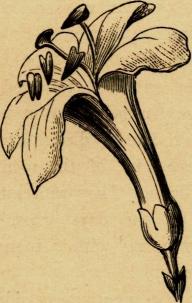
CHAPTER
WHALES, LIONS AND WAR DOGS.
SAN FRANCISCO has lions, and now and then a whale. For several days the street cars had been carrying "a banner with the strange device"—" To THE WHALE," and we entered one of those crowded cars bound to ride until somebody said " whale." But everybody said " whale," and persevered in it to such a degree that we asked the driver—the car was one of those Insurance-Company self-paying institutions—to say " whale" him-self just once when the time came. He did, and we bundled out of the car and followed the crowd. And there he was, the fin-back, seventy-six feet long and moored to the dock like a dismasted ship of the line. We never got much idea of the monster from the pictures we used to have. They represented a big, bulging rubber overshoe, in the days when they called them "gums," with a weeping willow turned to water growing out of the toe.
But here was the genuine sea-side tenement of the Prophet Jonah, with its arched door and seventeen-feet posts, but not a place for a bell-pull or a door-plate, the only evidence of high life being fixtures for a fountain in the front yard. But its blowing days were past. Roses blow, and so do whales. Being a whale of seventy-six, he was a Revolutionary aquatic, for he lay upon his back
240
WHALES, LIONS AND WAR DOGS. 241
and looked like the ribbed bottom of an awkward boat painted one coat of dirty white. He was moored stem and stern and slowly surged with the sea.
The crowd were as much of a wonder as the whale. "Where's his flippers?" said one; "his fins?" another; "his teeth?" a third; "Oh, hasn't he any ears?" whined a little lubber; "bid he really swallow Jonah, ma?" asked a good little Sunday-school girl; and so it went. Some women were looking for a mouth full of corset frames, but there being a doubt to which end the head belonged, they never found " those skeletons of the closet." An old whaler stubbing about estimated him at sixty barrels. And this ' was the sort of beast for which all tarpaulined Nantucket went round the Horn and widowed the women; the mountain of blubber that could thresh a boat like grain with one end and drown the crew with the other; the floating oil-well for the light of other days.
Polonius would not have said, "it is backed like a whale," for there was no ocular proof it ever had a back; but he could have declared, "it hath an ancient and fish-like smell," for it suggested a whiff of the smoky lamp of japanned tin that stood on the stand with a snuff-box and the family bible. A herd of whales going to "school" in mid-ocean, with the plumes of water waving and the great flukes lashing the sea into foam, must be a grand sight, but this ill-shapen wreck of oleaginous exanimation was not a success. Let us give it a bad name and be gone: the great northern rorqual of the genus Balccnoptera, class of mammals,—think of its having calves!—of the family of cetacea and the tribe of mutilates, and that is what it is, and badly mutilated too! The fishermen
11
242 BETWEEN THE GATES.
caught the whale, the whale caught us, and we caught the first car for home. Moral: " If you want to see a whale, ship before the mast for a three years' voyage.
SEALS.
A seal-skin sacque with a snug woman inside and a snug winter outside, is as pretty a sight as a snow-bird in its season. But a seal in its own jacket would not catch " the apple of discord " in the competition for beauty with anything you ever saw pulled out of the sea. It is an exaggerated garden slug, weighing from one hundred pounds to four thousand, dog-headed, ox-eyed, whiskers Spanish and sparse, a benign countenance and a pair of flippers. Seal Rocks, six miles from San Francisco and a ,few hundred feet from the headland, are three huge cairns with a Druidical look, piled up in the sea, the blarney-stones of San Francisco and the paradise of seals. They are the wards of the State, protected by law, and the piscatorial triumphs of the Coast.
You ride through Golden Gate Park, one of the most beautiful drives in the world, with its winding sweeps of magnificent distances, bowl up to the Cliff House and make for the balcony. Before you, blue and scintillant ,as frosty steel, is the Pacific, flaunting its white fringes and flounces along the shore at your feet, and dying away into the sky afar off. As the great waves come sliding up the slopes of gray sand and fling themselves down upon the land with thunder in the rustle of their garments, you think what a royal fool Canute was. Some flies with filmy wings are creeping along the curve of the horizon. They seem to move as the grass grows. They are ships from South America, from Oregon, from
WHALES, LIONS AND WAR DOGS. 243
round the Horn. Some tobacco smokes are rolling up in the distance. They are ocean-going steamers from Honolulu and Cathay. Some fragments of white love-notes are flickering in the air. They are sea-birds.
Before you rises the acropolis of seals. There are other inhabitants of the rocky fastnesses, but you do not notice them at first. There the seals are, some of them coming up sleek and dark out of the sea; some lying about with lifted heads, quarreling, gossiping, playing with their young; some working their way up the crags like so many portly men tied up in tawny bags from head to heel. You are half sorry for their helplessness at first, but when you see them climbing where you could not scramble for your life, your sympathy is lost in admiration. Their voices are a hoarse confusion of the bark of puppies, the creak of dry cart-wheels, the clatter of guinea-hens. You vainly try to translate the jargon into English. It rises above the roar of the sea and drives against the wind. These seals have a perennial cold and live an everlasting Friday, for their food is fish. They do their own angling, and twelve thousand pounds is no extravagant estimate for the monthly rations of the whole community. The fishing fleets would be delighted to work up the last skin of them all into caps. Fish, likewise eggs: for you begin to see the birds dotting the rocks, sitting in drowsy rows, rising in freckled clouds, settling dawn to the sea like big snow-flakes in the dusk. There are gulls, pelicans, sea-parrots, sea-pigeons, guillemots; some swift, some slow, and all lazy. They lay their eggs heedlessly about among the rocks, and the seals help themselves. The eggs are clouded and colored marbles, pretty enough to pave the king's court-

244 BETWEEN THE GATES.
yard, and no two alike. They are nourishing inside and neat outside. Fish and eggs! What intellectual folk the seals should be, with nothing but edible phosphorus on the bill of fare !
The Seal Rocks are a sort of domestic Juan Fernandez, but nothing could be wilder. To see Crusoe's Capricornus come round a corner would not surprise you. The clamor of the waves, the crying of the disconsolate winds, the screaming of the birds, the strident talk of the seals, give you the cast-away feeling of a shipwrecked mariner.
With any other surroundings such a Babel would be hideous, but delicate ladies sit by the hour and listen as to bassos with subterranean voices and larks of prima-donnas. California is proud of its seals and its seal. The Legislature tossed out a thousand-dollar bag of gold for the design, like the rich uncle in the play, when they could have bought a live bear and hired a live miner for half the money, while the bath-tub exclamation of Archimedes, "Eureka!" is everybody's, and Minerva the Romans had done with long ago. But it is wonderfully appropriate and peculiarly Californian. Contrast with
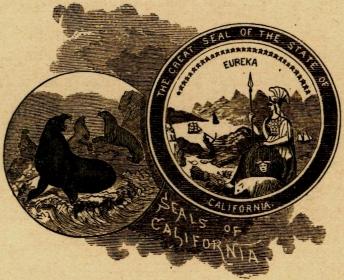
this exultant device the arms of Washington Territory, with its cheerful young woman, her hand uplifted, an anchor at her feet, a cabin and a capitol in the distance, the rising sun opening a fan of glory over the picture, and the modest, hopeful word, borrowed not from classic Greek but savage Indian, "Al-ki! "—lay and by.
THE GOLDEN GATE.
It was a memorable day when we visited the Cliff and The Golden Gate. The Lord made it that morning and pronounced it good. Even the bare sand dunes are beautiful with the pictured waves and ripples of watered silk. Two mountain ranges, the nearer, russet, the farther, blue, are in sight, and Diablo lifts his three thou-sand feet of smoky grandeur. And looking upon the purple hills and the blue and golden lights upon the water, we thought that if ever a spot could dispute with Athens her ancient title, it is San Francisco. Oh, " City of the Violet Crown," all hail!
Flocks of all river and ocean craft are coming and going. Here, a great steamer ploughs squarely out, leaving. a highway of wake and a line of drifted foam each side of the road. There, a fellow with one white wing lifted and body a-tilt, is skimming obliquely across the Bay.
Yonder, a little African of a tug with his nose out of water and his great fleece of black wool bigger than his body, has a leviathan by the halter, and is leading him up to the wharf. Now, a surly man-of-war comes in view, or a Chinese water-bug of a craft puts out its long antennm this way and that, feeling for something, or a ship with her top-hamper piled in volumes white
246 BETWEEN THE GATES.
and high, as if she had taken on a cargo of summer clouds for a dry market; or a schooner sits motionless on the water asleep in its bare bones, or a long lean boat darts about like a midge, with oars as slender in the distance as a fine-tooth comb. San Francisco Bay is a grand parlor with a crystal flooring of six or seven hundred square miles. The Bay is divided somewhat as General Lee of the Revolution partitioned off his one room into several apartments, with a piece of chalk and a garden line, into San Pablo and Suisun. And this grand reception chamber has furniture. There are Alcatras and Angel Islands, and Black Point, all parlor organs with iron batteries of pipes for pedal bass, that can pitch a tune and a shot at the same instant. San Francisco was ambitious to be an island itself, but the best it could do was to become a peninsula thirty miles long with the city upon its northeastern end, like a big word on the tip of a tongue.
And the parlor opens out upon the Pacific. Its front door is The Golden Gate. In fact, it is a hall five miles long and one and a half miles broad. Its gate-posts are Fort Point and Lime Point, a mile apart, and not the least like the pillars of Hercules, and a greater than Samson lifted the Gate from its hinges and flung it into the sea. It is the strait of Chrysopolae, and the name was prophetic, for early in 1848, before the discovery of gold, Fremont, the Pathfinder, because of the fertile shores to which it led, christened it The Golden Gate. At the South portal is a lock. It is Fort Point, a grim structure with eight-feet walls of brick and stone, mounting one hundred and twenty-three guns, and the Fortress Monroe of the farthest West. A solitary sergeant opened
WHALES, LIONS AND WAR DOGS. 247
a ponderous little door in a ponderous big door, and let us in. We passed through the hollow arched ways; went up and down the rusty iron stairs; crossed the echoing courts; paused in the cave-like alcoves where the cannon dwell, and slowly paced the iron arc of death upon the floor whereon the great guns swing round when they look out at the windows for the canvas-winged enemy, and speak to him in crashes of thunder; stood by the furnace where they cook cannon balls, and deliver the glowing planets " all hot," like the cross-buns of the Lon-don cries, on board the hostile ships; patted the black-mouthed monsters that forever watch the cobwebbed windows, waiting for something to say, and talking in mono-syllables when they talk at all; listened at the locked-up dungeon of thunder and lightning; sat upon a twelve-feet Spanish gun, adorned with the Castilian arms, and dated 1673, that spoke Spanish, perhaps, where Toledo blades are born, and came to this wilderness a century ago. Very silent, very solemn, is the place.
And then we saw how the guns from fort, island and point could send their iron shuttles to and fro across the hall, and string great ships, like beads, upon their fiery warp and woof. And then we went out and saw the fog-bell, shaped like an iron lupin or a Puritan's hat, hanging with its dead weight run down, voiceless, by the wall. Think of a hat weighing two tons ! And then, climbing the craggy hills above, we saw great kennels, and big dogs of war crouched in the sand, and their noses smutted with " villainous saltpetre," all pointed toward the Pacific.
And then we thought what a weary while ago it was, three hundred and one years, since Sir Francis Drake, with
BETWEEN THE GATES.
a ruff round his neck, lace in his sleeves, and a silk doublet, discovered the bay of St. Francis, and in the name of the Virgin Queen — who was no duck—named the land New Albion, and set a plate upon "a faire great poste, wherein was engraven her Majesty's name and yeere."
And then we took a long look at the battered door-posts of rock and mountain, and the dim ocean beyond, and saw a ship weighing and balancing in the offing, a wing spread here and a wing spread there, and curtsying through the Gate into the blue parlor of the Bay. And then we thought how the gray mists swept down, sometimes, upon crag and water, and blotted and brooded them all out. And then we turned away and passed Lone Mountain, the everlasting camping ground of dead Californians, and struck into the clattering streets of the living, and the music of a band swayed to and fro, and near and far, and loud and low, in the wind, and we met fellows invested principally in vests, with their feet apart, like an inverted Y, A, and the ribbons twisted like yarn, getting out of the roan and the bay all there was in them, and shouting: " Hi!" as the spokes grew dense in the dizzy wheels. And then we saw a placarded window that might have said, "Coffin plates purchased," when it did say, " Wedding presents bought or exchanged"; and at a street corner, " A. Goldmann " declares himself "Mender of Broken Articles," a piece of information that many a verdict of " twelve good and lawful men " has applied to tattered affections and fractured hearts, making them toughest and strongest at the spot that was weakest.
And then the sea breeze bore down upon us in a shower of sand like a troop of Bedouins, and the sky was Coventry-blue, and the day by the sea was ended.
CHAPTER XVIII.
A TRIP TO THE TROPIC.
THE valleys radiating from the Bay are among the - chief glories of the State: those spacious halls of beauty and abundance, San Joaquin, Sacramento, Napa, Santa Clara, forever opening into chambers along the way, and meaning bread for the Continent, flowers for its festivals, fruit for its tables, and the climates of all hospitable lands.
The Central and Southern Pacific Railroads took us over nearly five hundred miles to Los Angeles, the capital of Semi-tropical California. To build the thoroughfare through an appalling desert and over a rude and rugged rabble of disorderly mountains was a bold project, but it proved a triumph. The equipments are " express and admirable," the officers courteous. No more delightful winter trip than this can be found without inventing a geography. Leaving the Bay, the train runs through miles of perpetual gardens. Think of one horizon full of currants, another red with plums and cherries; a level world set with vegetables like a sunflower disc with seeds.
You set forth from San Francisco yesterday afternoon. At this morning's dawn you have left three hundred miles behind, and are up betimes to see the glories and difficulties of sunrise. It is August, and you look out
249
BETWEEN THE GATES.
upon great tawny plains dotted and tied down with tufts of sage-green grass, as were your grandmother's comforters with yarn. Those slate-colored thunder-clouds at your right are mountains. They look as smooth as a new monument. There are more mountains ahead in the way of the train, but it makes for them as if there was nobody there. You are in the region where the Sierras and the Coast Range Meet. It is the trystingplace for grandeur.
A DIFFICULT SUNRISE.
The day is yet in the gray. A flock of magpies have been racing with the train for ten minutes. They just showed what they could do and switched off. You see a Chinaman asleep in the open air on a flamingo-legged bedstead. He has achieved a second story without going upstairs. The arrangement suggests creeping things with shorter legs but more of them.
The shadows of the mountains begin to show along the plain. There is something beyond. As the light grows, the heights retreat before the coming train. They had drawn near in the dark to keep each other company, but courage returns with the dawn. The light strikes through a cleft between two lines of mountains, fires over your head, takes the landscape behind you at long range, while you are yet jarring on in the shadow. It is the phenomenon of clouds in a clear sky. The peaks in the West respond. They are covered with pinks in full blossom. It is as if Yesterday were pursuing you and To-day were heading you off. At last, the unrisen sun begins to define the edges of the mountains. He ravels them out into fringes of trees, and sharpens the
A TRIP TO THE TROPIC. 251
rocks into angles. You think he is about to rise here, and then a cliff crimsons somewhere else, and you are sure he will appear yonder. The sky is steadily growing golden red, like the ripening fruit of the Hesperian or-chards. The sun seems to be looking for a low place to rise in, and trying one notch after another in the jagged horizon. You see his upper edge an instant, and then he sinks back as you near him. The train swings round a curve and finds the canon where he must have halted for breakfast. An hour more and it is sunrise all abroad. The mountains' night-clothes that strewed the ground are rolled up and put away. The king of day has come to his own again.
THE TEHACHAPI LOVE-KNOT.
Tehachapi! is not a sneeze, but the name of a mob of mountain peaks and crags that disputed the right of way with the Southern Pacific Railroad. The heights were impracticable, the rocks were immovable, and so the train climbed as high as it could, and crept into a bur-row like a fox. It was an eyelet-hole drilled through and through, and so the train came out on the mountain's other side, found a shelf and climbed again, entered a second tunnel, a third, a fourth, swinging round and up and over and through. It is a tremendous screw cut out of mountains just to let that train run up the thread. So we go, skirting one peak, running to earth in an-other, whipping through seventeen tunnels, taking seven-teen stitches in the ragged selvedge, in the distance of ten miles, the engine and the train in two burrows at once. Now we look down upon four tracks we have come, and now we look up upon three tracks we are
252 BETWEEN THE GATES.
going, that are forever crossing themselves like a con-fused witness.
The little roasted village of Caliente lies in the valley four thousand feet below us, and we have been circling above that cigar-box of a town like a hawk over a barn-yard. We bid it a final farewell as often as' a star actor takes leave of the public, and round we swing again, and there is bewitching Caliente! It is a single mile distant, but we have gyrated six miles to make it. One curve of three-fourths of a mile lifts us seventy-eight feet above our own heads. We seem to be constantly meeting ourselves, pursuing ourselves, contradicting ourselves. The summit of Tehachapi is five-sixths of a mile above the sea, and the train climbs one hundred and sixteen feet to the mile for twenty-five miles. The engine does some tough tugging hereabouts, but then, going one way it runs forty-seven miles without pulling a pound. All it wants is a snaffle-bit and a hold-back. It boxes the compass in sixty minutes.
You have seen a cat feeling her cautious way through the currant bushes with her whiskers? If they touch, she tries another opening; if they clear, she disappears in the greenery; for she knows she carries the measure of her fur clothes at the corners of her mouth. This train, prowling and feeling its way among the crags of the knobbed world, has a cat-like way of its own. High-land and lowland, that engine is a wonderful civilizer, and there are only two hundred thousand of her on the globe, but they represent the physical force of a hundred millions of men, and a spanking team of twelve millions of horses. The double-stranded thread on which these heights are strung, called the Loop, is three thousand
A TRIP TO THE TROPIC. 253
seven hundred and ninety-five feet long, a great double bow-knot of steel.
The tunnels are about as thick as woodchuck holes in a New York pasture, and looking back upon the craggy mouth of one you have just threaded, you wonder how the cat made it without bending her whiskers and rasping her sides. There is some beauty about these bur-rows if you watch for it. Standing upon the rear plat-form as the train enters the great tunnel of San Fernando, a mile and seventeen hundred feet long, you see
x=55 Lpv(E
E)-IACHH-iPT
first a round frame with the picture of a rock and a tree in it. It is a rare medallion. It grows finer and finer, but clear as an artist's proof all the while, and then it changes into a great harvest moon in the horizon, and the umber-colored smoke tints it down to lunar light. Then as the train descends the grade of seventy feet in the tunnel, that moon begins to rise, and lessen as it climbs. The clouds sweep over its face, but leave no stain. That moon-rise in the mountain heart, with its undrilled welkin of solid rock, is a magical and beautiful illusion. You watch it with anxious eagerness as you are
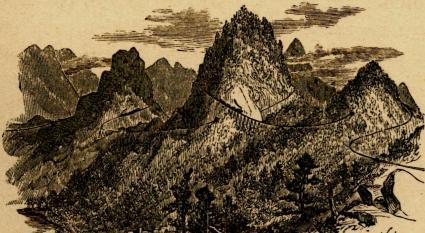



254 BETWEEN THE GATES.
borne away into the rumbling Erebus of the sunless hall. At last it is only a star of the fourth magnitude, a spark of light, then gone. Meanwhile the system of compensations sets another planet waxing at the other end of the tunnel; and so there are a pair of moons doing escort duty for every passing train.
You have noticed a hen before now, standing on one foot in a drizzly, lazy day, and you saw a sort of filmy curtain draw slowly over an eye about as intelligent as a glass bead, while the outside blind was wide open. Going through tunnel No. 5 of the Loop, I saw that pullet's eye magnified and glorified, and that same curtain — but made of yellow smoke this time — drawn slowly over the unspeculative optic in the absurdest way, while the great rocky eyelid remained lifted under the shaggy brow. There is something unaccountably ridiculous about both of them.
THE MOJAVE DESERT.
It is at mid-day, under a sky cloudless as the shield of Achilles, that we strike into the great desert of Mojave. I fancied I crossed a desert on the Overland Train, but it was a blunder. It was nothing but a batch of Satanic dough. But here are the cruel, glittering plains, flinty to the feet, fiery to the eye, " and not a drop to drink," thousands of square miles of desolation. No ruins here but the wrecks and ruins of all the Christian seasons of the year, shut out from the blessed promises of seed-time and harvest, and sending back fierce answer to the noon. It is the crumbling skeleton of Nature, hopeless of burial and bleaching in the sun.
I cannot realize this transit of the desert in a palace-
A TRIP TO THE TROPIC. 255
car, this turning a howling Tadmor into a luxury. It robs the route of all daring and adventure. I am sorry I cannot be as sorry as I was, for Mungo Park and Bruce, and the rest, who, foot-sore and camel-back, wandered hungry and athirst in the trackless sands. I can believe all they tell me of starvation and death; of trains bewildered and lost; of the lakes of delusion with which the mirage beguiled them miles from their way, only to sink down in the arid waste disconsolate; of the dumb despair that lashed to desperate deeds. Only a few days before, a Colonel of the Army had told inc of leading his command of infantry through this Desert, and eighteen days on the way; of the steel blade that could lie upon the ground the night out without a tarnish; of the wagons that tumbled to pieces without wearing out.
Away at the left, a sweep of two hundred miles, it is lost in the distance, and far to the front it touches the mountains. Tufts of raspy grass rigid as knitting-needles are sparsely sprinkled about among leprous patches of white earth. Everything that grows here is covered with thorns, or spikes, or stings, and seems making a stub-born fight for its life. What they want to live at all for nobody knows.
A VEGETABLE ACROBAT.
But the Yucca is the triumph of the Desert, and there are thousands of it. Fancy trees from twelve to twenty feet high, growing in the most fantastic shapes, and covered with deep-green bottle-brushes of foliage, never fading, but bristling all ways in the most irritable manner; their gnarled figures, dark as the black cypress, showing in mournful relief against the ghastly plains
256 BETWEEN THE GATES.
and the brazen skies, and you have the Yucca. It looks as if it might be an exaggerated cousin of the cactus family. The trunks of the chicken Yuccas are covered with coarse plumage, a little like the covering of a pine-apple, down to the ground, like so many Bantams feathered along the legs.
Nothing more grotesque in the vegetable world can be conceived: the limbs growing out just as it happens, from the trunk and from each other, sometimes live ball-clubs with the big ends farthest from the tree, and some-times oven-brooms for the wind to swing, if there were any more swing to them than there is to the tines of a pitch-fork in a breeze. Now you see a tree that oddly suggests one of the useless and ornamental waiters that infest hotels with their whisk brooms and open palms, but sprouted out all over with arms and legs, and the tip of every finger and toe finished off with a green brush. But the most resemble acrobats. Here a family of limbs make a slender-bodied, long-legged fellow with his lean arms resting on a branch beneath him, and just ready to leap over the top of the tree, which he never does. If we were not quite sure the Lord made the Yucca to fight and frolic in the Desert, we should lay its manufacture to a Chinaman. It has a grotesqueness quite "celestial" but not heavenly. Who knows but these trees are transmigrated champion equestians of the ring, and Mojave a sort of circus-riders' paradise? You have little idea how those Yucca fellows beguile the way, and I can hardly help thinking of them now as some tribe of East Indian jugglers turned vegetables.
The Yucca has its uses, the trees are being swiftly slain, and a short time will see the plains utterly de-

nuded. Who would suspect that closely folded in those. eccentric trunks were reams of bank-note paper? And yet I have before me a piece of the fibrous wood and a sheet of the firm, smooth fabric they wove of it.
THE MIRAGE.
We had been hoping for the phantasm of the mirage, and we were not disappointed. Some one cried "mireidge!" and some one corrected, " mi-razh ! " and there indeed it was, a beautiful lake of blue water at the left of the train and five miles away. We must surely run along the edge of its white beach. We must rest our eyes with a near look of the rank sedge, but we never did. The splendid waters rippled in the wind and refreshed the fancy; but as we approached they vanished, and the thirsty plain lay parched and rigid where the waves had glittered and glassed in the sun! We had seen one charming picture of aerial geography, one shore that never meandered, one lake that never was named, one world that was never mapped. And to think of the hundreds of travelers with blackened lips that had sought these seas of delusion, and died with dry eyes before they reached them !
The train halted at a Station, desolate as a light-house and as guiltless of door-yard as a gibbet, and a dilapidated stage, a sort of tattered tent on wheels, was waiting there for a victim. It looked just fit to connect with Charon's ferry and carry second-class passengers and dead-heads. One man with a pair of saddle-bags climbed into it, and we wondered if he meant to cross the river Styx after he left the coach. A little while after, we saw an eight-mule team, the wagon under bare hoops, like a
11*

258 BETWEEN THE GATES.
woman's dismantled skirt, creeping along in the distance like a procession of rats. Whether the canvas was burned off or blown off no one could tell. Somebody said they were going to a mining camp in the mountains, and they are quite welcome to everything they can get. One man said: " Things look barren as Sarah," meaning the African Sahara of the blundering old geographies. An-other man said: "That's so! Barren as Sarah—before she was ninety years old!" The other man had been made mad by the desolation, and a Yucca beside the track held up two hands full of brushes in deprecation and distress.
A field at the right of the train, white as a cambric handkerchief, sent everybody to the ice-pitcher with thirst. It was a lake of salt. A drier piece of waterscape can-not be found between Cancer and Capricorn. The salt was piled upon the shores of what was no sea, like the snow-forts of the Yankee boys in New England winters, and two wagons were there taking on a load of chloride of sodium. Sodom would have been at home in it, and Gomorrah also.
This traversing a desert reclining upon a sofa, with your lazy feet on an ottoman, defrauds a man out of the luxury of remembered deprivation and danger. We should have enjoyed its memory more had there been anything struggled through and escaped. Set a fellow on foot behind a mule bankrupt of thistles and with ears wilted down with the drouth; let the fellow's hair turn the color of corn-silk in the sun, and the canteen at his side tinkle loudly with emptiness, and he tighten his belt another hole to gird up his leanness—let him come to some blessed edge of the green world at last,
A TRIP TO THE TROPIC. 259
with a soul in his body and yet to be saved, and his recollections are worth keeping and telling.
We are nearing the mountain range of San Fernando. The entrance of the tunnel yawns for us with hospitable darkness. We enter it without misgiving. The disastered night is welcome. The avant-courier of a moon rises before us at the distant end of the tunnel. It broadens from sickle to crescent, from crescent to full. We pass out of eclipse into what Richelieu always declared there is—" another and a better world."
THE CITY OF THE ANGELS.
Entering the tunnel was a sort of dying out of the waste places, and emerging on the other side was a little like being born into an emerald world. We hardly knew how much we missed the green fields, the clear waters and the human homes, till we saw them again. Could the moon be towed alongside the earth and the twain connected by an unlighted hall a mile and a third long, through which a lunatic could come toll-free in ten minutes, the contrast could hardly be finer. And yet to see the valley and plains of Los Angeles in mid-summer sometimes throws dust in the eyes of enthusiasm. Tree and shrub, except where transfigured with the witchery of water, are powdery as a miller's coat, and the dry fields and highways are thickly and waste-fully strewed with Graham flour that rises without yeast. Palm leaves are as gray as an elephant's ears, and portions of the landscape have a disused air, as if beauty was about going out of business and moving away, while the heat dances a hot-footed hornpipe upon the top of your hat, and gives you the feeling that somebody
has slyly slipped an athletic and attractive mustard-plaster between your shoulder-blades.
I can almost see the fur of indignation rise as some Angelian reads this paragraph, but then we reached the city of " Our Lady" at high noon of an August day, when everything is in curl-papers like a woman's hair before breakfast, and it was an hour too early for the salted breeze to begin to blow from the sea, and the grim maps of the benighted regions of the heathen to be washed from our heated faces, and the cool tinkling of-the fountain in the "Pico House " court to be heard, where tropic vines we had never seen were climbing easily and noiselessly about in cool jackets of green.
Then there is ground for suspicion that the warm welcome we received from Mr. JOHN OSBORNE, of the Overland Transfer Company, and Colonel SAMUEL C. HOUGH, of the "Pico House," to both of whom we are indebted for attentions, as unwearied as they were grateful, may have given the thermometers an additional lift and made us a few degrees warmer than if they had turned the cold shoulder. In an action for slander, let the jury bring me in: "Not guilty, and so say we all!"
Whoever asks where Los Angeles is, to him I shall say: across a desert without wearying, beyond a mountain without climbing; where heights stand away from it, where ocean winds breathe upon it, where the gold-mounted lime-hedges border it; where the flowers catch fire with beauty; among the orange groves; beside the olive trees; where the pomegranates wear calyx crowns; where the figs of Smyrna are turning; where the bananas of Honolulu are blossoming; where the chestnuts of Italy are dropping; where Sicilian lemons are ripen-
A TRIP TO THE TROPIC. 261
ing; where the almond trees are shining; through that Alameda of walnuts and apricots; through this avenue of willows and poplars; in vineyards six Sabbath-days' journeys across them; in the midst of a garden of thirty-six square miles—there is Los ANGELES.
The city is the product of one era of barbarism, two or three kinds of civilizAtions, and an interregnum, and is about as old as Washington's body-servant when he died the last time, for it is in its ninety-seventh year. You meet native Californians, wide-hatted Mexicans, now and then a Spaniard of the old blue stock, a sprinkle- of Indians and the trousered man in his shirt and cue. You see the old broad-brimmed, thick-walled ,adobes that be-tray the early day. You hear somebody swearing Spanish, grumbling German, vociferating Italian, parleying in French, rattling China and talking English.
You read Spanish, French, German and English news-papers, all printed in Los Angeles. It is many-tongued as a Mediterranean sea-port, and hospitable as a grandee.
Yesterday and to-day are strangely blended. You stroll among thousands of vines that are ninety years old and yet in full bearing. You pass a garden just redeemed from the dust and ashes of the wilderness. You pluck an orange from a tree that was venerable when Charles the Fourth was king of Spain, and you meet a man who has sat down to wait six years for his first fruit. A drive through the old quarter of the city takes you to the heart of Mexico, with the low-eaved fronts, the windows sunk like niches in the walls, the Italic-faced old porticoes, the lazy dogs dozing about in the sun. In ten minutes you are whirled between two long lines of new-made Edens whence Eve was never
262 BETWEEN THE GATES.
driven; such wealth of color, such clouds of fragrance, such luxuriance of vegetation, and nothing nearer like the " waving sword at the Eastward" of the first home-stead than the slashed sabre-like leaves of the banana that holds up its rich, strange, liver-colored blossoms as if it were proud of them.
The Pueblo of the Queen of • the Angels was founded by the proclamation of Governor Felipe De Nieve, almost a century ago, and was the Mexican capital of Alta California. You are startled the first morning by a battle of tracked bells, as if ringing from the necks of a gal-loping and demoralized herd of cattle stampeding through the city streets. It is the pitiful complaint of the disabled chime of green bells in the old Parish Church of Los Angeles, and you stroll over to look at the ancient structure. A gray-haired padre, leaning heavily upon a young priest, " all shaven and shorn," comes slowly out. The inscription over the portal is: "Los Fieles de esta Parroquia a la Reina de Los Angeles "—The Faithful of this Parish to the Queen of the Angels. The church has a story and has been restored. The inscription formerly ran: "Los Pobres"—the poor, instead of the faithful, shadowing the fact that at one time it was the mite of the widow and not the wealth of the hidalgo that sustained the mission.
THE ORANGE GROVES.
My idea of an orange grove was of an orchard where the trees laden with golden fruit sprang up from a smooth, green turf " of broken emeralds," that invited you to sit down on the dapple of a shadow every few minutes and be happy; of trees with a tropic brightness of foliage
that would dispose me to listen to such fowls as the bulbul and sing gay little canzonets in two parts. Now an apple orchard is a cheerful place; it is spangled with clover; its fruit is of all colors but indigo; it has rob-ins and sparrows; its sturdy arms extend over you in a sort of pomonic benediction and invite you to perch in the Seek-no-further—or, as we called it, the signifider, but what signifies?—or the Pound Sweeting.
Nothing of all this belongs to an orange grove. The trees are tall, straight, symmetrical, not friendly in their way but a little stately, as if they should say: "Behold, we are oranges!" and not much more shadow about their roots than a Lombardy Poplar. There is no individuality. Every tree resembles every other tree. The earth is bare and tilled like a garden. When you feel like reposing in a well-weeded onion bed you can take lodgings in an orange grove. Driving through the splendid lines of trees numbering up to the tens of thousands, the whole year hung upon a single one, from the delicate white blossom that graces the bridal veil to the baby fruit, small as a walnut; to the tint of yellow struggling through the green; to the untarnished gold of the rounded and ripened fruit; the air, like a swinging censer, heavy with fragrance, and filled with the hum of bees; the lighter-leafed regiments of lemons, with their bright gilt orreries of fruit; the lime hedges, dotted with diamond editions of the full-grown mothers of lemonade; the cactus fences, all alive, slowly climbing over themselves in diagonals of serried pin-cushions; the bananas bursting into barbaric luxuriance ; the earth ter-raced off for the water to flow in, and, this moment, coursing along the checker-work of channels and shining

in the sun; the feathery plumage of the pepper tree, touched up with spangles and bugles of brilliant crimson and red; the fan-palms slowly lifting and lowering their great hands in perpetual salute,— all these scenes, lovely as anything in the vale of Cashmere, seem to rebuke your dear rugged home at the Eastward of Eden, and you grow grave when you meant to be gay, and are not quite sure a Rhode Island Greening, and a dough-nut with an orthodox twist, are not better than oranges, bananas and June all the year long. Here is an orangery of six acres, and five hundred trees fourteen years old, that filled thirty-eight hundred boxes the last season, and its owner sold the crop for six thousand dollars in advance. A man with a counterpane of a farm and six hundred orange trees can sit in the shade and draw a Star-preacher's salary without passing the plate. The orange is the true poinnrn anrantinin of California, the "apples of gold" of the old Scriptures.
THE VINEYARDS.
The tillage of the vine is the oldest in the world. It grows in the Old Testament and the New. It is a native of the Odes of Horace, and thrives in Grecian song. " Vine " and " wine" have stood up to be married by rhymsters
vine, two hundred thousand times in twenty years. If to one city more than another, of all cities I have seen, belongs the urbs in horto of Chicago's seal, Los Angeles is the place. It is not only a city in the garden, but a garden in the city. The two are interwoven like the blossoming warp and woof of a Wilton carpet. We visited the vine-yard and wine-presses of Don Matteo Keller. It is in the heart of the city, and contains one hundred and thirty-
seven acres, and has two hundred and ten varieties of grapes. In the season ten thousand gallons of wine are produced daily, and there were two hundred thousand gallons ripening in the vaults. I looked upon " the wine when it is red," when it " moveth itself aright," like pure amber in the cup; when it looked like the golden haze of Indian Summer. White, port, sherry, Angelica, are among the wines. The semi-tropical zone of Los Angeles county contains twenty-eight hundred square miles, of which about one hundred and twenty are under cultivation. It is the zone of three rivers, the Los Angeles, the San Gabriel, and the Santa Ana, and is guarded by two mountain ranges, the San Bernardino and San Gabriel, four being saints, and one full of angels. The Spanish-Mexican race beat the world in verbal magnificence. They will bankrupt Castile, Aragon, and the Halls of the Montezumas, to christen an adobe chapel, primitive as a Dutch tile, with saintly names enough to man St. Peter's, at Rome. Sometimes their religion is imposing, and their piety an imposition.
A vineyard is a torrid region in August, with hardly shadow enough to shelter a sheep. The broad leaves of the vines shining in the sun are warm to look at; the great purple clusters, like those the two pictured Israelites are bringing home from the Promised Land swung upon a pole, and the tip grapes of the pyramids touching the ground, are all about you as you walk. You are in Colonel B. D. Wilson's vineyard of two hundred and fifty acres, a quarter of a million vines around you, two and a half million pounds of grapes slung up by the stems, and two hundred and fifty thousand gallons of wine "in the original package."
12

BETWEEN THE GATES.
Let us escape to a great willow. Let us strike into the stately hall with its walls of live orange and its cornices of leaves. You are a little afraid of scorpions, but people tell you that while not much, in the way of personal beauty, they are not near so fatal as Daniel Boone's rifle. Looking in the Dictionary, you find it is "a pedipalpous, pulmonary arachnidan," with a pair of forceps coming out of its forehead. This is certainly pretty bad, but in the next sentence Webster comforts you with—" very seldom destructive of life." Tarantulas also. My friend cracked one over " the dead line" with his whip-lash just now, and the party flung its eyes about regardless of expense as it strolled over a dry plain. But then, to balance the books, we have—Los Angeles : Cr. by musquitoes, none; frost-bitten ears, none.
"A BEE RANCH."
I quote it because it is none of my verbal sins. To call a place where bees are harbored and robbed, a ranch, is about as bad as to name the grazing range of lowing herds a cattle academy. But to quote Webster at a Californian because he confounds hacienda with rancho would only be to provoke him to make a Dictionary of his own; so I leave him to "band" his sheep and herd his bees as he pleases. If bees are either cattle, sheep or horses, then there is such a thing as a bee ranch.
The sun beat, like a drummer in a spasm, upon the parchment-dry earth as we rode ten miles out to a bee village. It was some comfort to see the mountain, " Gray Back," snowy as a bride's cake, with its undated frosting, even if it was ninety miles away; and a grand orange-tree avenue to a vineyard, with its deep green foliage,
A TRIP TO THE TROPIC. 267
suggested a sort of " Abraham's bosom" Paradise to us poor feverish children of Dives in the valley below.
Stumbling over the mountain toes, and up to the in-step of the foot-hills, we entered a Bee Town. There, were the white, flat-roofed cottages, hundreds of them, in regular streets, and the bees, Italian hybrids, with less gold lace on their uniforms than our Eastern pagans of the old straw hives, were coming and going. If you can keep from sneezing, and are not taken with St. Vitus's dance, and your horses never emulate Job's chargers, and say "ha ha!" you are as safe as if nobody in that community carried concealed weapons. The population of this village—it was never incorporated on account of the taxes—is not less than five millions. New York, with all its dependencies, would be a mere suburb. The proprietor is a courteous Southron, lean, and long in the flank as a panther, and children as thick about him as the young shoots of a cottonwood. The bee is the most overworked animal in California, and is miserably imposed upon by the only creature that can match him in geometry.
His working day begins at four o'clock in the morning and lasts fifteen hours. Often so far from home at sunset that he cannot return, he puts up for the night at some wayside inn, and you often see him coming slowly in at sunrise with his heavy burden. In more inclement climates a night out is a life out, for the bee " that hesitates is lost." His usual foraging range is a circle about twelve miles in diameter, and he pastures upon plains and mountains that a crow of moderate means would never halt at. He extracts honey from the wild sage, willow, wild buckwheat, barberry, coffee bean,
268 BETWEEN THE GATES.
sumac; and .the greasewood, a disagreeable plant, as open to a honey suspicion as a lump of putty, affords an excel-lent article. That of the orange blossom is golden and oily, and good enough to follow the flower and sweeten the honeymoon. " How," said I to the patroon of the town, "is it that the bee derives the harmless luxury from noxious weeds?" "Ah," he replied, " bees are the best chemists in the world. They never err. They can get the unadulterated honey safely out and leave a strychnine crystal untouched. Bees are not like folks. Did you ever hear of their committing suicide?"
" Yes, we keep 'em to work. When the comb is filled and capped, we just uncap it by passing a hot knife-blade over it, fasten the comb in this hollow cylinder here, set it going, the honey is all whirled out into a reservoir below, we restore the empty cells, and the puzzled bees go at it again."
A curious case of litigation just then was exciting a little interest. The owner of a vineyard was the apiarist's next neighbor. Now a bee will not puncture an unbroken grape, but when it is crushed the honey-maker is Its best customer. He drinks like a Rhinelander. When the season for wine-making came, a few bees went over in a friendly way, though taking ,their rapiers along, returned to the village with a good report, and the whole community never stood " on the order of their going," but made for the press, drove off the workmen and took possession. The air was fairly dusty with bees. Where the grapes are trodden out as in Bible times, and as sometimes in California, though nobody owns it, the lazy, bare-foot tramp is accelerated to a quick-step out of the neighborhood. Therefore the patroon was ordered to
A TRIP TO THE TROPIC. 269
keep his bees at home and sued for trespass. But how can such unruly flocks and herds be fenced in? And so the defendant rejoined that the vine-dresser could protect his press with a wire gauze that would keep the busy aggressors on the right side of it, which is the outside. The case of Wine versus Honey is one of the legal novelties of the farthest West. Looking down street I noticed a boiling cloud of bees apparently in excited consultation, and suggested to my friends that "to be or not to be " was the question, and " wouldn't we better be going?" and we got safely out of town. Each swarm last year put up about one hundred and fifty pounds, that brought twelve dollars. To be the owner of five hundred hives is better than to be a member of the Cabinet.
THE MISSION OF SAN GABRIEL.
It was a splendid pilgrimage ten miles out, into the valley of San Gabriel and the old Mission. To the north is the Coast Range with a white proof-sheet of winter pinned upon Gray Back like a vandyke, beyond us a rolling plain with samples, you would say, of all sorts of soil from cinder-and-ashes and gravel to dark loam, a sort of jumble of the remnants of a geological ware-house. But no matter about the soil. All you want is a watering-pot or a waterspout, or something rather wet. All fruits and flowers are spelled out with the one word irrigation. On this plain, where the horses' hoofs tick like nail hammers, too hard-baked for a cracker and not quite hard enough for a brick, grass springs rank and strong from December to June, then makes hay of itself of its own accord, and lasts out the year.
We begin to see orchards, vineyards, cottages; the
270 BETWEEN THE GATES.
magnificent orange Alamedas, the walnut walks, the fig-tree lanes. At last we reach the quaint old Mission village where the adobe dwellings like last year's birds' nests are lost and forgotten in shrubs, vines and flowers. Some Indians and squaws were sauntering about. It was hot as Cayenne and quiet as Sleepy Hollow. We were at one of the ancient posts in the picket-lines of the Franciscan Fathers. We looked at the clock. It marked the year of our Lord 1774. Here, one hundred and four years ago, the Mission was established in the uttermost wilderness. Not a handful of clay had been moulded for any City of the Angels. We approach the gray Gothic church of San Gabriel, the buttresses projecting at intervals along walls that are five and a half feet thick, whose foundations were laid before the Minute-men of Concord and Lexington had rallied out.
A woman unlocked the ancient door, and bare-beaded and silent we entered in. Some neophyte had written, " Hats off. Pray don't talk," but with the thoughtful there was no need. Hollow as a cave and solemn as a tomb, the floor spoke back to the footfall. We saw the censers and the saints, the crosses and the crowns, the tattered tapestries that came from Spain to be unrolled in the desert, all faded like an old man's eyes. We stood, and not irreverently, upon the worn stone dished like the scale of Justice, by feet that turned long ago into leaves and flowers. Here clouds of incense and vespers rose harmonious, and the nocturn, a sweet song in the night, deepened into matins in the morning. We did
not hear the chime of bells that came from the Span-.
ish furnace rich with gold and silver offerings that were
flung into it, and are heard in every tone of the ,neck-
A TRIP TO THE TROPIC. 271
lace of melody even until this day. They are trinkets as safe from all thieves as treasures laid up in Heaven. Borne across the sea to a wilderness without a name, they have rung out upon the charmed air for a hundred years like three bell-birds of Brazil. But as has been well said by Major BEN. C. TRUMAN, of Los Angeles, they are only links in the endless chain of melody flung from San Diego to the Red River of the North.
"The bells of the Roman Mission That call from their turrets twain, To the boatman on the river,
To the hunter on the plain."
We went through a side door into the poor, neglected city of the silent. It has survived grief and friends. It is too old. Gray, wooden crosses lean this way and that, over graves that are nameless. Sealed tombs are crumbling. It lies there under the church wall in the glare of the sun, the autograph of death and desolation scrawled upon the dusty, thirsty and insatiate earth. It is consecrated ground, but dishonored by neglect. What would we have? Is there more than one man that can weep at the grave of Adam? Does anybody set pansies on the grave of his mother-in-law's mother-in-law?
THE GARDEN.
The Mission Garden is not as old as the Garden of Eden, but it was a cultivated spot, for all that, when there was not a State between Pennsylvania and the Pacific ocean rout the state of Nature, and when saddles, bateaux, dug-outs and moccasins were the only means of conveyance. We came to a high wail and a low adobe, and halted in the shade of a great palm seventy feet high planted by a Franciscan two generations ago. It
4
r
272 BETWEEN THE GATES.
was my first acquaintance with the tree where it seemed to be at home. Its trunk was curiously fluted, and it spread its great palms as if it felt and enjoyed the sun-shine. • Our knocks at the gate brought the reply of a couple of dogs, and if I can judge of the canine gamut, I should say those dogs were hungry, and barked in the key of C sharp. They leaped, and looked through the cracks of the wall, and snuffed like a camel that smells water, barking their way up and down those cracks as a boy runs his mouth along the holes of a harmonica and blows. It was a good thing for them that the wall was too high for me to get at them, and I said, my voice trembling with compassion, "Let us not worry those poor"— I was just about to say "dumb brutes" when one of them put his mouth to a crevice not more than a foot from my ear and barked me six feet from the fence at one jump — so I said, "poor brutes any more. Let us go away. The merciful man is merciful to the beast."
My humane counsel prevailed, and we all went to the low door of the adobe. A battered old hatchet tethered by a string bung from the door-post for a knocker, and some one lifted it and smote the heavy gray portal, and a Spanish woman opened it and admitted us with a smile. She was eighty, and no dentist's window ever showed so handsome a set of teeth, even, white, none gone, and hers by-birthright; and her hair, just silvered to the tint of beauty, was as rich and heavy as the mane of Bucephalus. We saw the fire-place wide and deep as a cave and the quaint smoky furniture, and went out into the garden.
Here we were, where the Franciscan Fathers had paced, and veiled sisters flitted in the morning twilight
A TRIP TO THE TROPIC. 273
of the present century; in the early afternoon of the last. Here was the garden of olives. We stood under fig-trees hung with money-purses filled with seeds, that paid their way with just such coin when the janitrix of fourscore was a baby in arms. Here were orange-trees that were bearing in 1800, and sweet lemons and sweet limes from Barcelona. The scabbards of Toledo blades have clanked along these rambling alleys, and boots of Cordovan leather printed off the dust. Here was a Mission grape vine with a gnarled trunk like a great tree, and mother of the vines of the valley, that came over from Spain in a three-storied castle of a galleon in 1798, and beat grandly up the bay to the embarcadero of the Mission of San Gabriel. But it is not worth while to waste any sentiment upon the place, for, truth to tell, it is not a bit more like Irving 's Alhambra than a Scotch kale patch is like the Queen's .gardens at Kew.
There is no implement on the premises less than a half century old. The walks are dusty, the borders are ragged, the trees have grown wanton and willful. Every-thing is a hundred years old but the madre and the dogs. Those dogs! Come to see them, one weighs less than eight pounds, and his bark is bigger than his body. But the earth has not forgotten its cunning, nor the sun been shorn of his glory. There is no hurry here in any-thing but growing. Kill the dogs, and Sterne's starling would never have sung here to get out, and Cowper's hare would have slept undisturbed in her form. The old glories of the Mission have departed. As we filed out of the door some one said a friendly word to the woman. I can see her pleasant mouth as, with a smile flickering across her white teeth, as if some one passed by with a light,
274 BETWEEN THE GATES.
and a hand pushing back her silver hair, she said "Gracias, A Dios!" and so we went out from the old garden on an errand.
Went out to see a girl! And her name, it is Ulailie Perez Geuillen. Her father was a soldier in Lower California, her mother followed the regiment, and she was born in the Presidio Loretta. But the girl had gone visiting, and she has figured in a lawsuit. She had some friends who wanted to take her to the Centennial Exposition, and others who resisted. So, one party stole her, and the other replevied her. When the Mission church was built and the Mission garden was planted, Ulailie was old enough to catch a bee in a hollyhock, to tell her beads and say her paternoster. She is seven years older than the United States of America, for she was born in 1769. She retains her faculties, for though she has not danced a fandango or beat the castanets in eighty or ninety years, she knows a tarantula from a tortilla with the naked eye. She can read as readily without spectacles as she did at eighteen. The fact, however, is not so noteworthy as it would be had Ulailie ever learned to read at all.
The return to Los Angeles was in the burden and heat of the day, and the " Pico House" was grateful as the shadow of a great rock in a weary land. Thinking over the facts, I must express the conviction that no place between the oceans and North of the Gulf of Mexico offers so delightful a refuge from the inclemency of hyperborean winters as Los Angeles, and I trust it will prove in the future as it has been in the past, the city of good angels to thousands of fugitives from the " tempestuous wind called Euroclydon."
A TRIP TO THE TROPIC. 275
Returning from San Gabriel to the city a-flying, we 'sat in the pleasant court of the " Pico House" with pleasant friends, and heard the story of a running vine that is yet hurrying about, looking for Longfellow's immortal Latin comparative. The runner, on a growing night, mounted a ladder of pencil-marks on the frame, at the rate of an inch an hour, and several truthful gentlemen watched it go up, and not one of them could have over-taken that vine in all night if he had been compelled to climb the same ladder!
Our brief visit was ended, and bidding good-by to the friends we had found, we betook ourselves to the mountains and the desert and the valleys, and with bright memories of the old Franciscan paradise, we became San Franciscans ourselves.
CHAPTER XIX.
KINGS OF SOCIETY.
TN old California the Agamemnons, the kings of men, were the cattle-kings. They were the leaders of society. Their daughters were the belles of balls by virtue of the herds their fathers owned. The crack of the herder's whip was music. Over tens of thousands of acres, tens of thousands of cattle ranged at will. The ranches were principalities and duchies. In Europe their masters would have been dukes and princes. The blue blood of California was the blood of a bullock. Below them in the social scale were the owners of swine, but bristles had no entrance into the bellowing realm where tossing horns were the cornucopia?. Bitter were the envyings of the daughters of the household of pork, and many a swineherd has yielded to their importunities and turned bacon into beef. And why is not beef as good a basis for position as bullion? " Answer me that and unyoke!" Then came the mining monarchs and the mighty shepherds, and the grain potentates, and the railroad magnates. Fortunes of silver and gold in a week; broad harvests controlled by the scratch of one man's awkward pen. A railroad must traverse the broad State, or it is a bagatelle. In all this there is no such thing as a safe mediocrity. Think of a country where it is possible to say, as of Colonel W. W. Hollister, of Santa Barbara: " He used to be in the sheep business, but is now nearly out of
276
HINDS OF SOCIETY. 277
it, having only fifty thousand left, a remnant of his wonderful bands," and this because he must look after his almond orchard of fifty-four thousand trees. What is a ranchman of two hundred pitiful acres, that are just standing room for his feet to save his being crowded out of social existence? The four B's of California are bread, beef, bacon and bullion.
Visit Dr. Glenn's " little farm well tilled," lying on the west bank of the Sacramento, with a river front of thirty miles, with its twenty-three thousand acres under cultivation, fifteen thousand of wheat and six hundred of barley, its fifteen hundred horses and mules, and its hundreds of men. Think of forty-nine gang-plows going at once; harvest machinery driven by three engines; harrows enough to demand the muscle and patience of two hundred mules. Think of a harvest time kindly distributed through the year, from the fifteenth of May to the first of October, making all these things possible. See that field of alfalfa. It yielded two tons an acre in March, and was cut six times during the season.
What would Joel Barlow, poet-laureate of maize, have said to such a grouping of the seasons in one landscape and day, as this: Corn in the blade, corn in the tassel, corn in the silk, corn in the milk, corn in the gold, corn in the heap? And the first shall overtake the second, and the second the third — a sort of Grecian torch race along the line of almost, perennial harvests. Make us up a bouquet of May, June, July, and September, and tie them with a ribbon of Longfellow's verse to grace this story:
And the maize-field grew and ripened, Till it stood in all the splendor Of its garments,grecn and yellow, Of its tassels and its plumage."
278 BETWEEN THE GATES.
Think of a single vine in Yuba County bearing twen
ty-six hundred pounds of genuine squash in a year, equal to the manufacture of two thousand Thanksgiving pies; of a eucalyptus four feet in diameter and sixty feet high,
that was in the seed six years ago; of a tomato plant
laden with love-apples the fourth year of its bearing; of
onions twenty-two inches about, that old Connecticut Wethersfield would have wept over with exceeding joy; of a sixteen-pounder of a potato; of cabbages weighing fifty pounds a head, that in Wolfert Webber's time would have made him a burgermeester of New Amsterdam—and these cabbage plants, if not watched, will turn into perennials, attaining the height of six feet, and yet growing; of a rose in the public-school grounds at Hayward's, blooming in February and March, a hundred feet in circumference; of building a cottage in it thirty feet square and fourteen feet high, and nobody needing to know it is there, with the thousands of flowers looming up like a fragrant pink cloud on every side.
If Nature lengthens the harvest time to suit the convenience of the grain kings of California, yet nowhere in the world has a plate of light white biscuits been brought a minute nearer to the standing grain rustling with ripeness. One five o'clock in the morning of a summer day in 1877, on the Rancho Chico, the first header
wagon brought a load of wheat to the machine to be
threshed; two sacks were thrown into a wagon, whirled away two miles to mill, turned into flour, and a housewife"s clean knuckles were kneading it and moulding it at half-past six, and at seven the biscuits were heaped upon a plate ready for butter and appetite.
Nowhere else in America but in San Francisco can








KINGS OF SOCIETY. 279
you see mansions of regal splendor costing from $200,000 to $800,000 each, with kittens of dwellings almost under the shadow of their walls that would attract no attention in a country village. A rusty old calash-topped carryall, painted last in the days of the Argonauts, gives only half the way to the carriage glossy as a cricket, a mirror on wheels without, a boudoir within, gold-mounted horses, and servants sewed to 'big buttons. The occupant commands neither attention nor respect. The faded woman who walks apologetically along the sidewalk was once a peeress of the realm in which my lady of the carriage reigns to-day. The world goes up and the world goes down, and nowhere with more startling rapidity than in California. It is a rocket under saddle. There is no abject worship of wealth. It is never accepted as legal tender for brains or culture. Of the older residents, nearly every one has' had plenty of money. He knows just what it brought him and cost him and lost him.
Enormous wealth suddenly acquired, wealth that distances the fables of the Orient, exists on " the Coast," and enormous wealth is one of the most barbarous and cruel things on earth. It does not spare its possessors. It is relentless. It chills them with anxiety and chains them with cares. They fill their own horizons, and there is nothing visible beyond. It is a monarch reigning over itself. It is selfishness crowned king. Such wealth seldom does a generous thing, and seldom thinks a wise one. We wonder why, but in its place we should find it as natural as , breathing. Nobody is so liberal as he that has little to give, and nobody so grasping as he who holds the world in his hand. In the unstable footing of these behemoths of Plutus is the universal salvation of society.
280 BETWEEN THE GATES.
One after another, sooner or later, they must come
down, and their loss will make a gainer of the world.
Then for the first time they will forgive people for being
poor, and listen for somebody to say to them, " Go and
sin no more." When Crwsus gives munificently he gives
for Crcesus' sake. His name must christen the charity,
be graven upon the tablet. It is his right. It is the
luxury that his princely coffers
can procure him, and who shall
pass sumptuary laws to restrain
him? The genuine Californian is
proud of his golden lions, but he
does not bend the knee to them.
Some time or another he has
i 1~ 11F
been a lion himself, and familiarity is not the mother of reverence. To modify the proverb, when a man is his own valet he never takes off his hat to
} himself.
There is nothing here if it is not tremendous. It is a sort of feudal system revived upon the Pacific Coast. And here comes in the question of cheap labor. Here the temptation to fill the land with heathendom; to make labor degrading because the business of serfs and coolies, and to banish the white toiler from California. There is a sentimental view of the situation, made up of references to all sorts of Fathers, Pilgrim, Revolutionary and Declaration, that denounces any prohibition of Chinese immigration, and spreads an eagle over it, and makes America the welcome home of everything from a grass-hopper to a coolie, and fashions a capital piece of dema-





KINGS OF SOCIETY. 281
gogic eloquence out of the whole thing. It is simply a question of Christendom versus Heathendom. It may be deferred, but sooner or later it must be squarely met.
LATITUDES.
I can hardly repress a smile when I think of the up-lifted hands of horror with which the dear old fathers of the Eastern churches would have regarded things here that hardly excite a comment. They would have looked for Noah or a life-preserver or an asbestos clothing-store, or some other defense against fire and water. They could not have understood what a difference it makes with a man whether his pulses beat with blood or quicksilver. But those who sail over the old parallels of latitude byand-large believe in fair play. In no State of the Union is a camp-meeting or a religious assembly more exempt from interference than in California. Convene it in a canon adjoining a mining-camp, or in some suburban re-sort, and it is safe from all harm. "Give every man a chance" is incorporated in the proverbial philosophy of the land. The nian who has just tipped a tumbler of what he calls in his random recklessness, " The coal-burner's ecstasy" or " The sheep-herder's delight," or taken a chew of the lovely narcotic called " The Terrible Temptation," will tighten his belt another hole at the first symptom of anybody's disturbing a religious meeting, and sail in with " Give the parson a chance," or " the devil his due," or whatever expression he is most familiar with, to express his advocacy of fair play. It is a rough sense of honor with the bark on.
Nearly everything will grow in California but reverence. It seldom gets knee-high. And yet nothing is 12*
easier than to do this people wrong. A sterling old man from some Eastern rural district came not long ago to see the land of gold. He had one of those simple, trans-parent natures, and loved his fellow-men. A Californian rendered him several little services in San Francisco, for which he was very grateful, and at parting he took the friendly stranger by the hand, and with a doubting manner said:
" There is something I want to say to you, if I can do it without giving offense."
"What is it?" asked his companion; " I am sure it cannot be anything unpleasant." He still hesitated, but finally brought it out thus: " If you wouldn't mind it—I should like—to say—God bless you!"
" Why, of course," replied the amused recipient of the beatitude; "why shouldn't I like it? What idea can you have of us out here?"
"Ah, but," replied the old man, " I said it to a per-son up in the country, and he flew into a passion and swore frightfully, and I was afraid I had done him more harm than good."
No city in America is governed more easily and with less show of authority than San Francisco. It seems to govern itself. With elements enough to make a second Babel more confused than the first, it is comparatively quiet and well ordered. Policemen are seldom seen. The mayor appears to be a sort of ornamental figure-head. The aldermen are nowhere. The city moves peacefully on. Theft is rare; bold robbery a thing almost unknown. Every day you see slender boys darting about the city shouldering canvas bags.; old men laboring under canvas bags that seem heavy enough to have a package of con-
BETWEEN THE GATES.


KINGS OF SOCIETY. 283
centrated attraction of gravitation in them; everywhere canvas bags. Those little grists are money-purses containing gold and silver coin. Scores of thousands of dollars are flirted about the city every day. There goes an old expressman with twenty thousand in gold lying exposed in his rickety old vehicle. He is going across the city with it. Everybody sees, nobody minds. You can set a bag down on a sidewalk or in an office, and chat with a friend. It may contain thousands, and it will be waiting for you when you are done talking. Try this whisking about of bags of money• in Eastern cities, and see what will come of it! You seek the reason of this security, and you find it in three things: the rough sense of honor inherited from the old days; the fact that almost every long resident has had the handling and ownership of just such bags himself; the salutary traditions, neither dim nor distant, of that tremendous institution, the Vigilance Committee, which punished the beginning of offenses with the ending of the law, which is the rope's-end. That institution was the spirit of the law made swift to execute. Its treatment was heroic, but it has been a blessing to The Coast. Its ghost yet walks abroad, and as Spiritualists say, it could be " materialized " any day of the seven, and wo to the culprit upon whom it lays its hand.
THE SPIRIT OF CALIFORNIA.
The spirit of California has been grossly caricatured. It is not a land of profanity and slang. The Dutch Flat and Mining Camp literature that has been dished up in equal parts of bad grammar, shrewdness and blasphemy, and called touches of nature; the villains that have been rhetorically made up, girdled with zodiacs of knives and
284 BETWEEN THE GATES.
revolvers, tobacco, bad speeches and whisky, each worse than the other, in their mouths, and then tricked out with some school-girlish posy of tender sentiment for something or somebody, to make the injudicious think that the best way to brighten a little virtue is to pin it upon the dirty blouse of a vulgar renegade—whom nothing saves from a prison but the lack of one—these absurdities have tinged and tainted many a man's thought of the country, until when he comes to see it he cannot recognize it as the original of his grotesque ideal, wherein revolting oaths have been seasoned to the taste with adroit dashes of angelic nature, and murders condoned for the tears of sympathy the rascals shed for the widows of their victims.
That the old stock was rough, venturous, dreamy and visionary, the fact that they dared savage nature and more savage savages to get here is ample proof; that the traces of the free consciences that slipped their bridles and ran wild in the new land yet remain, nobody can deny. People sow their wild oats here earlier and later, and harvest them oftener than elsewhere. But is it to be wondered at, when Nature herself has not done sowing her own? You can see them by hundreds of acres among the mountains. They are beef and mutton in disguise. Let us hope something quite as good for the wild oats of humanity. The world they left has gone on without them. They have developed a new and peculiar civilization, whose points of contact with the old are very few and very slight indeed. It is easy to be respectable in California, but it is the most difficult thing to be famous. A twenty-thousand ox-team power will draw you to the pinnacle. Get into the one dish of the scales and put a million in


KINGS OF SOCIETY. 28 5i
the other, and you will kick the beam as quick as a man can cock a revolver. But people here look all ways at once. There is no agreed pride in anything but California. They resent criticism. No Bantam cock of the walk ever ruffled quicker than they at invidious comparisons, and yet they are the only beings I ever saw who will never swallow eulogy with their eyes shut. They want to see if you believe it; if you say it as if you couldn't help it; and if they think you do, they just score one for California, and commiserate you that you have not been there long enough to be a fraction of the State, and so the recipient of your own praise of yourself.
The unadulterated Californian is hopelessly himself, and by this I mean that there is nobody like him East of the Rocky Mountains. He is imaginative, prospective. What he left behind him he brought with him, What he brought with him he has forgotten. He left his youth there years ago, but he has renewed it here. He brought certain staid old notions of life and labor upon a plan; of giving six days to work and the seventh to the Lord; of having a family board and children ranged around it like pansies in a garden border, when you might as well set the table for a flock of quails and ring the bell for dinner. All these things he lost out of his knapsack on the plains. In such a country Christians need more lead in their shoes or more grace in their hearts. To be steadfast when everything has tripped the anchor, and the very seasons have free range of the whole year, is a difficult achievement.
Out of the elements of character sketched in these pages, the reader will rightly infer that the genuine Californian is a lover of poetry. He prefers it to prose;
286 BETWEEN THE GATES.
sips it with the soup, and munches it with the filberts. It is verse ab ovo usque ad mala. He calls for it on public occasions; his daughters write it, also his wife, likewise his hired man, otherwise himself. I have seen two dogs that could sing, but they never learned to write. His papers are filled with poems. Many columns look as if the language had turned bellman and fallen to ringing chimes.
There are more writers of verse in San Francisco and its suburbs than in the whole State of New York. They have poems at picnics and clam-bakes. Farther East, poetry on a public occasion is generally regarded like an extra length of tail to a cat—of no special utility, for it does not help her to catch mice—and people speak of a poem much as a lion would sniff at a pink when he is waiting for a beef-steak. California is the rhymster's paradise.
A Black Sea of ink floods acres of paper in San Francisco. Of dailies, weeklies and monthlies there are ninety, and it takes eight languages to go round—English, German, Scandinavian, French, Italian, Spanish, Chinese, and a touch of Hebrew. The newspapers, as a race, are bright, sharp, aggressive, Californian. You miss the old familiar names of Tribune, Herald, Times, Sun, World, appended to quoted articles, and you wonder at it till you think how old an Eastern paper gets to be before it reaches California. Two days more would give sight to a puppy, and ripen bean-porridge to the fine perfection of " nine days old." The news of the world reaches California, not by steam, but by lightning. The flash tears out its spirit and flies away with it, and the remains come slowly and reverently after by railroad.
THE MEN AND WOMEN.
In any Eastern sense there is no rural life in California, and the thing called rustic simplicity is unknown. To be sure, you can find a miner coiled in a hole in the hill like a woodchuck at home. You can find places where it is always border land and camp-life. You can share somebody's shake-down with your feet to the fire, walled in with mud like a barn swallow. But the instant you rise to the dignity of a home, with women and comforts in it, fig-leaves disappear and Eve's flounces grow artistic. You meet farmers on California street, which is the Wall street of San Francisco, and you cannot distinguish them from the habitues of the place. There is no rustic cast to their coats, no hay in their hair, nor is it gnawed square across with the family shears. The language of the city is the vernacular of the country. Provincialisms are as rare as gold eagles in contribution boxes. Rural simplicity, which means living and doing like their grandmothers, does not exist. They have done with their grandmothers. Find a place that seems as isolated as. a mid-ocean island, with neither lightning nor steam, and the dwellers are not prisoners. There is not a slip of a girl in the house but can mount a horse, as vicious at both ends as an Irishman's shillelah and chronically wound up for a twelve hours' gallop, and ride to Vanity Fair without minding it. People that are born on horseback, in countries where there is any place to ride to, can never be very primitive. And so it is that bits of city life and talk and notions can be found any-where in the State, and the tint of green that Webster's milkmaid meant to have is worn by nobody. I have not

288 BETWEEN THE GATES.
seen one in the State whom the color became, unless he was somebody fresh from the East.
California is wonderful in wonders. There is every-
thing in gold but the "golden mean." Her trees keep
on growing like Babel's tower, and as if the law had for-
gotten them. The Eastern dots of flowers are discs. They
wax like crescent moons. Her springs expand to sum-
mers, and her summers are all the year. Her face is
eloquent with the charm of valleys, the sweep of plains
and the might of mountains. It is a sweet, strong face,
full of character and never to be forgotten, where desert
and wilderness, beauty and grandeur, age and youth, for-
ever struggle for the mastery and never triumph. As
country in which
Talleyrand said of Spain, California " is a two and two make five."
But men and women are the most wonderful product of California, and the problem of the continent. If not actually born there, she adopts them in five years into full brother and sisterhood.
If ever anywhere men needed one "pull-back" and women two, it is in California. In a hundred years, unless men of brains in the right region take the helm, the Coast will be a land whose luxurious wickedness will be equaled only by its energy, its liberality and its courage. It will have great poets and painters. It will have grand sculptors and musicians. They must come, for the climate craves them, but the poets will sing of love like Anacreon, and Cleopatra will sit oftener than Ruth for her picture, and poor Dorcas not at all, and the "Peeping Toms" of Coventry will go unrebuked. The sculptors will lend to lip and limb a semi-tropical languor that is not weakness, and the musicians will score new measures,
KINGS OF SOCIETY. 289
but not a Dead March in Saul. There is no such field under the sun wherein to lay the foundations of a Pantheon for the Christian arts and the Christian muses as California, and I believe the master builders are there who have the inspiration of unquestioned power to exact respect and to command success.
The children that are springing into maturity with-out permission, and without waiting for time, are electric with vitality. You think, sometimes, that a dozen of them would make a battery strong enough to send a telegram around the world. And they will be heard for right or wrong, for good or ill. If you ever go among the redwoods, where the columns stand in close order, dense as corn, and you fear they must pump the earth into hopeless poverty, you will see the ruins of trees that have been felled. Around them, hurrying up from the ground, nimble as squirrels, are the shoots and slips of young redwoods. They dart out from the base, with a crook here and a crook there, to get up to the light. They are so bright and saucy, they look at you so impudently, as if they had eyes that never winked, that it requires little fancy to think them vigorous young animals instead of living riding-whips that can get another mile an hour out of your lagging horse. The young pioneers are the young redwoods of mankind. They need a law to grow by to be straight and grand. They are sure to lash another mile an hour out of the horse "California," no matter what the pace she was going when they took the saddle. Let us hope that so gracious an air, so responsive an earth, where the new Jacob gets Esau's birthright and the pottage besides, may develop them into a statelier manhood.
13
290 BETWEEN THE GATES.
When the mines shall be impoverished and the ml who worked them pass into tradition, the State will n be bankrupt, for the seasons will turn miners, and silo and gold will grow from the ground over countless acr now lazily sleeping in the sun. The wild and mis imaginings of the adventurer will vanish before t] broader, steadier light of a better day, when men w toil under an enduring promise that summer and wintt seed-time and harvest, shall not fail. The training
the mountains in chemistry and hydraulics will set fou tains playing and grasses growing where waters nev fell nor herbage sprung. What ought not the world demand of a land where music, poetry, painting al architecture can flourish in the open air; where the sta march in splendor and review before the eyes of Scien for half the year, through cloudless skies; where man h nothing to fight but indolence and himself ?
If the ten talents are shaken from the napkin, al California is true to her opportunity, the world w wonder at the new civilization, and the evening sun, he puts to sea, with his royal standard dipping and glory trailing along the threshold of the Golden Gal will bid good night to no truer Promised Land in t round world. The words of Bishop Berkeley will born again in all the beauty of a fresh inspiration, a: inscribed to this Ultima Thule of the new geograp according to man:
"Westward the Star of Empire takes its way: The first four acts already past,
The fifth shall close the drama of the day, The noblest and the last!"

HOME AGAIN. 291 HOME AGAIN.
It is a bright winter morning; the snow is clean and crisp under foot as a new bank-note; the smokes from the kitchen fires go straight up and kindle and are glorified in the sun; a cloud of snow-birds has rained merrily down and dotted a drift; I am writing the closing paragraphs of this rambling book.
The broad days of sunshine rise in the West full upon my thought; the stately trees, the royal mountains, the revel of the flowers, the tonic of the air, the breezes of the sea, the loveliness of the valleys, the welcome of the friends. And yet the charm of a beech-and-maple fire, with the andirons leg-deep in the fallen rubies, and the robin-mouthed tea-kettle on the crane, and a brick in the jamb dished out by the tongs, the faithful old pair! that, leaning so long in one place, have grown magnetic in both legs, fits my fancy better than a marble mantel set on fire with flowers that are never quenched; and the cleft logs in a glow, which were shafts aforetime with sugar running down within and squirrels. running up without, warm my hands and my heart as well.
One of the most suggestive objects in California is not Shasta, but the granite rock in the Yo Semite ,that some day gave a lunge into the air and never came down. And because almost every pilgrim yawl of cloud idling about in the valley's offing is pretty sure to touch at that granite landing in the sky, it is called Cloud's Rest. I myself have seen a small white craft, the only one in sight, make the aerial wharf and wait until the freshening wind drifted the waif away. I named it Abde-el, which is the Cloud of God.
292 BETWEEN THE GATES.
It is pleasant to go sailing on the sea. It is delightful to go gypsying on the land, but there comes a time when we crave an anchorage, some blessed Salem or Manoah, some place of rest. I was sorry for the little Abde-el that it could not tarry at the landing in the blue, and so, whatever it be, a bank of violets or a drift of snow, I join the world in the restful song of
THERE'S NO PLACE LIKE HOME!
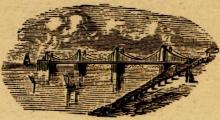

CHICAGO_
ANDERSON—AMERICA NOT DISCOVERED BY COLUMBUS. A historical Sketch of the Discovery of America by the Norsemen in the loth century. By Prof. R. B. ANDERSON. With an Appendix on the Historical, Literary and Scientific value of the Scandinavian Languages. Iamo, cloth, $i.
" A valuable addition to American history."—Notes and Queries, London.
ANDERSON—NORSE MYTHOLOGY; or, the Religion of our Forefathers. Containing all the Myths of the Eddas carefully systematized and interpreted; with an Introduction, Vocabulary and Index. By R. B. ANDERSON, Prof. of Scandinavian Languages in the University of Wisconsin. Crown 8vo, cloth, $2.5o; cloth, gilt edges, $3; half calf, $4.50.
"Prof. Anderson's work is incomparably superior to the already existing books of this order."—Scribner's Monthly.
"The exposition, analysis and interpretation of the Norse Mythology leave nothing to be desired. The whole structure and framework of the system are here; and, in addition to this, copious literal translations from the Eddas and Sagas show the reader something of the literary form in which the system found permanent record. Occasionally entire songs or poems are presented, and, at every point where they could be of service, illustrative extracts accompany the elucidations of the text."—Appleton's journal.
ANDERSON—VIKING TALES OF THE NORTH. The Sagas of Thorstein,Viking's son, and Fridthjof the Bold. Translated from the Icelandic by Prof. R. B. ANDERSON; also TEGNER'S FRIDTHJOF'S SAGA, translated by GEORGE STEPHENS. In one volume, Lzmo, cloth, $2.
" Prof. Anderson's book is a very valuable and important one."—The Nation. " A charming bock it is. Your work is in every way cleverly done. These quaintly delightful sagas ought to charm many thousands of readers, and your translation is of the best."—Prof. Willard Fiske, Cornell University.
BURRIS—THE TRINITY. By Rev. F. H. BURRtS. With an Introduction by JOSEPH HAVEN, D.D., LL.D. Irmo, clo., $t.5o.
" One of the most unique, sincere and thorough discussions of the subject of the Trinity which we have ever seen."—American Wesleyan, New York.
CAREW—TANCLED. A Novel. By RACHEL CAREW. Square 16mo, cloth, $t.
A beautiful and sparkling tale of an Alpine watering place.
"The flirtation which gives its title to this very bright little novel is one of the oddest, funniest and most original affairs we ever read of. We have enjoyed a very hearty laugh over the situation."—Inter-Ocean.
,Books will be mailed postpaid on receipt of price.
PUBLICATIONS OF S. C. GRIGGS & CO., CHICAGO.
CONE—TWO YEARS IN CALIFORNIA. By M. CONE. With fifteen fine Illustrations, a map of California, and a plan of the Yosemite Valley. 12MO, cloth, $I.5o.
A thoroughly reliable book for tourists and settlers.
" It abounds in information practical in character, and is stored with facts which will be new to the vast majority of our people. . . . No romance is more interesting, and no description of the book can do justice to it. Every page deserves to be read and studied."—Albany Evening 7ournal.
DEMENT—INCERSOLL, BEECHER AND DOCMA; or a Few Simple Truths and their Logical Deductions, in which the Positions of Mr. Ingersoll and Mr. Beecher are Considered. By R. S. DEMENT. I2100, cloth, $I.
" Mr. Dement's trenchant diction is well matched by his potent logic. lie has written an earnest, honest, hearty and healthy book for the times."—The Standard, Chicago.
FAWCETT—COLD AND DEBT. An American Hand-Book of Finance, with over Eighty Tables and Diagrams. By W. L. FAWCETT. 121110, cloth, $I.75.
"Of interest to the general reader, and quite invaluable to the banker and man of public life. . . . To those who want a handy volume of reference upon these important subjects, we can recommend this work."—The Banker and Tradesman, Boston.
"As a full and very complete collection of monetary statistics this work has never been equaled or even approached. It is a storehouse of facts."—The Philadelphia Press.
FOSTER—PRE-HISTORIC RACES OF THE UNITED STATES. By J. W. FOSTER, LL.D. Crown 8vo. Illustrated. Cloth, $3; half-calf, gilt top, $5; full calf, gilt edges, $6.5o.
It is full of interest from beginning to end."—Popular Science Monthly. "This book is literally crowded with astonishing and valuable facts."—Baston'Post.
One of the best and clearest accounts we have seen of those grand monuments of a forgotten race."—The Saturday Review, London.
FORESTIER—ECHOES FROM MIST-LAND; or, The Nibelungen Lay revealed to Lovers of Romance and Chivalry. By AUBER FORESTIER. 12100, cloth, $I.5o.
"The simplicity and directness of the ancient chronicle are admirably pre-served in the version, and the work forms a unique addition to our store of sterling fiction."—New York Home journal.
" The Intr„duction traces the history of the legend, and Its connection with the Indian myths and Norse legends, besides giving a large amount of information with respect to the Pagan mythology of our Teutonic ancestors."—Boston Evening Traveller.
" The great epic poem of those early days of chivalry and knightly valor, the Nibelungen Lay, is opened to us to a rehearsal of the weird and fascinating story in clear and flowing English."—Lutheran Quarterly Review.
PUBLICATIONS OF S. C. GRIGGS & CO., CHICAGO.
HOLCOMB—FRIDTHJOF'S SAGA. A Norse Romance. By ESAIAS TEGNER, Bishop of Wexio. Translated from the Swedish by THOMAS A. E. and MARTHA A. LYON HOLCOMB. 121n0, cloth, $1.50.
"The translation is exceedingly well done This is not the first attempt to reproduce Tegner's famous work in English, but we believe it to be quite the most successful."—Harper's Magazine.
"No one can peruse this noble poem without arising therefrom with a loftier idea of human bravery and a better conception of human love."—Inter-Ocean, Chicago.
" Wherever one opens the poem he is sure to light upon passages of exquisite beauty. Longfellow styles it the noblest poetic contribution which Sweden has yet made to the literary history of the world."—Church Journal, New York.
HUDSON—LAW FOR THE CLERGY. A compilation of the Statutes of the States of Illinois, Indiana, Iowa, Michigan, Minnesota, Ohio and Wisconsin, relating to the duties of Clergymen in the solemnization of Marriage, the organization of Churches and Religious Societies, and the protection of Religious Meetings and Assemblies; with notes and practical forms, embracing a collation of the Common Law of Marriage. By SANFORD A. HUDSON. 16mo, cloth, $1.
"It contains what every preacher should have. It is a safe guide in securing deeds and titles to property, to churches, etc."—Religious Telescope, Dayton. " Every Western minister should have it. Its value to those for whom it is especially designed must be apparent at a glance."—The Standard, Chicago.
JONES—THE MYTH OF STONE IDOL. An Indian Love Legend of Dakota. By WILLIAM P. JONES, A.M. I vol. small 4to, handsomely bound, $I. r
" We read it through, beguiled by its melodious lines and the pathos of its simple tale. Its descriptions are fine pictures."—Zion's Herald, Boston.
KIPPAX—CHURCHYARD LITERATURE. A choice collection of American Epitaphs, with remarks on Monumental Inscriptions and the Obsequies of various nations. By JOHN R. KIPPAX, LL.D. 12mo, cloth, $1.50.
"A collection remarkable for quaintness and eccentricity."—N. Y. Daily Tribune.
" A volume both instructive and amusing, which will amply repay perusal."—N. Y. Graphic.
LIE—THE PILOT AND HIS WIFE. A Norse Love Story. By JONAS LIE. Translated by MRS. OLE BULL. cloth, $I.50.
" Most absorbingly interesting. . . . In realism, picturesqueness and psychological insight, ' The Pilot and His Wife' leaves very little to be desired. Every one of the dramatis persona; is boldly conceived and elaborated with great skill. We have none of the stale repetitions of the usual well-worn characters of fiction, which is indeed no mean praise. . . . A delightful and entertaining book."—Scribner's Monthly.
MATHEWS–GETTING ON IN THE WORLD; or, Hints on Success in Life. By WILLIAM MATHEWS, LL.D. I vol. 12mo, cloth, $2; the same, gilt edges, $2.50; half calf, gilt top, $3.50; full calf, gilt edges, $5.
" As a work of art, it is a gem. As a counselor, it speaks the wisdom of the ages. As a teacher, it illustrates the true philosophy of life by the experience of eminent men of every class and calling. It warns by the story of signal failures, and encourages by the record of triumphs that seemed impossible. It is a book of facts and not of theories. The men who have succeeded in life are laid under tribute and made to divulge the secret of their success. They give vastly more than ' hints'— they make a revelation."— Christian Era, Boston.
MATHEWS–THE GREAT CONVERSERS, and Other Essays. By WILLIAM MATHEWS, LL.D.I2mo, cloth, $I.75.
"These pages are crammed with interesting facts about literary men and literary work."—New York Evening Mail.
" One will make the acquaintance of more authors in the course of a single one of his essays than are probably to be met with in the same limited space anywhere else in the whole realm of our literature."—Chicago Tribune.
MATHEWS–WORDS, THEIR USE AND ABUSE. By WILLIAM MATHEWS, LL.D. I2mo, cloth, $2.
" We heartily recommend the work as rich in valuable suggestions to those who desire to cultivate accuracy in speaking and writing."—The Lutheran Quarterly Review.
"It can be read with profit by every intelligent student of the English language."— The International Review, New York.
MATHEWS–HOURS WITH MEN AND BOOKS. By WILLIAM MATHEWS, LL.D. I vol. I2mo, cloth, $2.
" The elder Disraeli has certainly found a worthy successor in the present writer."—New York Tribune.
" A rare entrepot of information conveyed in a style at once easy, lucid and elegant. Any one desirous of cultivating an acquaintance with the leading thinkers and actors of all ages, and to have in a compendious form intelligent opinions on their lives and works, will find herein the result of deep research and sound reflection."—Sheffield Post, England.
MATHEWS–MONDAY-CHATS. By C. A. SAINTE-BEUVE. With an Introductory Essay on his life and writings by the translator, WILLIAM MATHEWS, LL.D. I2mo, cloth, $2.
" The translation is excellent throughout."--New York Evening Pest.
"No essays of the kind in modern literature are superior, if equal, to these masterly portraitures, in which philosophy and elegance are happily combined.' —Boston Daily Globe.
" It is not too much to say that the ' Introductory Essay' is one of the best pieces of literary criticism in American literature."—Utica Morning Herald.
" To the man of letters this book will be a delight; to the general reader a charming recreation; to the student a model of taste and culture."—Boston Christian Register.

PUBLICATIONS OF S. C. GRIGGS f- CO., CHICAGO.
MATHEWS—ORATORY AND ORATORS. By WILLIAM MATHEWS, LL.D. In preparation. 1 vol. I2mo, $2.
MILLER—WHAT TOMMY DID. BY EMILY HUNTINGTON
MILLER. Illustrated. 16mo, paper covers, 50 cents; cloth, Sr.
"If there is any other way in which fifty cents will purchase as much sustained and healthful amusement as is offered by this little book we should be glad to know it."—john Habberton, in the Christian Union.
"We laughed all the evening over the many funny things Tommy said and did. . . . We will warrant that no one, young or old, will lay it down until read through."—Northern Christian Advocate.
MISHAPS OF MR. EZEKIEL PELTER. Illustrated. $I.5o.
"Immensely amusing."—Boston Commonwealth.
"If it be your desire `to laugh and grow fat,' you will find The Mishaps of Ezekiel Pelter a great help."—American Christian Review, Cincinnati.
ROBERT—RULES OF ORDER, for Deliberative Assemblies. By MAJOR HENRY M. ROBERT, Corps of Engineers, U. S. A. Pocket size. Cloth, 75 cents.
"Robert's Rules of Order is a capital little book. I have given it a very critical examination. . . . For general use and application, I regard it the best book extant."—Hon. lames W.. Husted, Speaker of the New York State Legislature.
"It is just such a guide as is needed by all presiding officers. . . . The table of rules relating to motions, and the cross references, which enable any one to find almost instantly anything in the book, give it almost inestimable value."—New York Christian Advocate.
SMITH—PATMOS; or, The Kingdom and the Patience. By J. A. SMITH, D.D., Editor of The Standard. Cloth, $1.25.
"No one can read the nine chapters which this volume contains without receiving a new inspiration to faithful service in the cause of Christ."—Zion's Advocate.
TAYLOR—BETWEEN THE CATES. By BENJ. F.TAYLOR, Author of "The World on Wheels," etc. etc. I2mo, cloth. II-lustrated. $1.50.
" The light, feathery sketches in this volume glitter with all the colors of the rainbow and sparkle with the reflection of the morning dew. The reader of imagination and taste will delight in the subtle alchemy which transmutes gold into beauty, and changes the facts of common life into ideal visions. Mr. Taylor detects the enchantments of poetry in the most prosaic experiences, and the dusty highways of life are refreshed with the waters of Siloam, and bloom with the flowers of paradise."—New York Tribune.
"A series of verbal photographs of California characters and scenery that are exceedingly graphic, poetic and entertaining. . Picturesque and romantic in style, yet altogether accurate in fact."—Episcopal Register, Philadelphia. "Lively as a novel and accurate as a guide book."—Philadelphia Press.

PUBLICATIONS OF S. C. GRIGGS & CO., CHICAGO.
TAYLOR–IN CAMP AND FIELD. By BENJ. F. TAYLOR. Izmo, cloth, $I.50.
"Each of these sketches is a gem in itself. One may search the annals of war from Tacitus to Kinglake and not find anything finer."—Inter-Ocean. "The description of Hooker's battle 'above the clouds' is one of the grandest pieces of word-painting in the English language."—Peoria Transcript.
TAYLOR–OLD-TIME PICTURES AND SHEAVES OF RHYME. By BENJ. F. TAYLOR. Illustrated, small quarto, silk cloth, price $I.5o; the same, full gilt edges and side, $I.75.
"I do not know of any one who so well reproduces the home scenes of long ago."—john G. Whittier.
TAYLOR–THE WORLD ON WHEELS, and Other Sketches. By BENJ. F. TAYLOR. Illustrated. Izmo, clo., $I.5o.
" One of the most elegant, as well as pungent and rich, specimens of wit and humor extant."—New York Illustrated Weekly.
" Brings you very near to nature and life in their pleasantest moods wherever you may happen to be."—E. P. Whipple, Esq., in Me Boston Globe. " Few equal Mr. Taylor as a word painter. He fascinates with his artistic touches, and exhilarates with his sparkling humor, and subdues with his sweet pathos. His sentences glisten like gems in the sunlight. "—Albany 7ournal.
TAYLOR–SONCS OF YESTERDAY. By BENJ. F. TAYLOR. Beautifully illustrated. Octavo, with handsomely ornamented cover in black and gold. Full gilt edges, $3; morocco, $6.
"The volume is magnificently gotten up.. .. There is a simplicity, a tenderness and a pathos, intermingled always with a quiet humor, about his writings which is inexpressibly charming. Some of his earlier poems have become classic, and many of those in the present volume are destined to as wide a popularity as Longfellow's' Village Blacksmith' or Whittier's ' Maud Muller.'" —Boston Transcript.
WALKER–PHILOSOPHY OF THE PLAN OF SALVATION. By J. B. WALKER, D.D. With an Introductory Essay by CALVIN E. STOWE, D.D. I2mo, cloth, $I.50.
"We think it more likely to lodge an impression in the human conscience rn favor of the divine authority of Christianity than any other work of the modern press."—London Evangelical Magazine, England.
WALKER–THE DOCTRINE OF THE HOLY SPIRIT; or, Philosophy of the Divine Operation in the Redemption of Man, being volume second of "Philosophy of the Plan of Salvation." By Rev. JAMES B. WALKER, D.D. Izmo, cloth, $1.5o.
"Every minister and teacher should arm himself with strong weapons by perusing the arguments of this book."—Methodist Recorder, Pittsburg. "Of unanswerable force and extraordinary interest."—New York Evangelist.
PUBLICATIONS OF S. C. GRIGGS & CO., CHICAGO.
TEXT-BOOKS—RETAIL PRICES.
BACON—A MANUAL OF GESTURE. With too Figures, embracing a complete System of Notation, with the Principles of Interpretation, and Selections for Practice. By Prof. A. M. BACON. 1210o, cloth, $1.50.
"The work comprehends all that is valuable upon the subject of gesture."—R. L. Cumnock, Professor of Elocution, Northwestern University.
BOISE—FIRST LESSONS IN CREEK. Adapted to Good-win's, to Hadley's Larger and Smaller Greek Grammars, and intended as an Introduction to Xenophon's Anabasis. By JAMES R. BoisE, Ph.D. 12mo, half leather, $1.25.
"It is an admirable guide to the learner, and will teach the inexperienced teacher how to teach in the best way. I like the book better than any other manual for beginners I have seen, and I have seen most, and used several different ones in teaching."—Prof. H. F. Fisk, Northwestern University, Ill.
BOISE—HOMER'S ILIAD. The First Six Books of Homer's Iliad; with Explanatory Notes, intended for beginners in the Epic dialect; accompanied with numerous References to Good-win's, to Hadley's Greek Grammar, to Kiihner's Larger Greek Grammar and Goodwin's Moods and Tenses. By- J. R. BOISE, Ph.D. 121110, cloth, $I.50.
" Incomparably superior to any other edition of Homer ever published in this country ."—M. L. D'Ooge, Ph.D., Professor of Greek, University of Michigan.
BOISE—EXERCISES IN CREEK SYNTAX. Being Exercises in some of the more difficult Principles of Greek Syntax; with References to the Grammars of Crosby, Curtius, Goodwin, Hadley, Koch and Kiihner. A Sequel to "Jones's Exercises in Greek Prose Composition," and intended for the First Year in College. By JAMES R. BoIsE, Ph.D. I2mo, half leather, $1.5o.
"' Prof. Jones's Exercises' and ' Dr. Boise's Exercises in Greek Syntax' are a vast improvement upon 's books on Prose Composition. I like much the principles upon which they are constructed. . . . The two works taken together constitute an apparatus which is unsurpassed, or rather, if I mistake not, unequaled, for the acquisition of a thorough and familiar acquaintance with Greek forms."—Henry M. Baird, Ph.D., Prof. of Greek Language and Literature, University of the City of New York.
BOISE & FREEMAN—SELECTIONS FROM VARIOUS CREEK AUTHORS. For the First Year in College; with Explanatory Notes and References to Goodwin's Greek Gram-mar, and to Hadley's Larger and Smaller Grammars. By JAMES R. BOISE, Ph.D., and J. C. FREEMAN, M.A. 12100, cloth, $2.
" I found the book so admirable in the matter selected, in the soundness and accuracy of the annotations, and in the unusual excellence of the press-work, that I could not do otherwise than urge its adoption, and my high opinion of the book has been corroborated by daily use."—A. H. Buck, A..4!., Prof. of Greek, Boston University.
PUBLICATIONS OF S. C. GRIGGS & CO., CHICAGO.
D'OOCE—DEMOSTHENES ON THE CROWN. With Ex-tracts from the Oration of .zEschines against Ctesiphon, and Explanatory Notes. By M. L. D'OOGE, Ph.D., Professor of Greek, University of Michigan. I2mo, cloth, $I.75.
"I have examined it again and again, and am better satisfied with it than any other text-book on The Crown I have seen. I shall therefore use it in preference to all others."—Prof. R. B. Youngman, LaFayette College.
JONES—EXERCISES IN CREEK PROSE COMPOSITION. With References to Hadley's, Goodwin's and Taylor's-Kiihner's Greek Grammars, and a full English-Greek Vocabulary. By Prof. ELISHA JONES, Univ. of Michigan. I2mo, $I.
"No better exercises can be found for classes in Greek Prose Composition, whether in college or the preparatory school."—From Edward North, L.H.D., Professor of Greek, Hamilton College, N.Y.
JONES—FIRST LESSONS IN LATIN. Adapted to the Latin Grammars of Allen & Greenough, Andrews & Stoddard, Bartholomew, Bullions & Morris, Gildersleeve and Harkness, and prepared as an Introduction to Caesar's Commentaries on the Gallic War. By ELISHA JONES, Professor in the University of Michigan. I2mo, cloth, $I.5o.
" I do not know of a better drill book for classical schools to prepare the way for the reading of Caesar and to lay the foundation of a very thorough and accurate scholarship in Latin."—Prof. E. P. Crowell, Amherst College.
PETERSON—NORWECIAI -DANISH GRAMMAR AND READER. With a Vocabulary, designed for American Stu-dents of the Norwegian-Danish language. By Prof. C. I. P. PETERSON, I2mo, cloth, $I.25.
''I rejoice to see the door opened to American students to the treasures 3f Norwegian letters, and in so attractive a manner as in Mr. Peterson's book."—F. Sewell, President of Urbana University.
STEVENS—SELECT ORATIONS OF LYSIAS. With Introductions and Explanatory Notes. By W. A. STEVENS, Professor of Greek, Denison University, Ohio, I2mo, cloth, $I.5o.
" A valuable contribution to our college text-books and ought to be most cordially welcomed."—W. W. Goodwin, Ph.D., Prof. of Greek, Harvard College.
THOMPSON—FIRST LATIN BOOK. Introductory to Caesar's Commentaries. By D. G. THompsoN, A.M. I2mo, $I.5o.
"The plan is thoroughly excellent, the execution of it in all points admirable."—Thomas Chase, Professor of Philology, Haverford College.
ZUR BRUCKE—GERMAN WITHOUT GRAMMAR OR DICTIONARY; According to the Pestalozzian method of teaching by Object Lessons. I2mo, cloth back, 50 cents.
" By far the best method to enable pupils to acquire familiarity with a language and readiness to speaking it."—Boston Commonwealth.
| Index |